Isle of Mull and Iona
Mull and Iona from Edinburgh: ferry routes via Oban, what to see on both islands, puffins at Staffa, and which 3-day tours are worth booking.
Edinburgh: Isle of Mull and Iona 3-day tour
Quick facts
- Best time to visit
- May–September; puffins at Staffa late April to early August
- Days needed
- 3 days (including travel)
- Getting there from Edinburgh
- ~2.5 hrs to Oban by car or coach, then ferry to Craignure (Mull)
- Budget per day
- £70–£130 on guided tours; ferry crossings extra if self-organising
Two islands, one pilgrimage route
Mull and Iona are usually spoken of together, and for good reason — Iona is a tiny island (three miles long, one and a half wide) off the southwestern tip of Mull, and the standard visitor route from the mainland involves a ferry to Mull at Craignure, a drive across Mull to Fionnphort, and a further short ferry to Iona. The two islands offer very different things: Mull is substantial enough to have its own character, wildlife, and variety; Iona is small, almost entirely free of cars, and historically one of the most significant sites in the British Isles.
The logistical gateway is Oban, a ferry port on the Argyll coast approximately 2.5 hours from Edinburgh by car or coach. From Oban, CalMac ferries cross to Craignure on Mull in about 45 minutes. This ferry-dependent nature of the journey means Mull and Iona sit in a different category from day trips: three days is the minimum to do them justice from Edinburgh, and the logistics of ferries and driving single-track roads make guided tours the practical choice for most visitors.
Iona: Christianity’s foothold in Scotland
Iona’s significance is difficult to overstate in the context of Scottish, and indeed British, history. In 563 AD, the Irish monk Columba arrived on Iona with twelve companions and established a monastery from which Christianity spread across Scotland and into northern England. The Book of Kells — one of the most celebrated illuminated manuscripts in the world, now in Trinity College Dublin — was most likely begun on Iona. The island remained a centre of learning and manuscript production for over two centuries, survived Viking raids with extraordinary resilience, and produced missionaries who converted the pagan kingdoms of Scotland and Northumbria.
The present Iona Abbey is a restored medieval Benedictine structure, rebuilt in the 20th century and maintained by the Iona Community. It is an active place of Christian community life, not simply a heritage site. Entry is £10 for adults online (Historic Environment Scotland, though the Iona Community manages day-to-day operations). The abbey contains the tombs of Scottish kings, including, by tradition, Macbeth and Duncan I. St Oran’s Chapel, in the adjacent Reilig Odhráin graveyard, is the oldest surviving building on the island and is genuinely old — the current structure dates from the 12th century.
The island itself has no cars beyond residents’ vehicles. Visitors leave cars at Fionnphort and walk or cycle on Iona. The northern beach (Traigh Mhor) has remarkably clear green-turquoise water and white sand. The Marble Quarry in the south, where green Iona marble has been quarried since medieval times, is a short walk from the ferry. The lack of road traffic makes the atmosphere on Iona genuinely different from mainland Scotland — quieter, more contemplative, and more aligned with what draws people to the island in the first place.
Mull: the whale-watching island
Mull is large enough to have a genuine character of its own beyond being the transit route to Iona. At 338 square miles it is Scotland’s fourth-largest island, with a landscape that ranges from the dramatic sea cliffs of the south and west to the gentler hills of the north and the volcanic landscape around Ben More (the only Munro on the island, 966 metres).
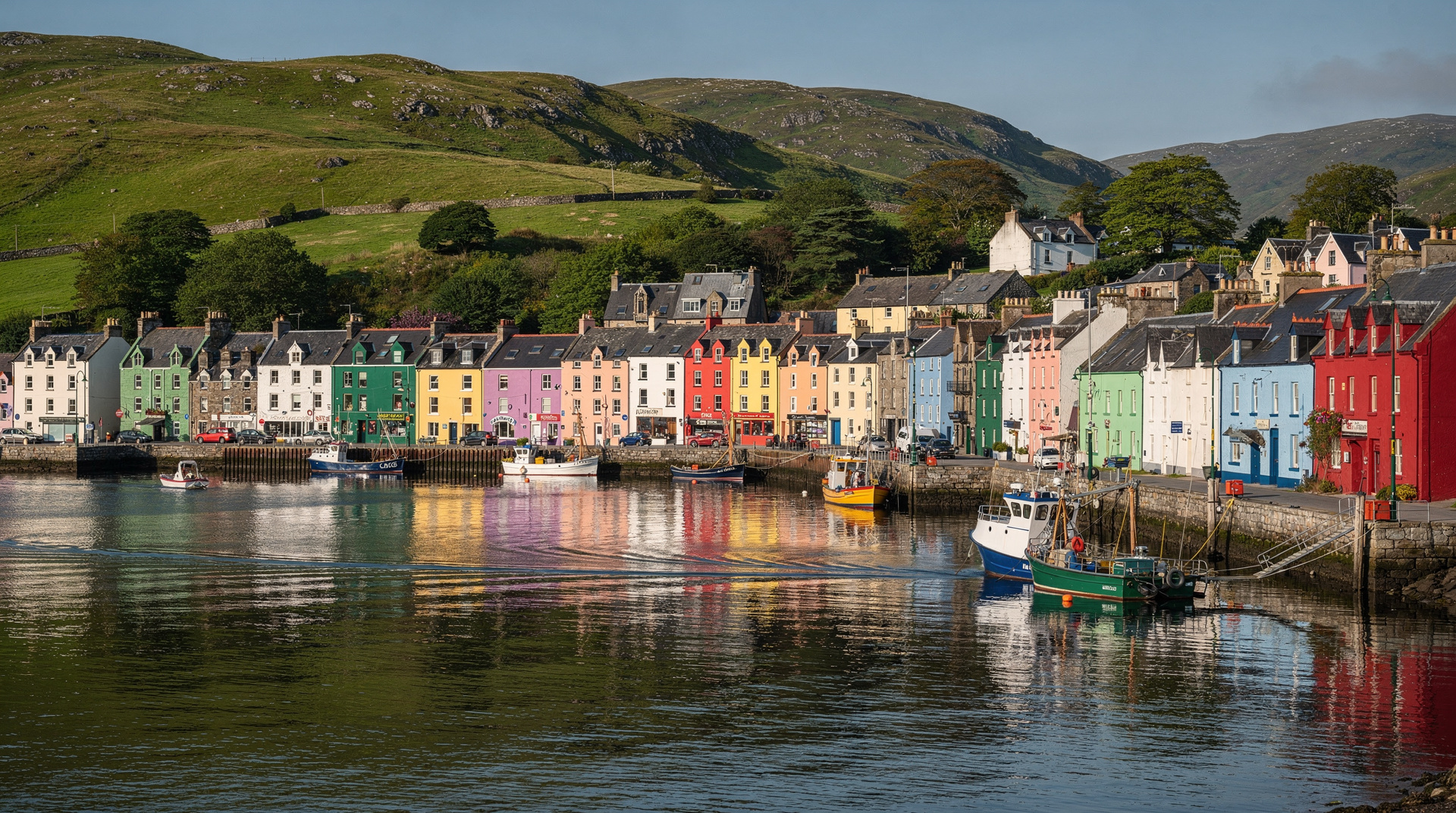
Tobermory is the island’s main town and is famous worldwide for one reason: its brightly painted harbourfront buildings, which appeared in the children’s television series Balamory. The effect in person is as good as it looks in pictures — genuine vernacular architecture with bold colour choices, reflected in the harbour. The town has several decent restaurants (Café Fish on the pier for seafood), a distillery (Tobermory Distillery, tours and tastings available), and a good selection of independent shops. An hour or two is the right amount of time.
Wildlife on Mull is the island’s strongest claim on visitors with natural history interests. Mull supports a higher density of white-tailed sea eagles than almost anywhere else in Britain, and the area around Loch Frisa is one of the best places in Scotland to see them. Golden eagles, hen harriers, red deer, otters, and basking sharks are all regularly observed. Mull Wildlife Tours and Hebridean Whale Cruises run specialist wildlife-focused excursions from Tobermory.
Duart Castle, near Craignure where the ferry arrives, is the seat of the Clan Maclean and is open to visitors. The castle dates from the 13th century and is in good structural condition, with interior rooms giving an honest account of its history including its partial demolition by the Campbells and subsequent restoration. Entry to the castle is £13 for adults (£6 for children aged 5-15). It is on the main road from the ferry port and easily visited immediately on arrival.
Staffa and the puffins
Staffa is an uninhabited island about 6 miles north of Iona, famous for two things: Fingal’s Cave (the hexagonal basalt column formations that inspired Mendelssohn’s Hebrides Overture) and, from late April to early August, a large puffin colony. Boat trips to Staffa run from Iona and from Fionnphort; the crossing takes about 30-45 minutes and landings are weather-dependent.
The basalt columns at Fingal’s Cave are geological spectacle on a small but vivid scale — the same volcanic process that created the Giant’s Causeway in Northern Ireland, but in a sea cave with remarkable acoustic properties. The puffins nest in burrows on the island’s grassy top and are remarkably unperturbed by visitors — you can observe them from a few metres away at the height of the nesting season.
The 4-day Mull, Iona, Staffa and Puffin Isles tour from Edinburgh is the premium island option, incorporating a Staffa landing with the standard Mull and Iona visit. This is the right tour if puffins or Fingal’s Cave are a priority. The Staffa landing depends on sea conditions — operators are honest about this and will always offer a refund or alternative if conditions prevent landing.
Getting there: guided tour vs independent
Guided multi-day tour: The most practical option for most Edinburgh visitors. The Isle of Mull and Iona 3-day tour from Edinburgh covers all the essential logistics — coach from Edinburgh, ferries, accommodation, guided visits to Iona Abbey and Tobermory — in a structured three-day package. This is the recommended approach for first-time island visitors.
Independent: Possible but more involved. ScotRail from Edinburgh to Oban takes approximately 3 hours (via Glasgow Queen Street, change required). CalMac ferries from Oban to Craignure run regularly; book ahead in peak summer. Car hire in Oban is possible, and driving single-track roads on Mull is the main logistical challenge. The roads are fine once you understand the passing-place system, but they are slower than maps suggest.
The drive from Edinburgh to Oban takes about 2.5 hours via the A85 west from Crianlarich. Oban is a pleasant ferry town in its own right — the McCaig’s Tower viewpoint above the town is worth the short walk for views over the harbour and islands.
For visitors who want to see more of the Argyll coast on the way, the Oban, Glencoe and the Highlands 2-day tour combines the journey to Oban with a proper stop at Glencoe, making the gateway town itself part of a fuller Highland day rather than just a ferry transfer point.
Cost comparison: guided tour vs independent travel
| Guided 3-day tour | Independent (2 people) | |
|---|---|---|
| Base cost | around £280–£380 per person, accommodation included | ferries + car hire + accommodation booked separately |
| Ferries | included | Oban–Craignure and Fionnphort–Iona, roughly £40–£60 per person round trip with a car |
| Accommodation (2 nights) | included | £150–£300 depending on standard and season |
| Flexibility | fixed itinerary, guided context | full control, but single-track roads and ferry timetables to manage yourself |
Independent travel can work out cheaper for confident drivers who book ferries well ahead, but the guided tour removes the single biggest headache of a Mull and Iona trip — coordinating two ferry crossings and a single-track drive across the island around a fixed schedule.
Combining Mull and Iona with Skye
A five-day itinerary from Edinburgh can sensibly combine Mull, Iona, and Skye: Edinburgh to Oban to Mull (days one and two), Iona visit (day three), then north along the A85 and A82 to the Isle of Skye via Ballachulish and Fort William (days four and five). This covers the two most significant island destinations in western Scotland and gives a broader Highland circuit. The Isle of Skye guide covers that part of the itinerary.
For those with more time, Orkney in the far north and Mull and Skye in the west represent Scotland’s three most distinct island experiences, each with very different character. See the Orkney guide for the northern islands.
Walking and wildlife on Mull
Beyond Tobermory and the Iona route, Mull has walking and wildlife opportunities that justify time on the island for its own sake. Ben More (966 metres) is the only Munro on any Scottish island outside of Skye, and the ascent from Loch na Keal is a serious hill day with outstanding views when clear. The route involves about 5-6 hours round trip and requires full hill-walking equipment. It should not be attempted without appropriate experience in Scottish mountain conditions.
For less demanding walking, the Ross of Mull — the long southwestern peninsula — has a coastal path from Fionnphort that gives excellent views toward Iona and the outer islands. The rocky shoreline at Fionnphort on a calm day, with the white sands of Iona visible across the sound, is one of the more quietly beautiful spots in the Scottish islands.
Sea-kayaking around Mull is a legitimate option for experienced kayakers — the combination of sea caves, island passages, and wildlife (seals, basking sharks, dolphins) makes Mull one of the better kayaking destinations in western Scotland. Operators in Tobermory offer guided sea-kayaking trips for those without their own equipment.
The Treshnish Isles and puffins
The Treshnish Isles — a chain of uninhabited islands southwest of Mull — are the best puffin-watching location in the area. Lunga, the largest of the Treshnish islands, has a large puffin colony accessible by boat trip from Ulva Ferry on Mull or from Fionnphort, with landings allowed in season. The puffins nest on the clifftop and are so accustomed to humans that you can observe them from a metre away during the breeding season (late April to early August).
Staffa, a separate island east of the Treshnish chain, is the more famous destination — Fingal’s Cave and the gannet colony — but the Treshnish puffin landing is the better wildlife experience. Boat trips typically take three to five hours and are weather-dependent.
For visitors who want both without choosing between them, some operators run combined Staffa and Treshnish trips in a single longer day, weather permitting — worth asking about when booking directly with Staffa Tours or Turus Mara, as the standard advertised trips often cover only one or the other.
Understanding Iona’s place in Celtic Christianity
The Christianity that came to Scotland with Columba in 563 AD was distinct from Roman Christianity in several respects: it operated through a monastic network rather than a diocesan structure, it had different liturgical practices and a different calculation of Easter, and it placed high value on scholarship and manuscript production. The tension between the Iona tradition (Columban Christianity) and Rome came to a head at the Synod of Whitby in 664 AD, where the English church adopted Roman practices. Scotland’s church remained influenced by the Iona tradition for longer.
This matters for understanding Iona because the monastery there was not just a religious community but a centre of intellectual production. The Cathach of St Columba (currently in the Royal Irish Academy in Dublin) and the Book of Kells are the highest expressions of what Iona’s scriptorium produced. The manuscript tradition — insular script, interlaced decoration, the remarkable zoomorphic ornament of Hiberno-Saxon art — is visible in any good reproduction of the Lindisfarne Gospels (produced at Holy Island, which shared the Iona tradition) or the Book of Kells. Understanding this context transforms a visit to the plain stone buildings of Iona Abbey from a heritage tick-box into something with genuine intellectual depth.
Accessibility on Mull and Iona
Iona Abbey’s ground floor and the graveyard are accessible with a wheelchair, though the island’s paths beyond the immediate abbey area are uneven grass and gravel tracks not well suited to wheels. Tobermory’s harbourfront is flat and easily walked. The Staffa boat landing involves a scramble over rocks and is genuinely not accessible for those with mobility restrictions — the boat trip itself, without landing, is a reasonable alternative that still gives good views of Fingal’s Cave from the water. Duart Castle has a mix of accessible ground-floor rooms and inaccessible upper floors typical of a historic tower house.
Practical information for 2026
Ferries: CalMac (calmac.co.uk) operates Oban-Craignure and Fionnphort-Iona. Book ahead for summer crossings, particularly if you are taking a car. Summer peak departures fill weeks in advance.
Staffa and Treshnish boat trips: Staffa Tours and Turus Mara run seasonal trips from Iona and Fionnphort. Check weather and sea conditions. Late April to early August for puffins at Treshnish.
Driving on Mull: The A849 from Craignure to Fionnphort is 38 miles — allow 75-90 minutes each way. The road is single track in many sections. Drive slowly, use the passing places, and allow extra time in summer.
Iona timing: Day-trippers from Mull arrive on the 10am and 11am ferries. Visiting early morning or late afternoon is quieter. Staying overnight on Iona is genuinely atmospheric; the St Columba Hotel is the main option.
UK ETA: International visitors should check the UK ETA guide for entry requirements.
For planning context, see the multi-day Highland tours guide. Related island destinations: Isle of Skye, Orkney.
Frequently asked questions about Mull and Iona
How do I get from Edinburgh to Mull and Iona?
The route is Edinburgh to Oban (2.5 hrs by car or 3 hrs by train via Glasgow), then CalMac ferry from Oban to Craignure on Mull (45 min), then drive across Mull to Fionnphort (75-90 min), then a short ferry to Iona (10 min). Total travel time from Edinburgh to Iona is around 5-6 hours. Guided multi-day tours handle all of this.
How much time do I need on Iona?
A half day covers the abbey, the graveyard, and a walk to the northern beach. A full day is more relaxed and allows you to explore more of the island on foot. Staying overnight (one night is ideal) gives you the island in the early morning and evening when day-trippers have left.
Is Mull worth visiting for more than the route to Iona?
Yes, particularly for wildlife and Tobermory. Mull has excellent sea eagle and otter viewing, a worthwhile distillery, and enough variety in its landscape for a full two days. Many visitors treat it only as the transit route to Iona, which undersells it considerably.
When is the best time to see puffins on Staffa?
The puffin colony is active from late April to early August. Peak numbers are in June and early July. After August the birds leave the nesting grounds. If seeing puffins is a priority, plan the visit accordingly.
Is Iona Abbey worth visiting even for non-religious visitors?
Yes. The abbey’s historical significance — as the starting point for the Christianisation of Scotland and northern England, the likely origin point of the Book of Kells — stands entirely independent of its religious function. The buildings are attractive, the graveyard with the royal tombs is atmospheric, and the island setting is unique.
Is Mull and Iona accessible for visitors with mobility restrictions?
Partially. Iona Abbey’s ground floor and Tobermory’s harbourfront are accessible, but the wider island paths are uneven and the Staffa boat landing involves a rock scramble that is not suitable for wheelchairs. A Staffa boat trip without landing is a reasonable alternative that still shows Fingal’s Cave from the water. Contact the tour operator in advance to discuss specific access needs.
Is a guided tour or independent travel better value for Mull and Iona?
It depends on how far ahead you can book and your comfort with single-track driving. A guided 3-day tour costs roughly £280–£380 per person with everything included; independent travel can be cheaper if you book ferries and accommodation well ahead, but requires managing two ferry crossings and Mull’s single-track roads yourself. See the cost comparison table above for the full breakdown.
What to read before visiting Mull and Iona
Context transforms a visit to Iona from a pretty island with old buildings into something considerably more significant. A few accessible reading recommendations for those who want more background:
George MacLeod’s biography (any edition) covers the founder of the Iona Community, who began rebuilding the abbey from ruins in 1938 as a project of social and religious renewal — a remarkable story of practical idealism and physical reconstruction.
Adam Nicolson’s Sea Room, while ostensibly about the Shiant Islands (off the Lewis coast), gives the best general account of what island life in the Hebrides means in practice — the tidal rhythms, the isolation, the long light of midsummer — and is useful background for any Scottish island visit.
For the Mull wildlife dimension, Kenny Taylor’s Machair: The Flowery Plains of the Hebrides and Polly Pullar’s various Scottish wildlife guides give accessible introductions to what you might see. The RSPB Scotland website has up-to-date information on sea eagle viewing points on Mull.
Currency and practical logistics reminder
The entirety of the Mull and Iona journey — Edinburgh, Oban, Mull, Iona — takes place in the pound sterling (£) zone with no currency changes. See the Edinburgh currency guide for general exchange advice for non-UK visitors. UK ETA requirements apply for international visitors from the point of entry into Great Britain — see the UK ETA guide. The guided tour package prices for the Mull and Iona 3-day tour include accommodation and most transport; budget for meals, entry fees, and Staffa boat trips as extras.
For the full island-hopping Scotland picture, see also the Isle of Skye guide and the Orkney guide.
Top experiences
Bookable activities with verified prices and instant confirmation on GetYourGuide.