Orkney
Orkney from Edinburgh: Stone Age monuments, Scapa Flow, the Italian Chapel, and honest advice on 5-day tours versus flying independently to Kirkwall.
Edinburgh: Orkney and the Far North 5-day tour
Quick facts
- Best time to visit
- May–September; midsummer for long light; May for quiet
- Days needed
- 3-5 days minimum
- Getting there from Edinburgh
- ~1 hr by flight to Kirkwall; or 5-day guided tour from Edinburgh
- Budget per day
- £70–£140 on guided tours; flights from Edinburgh around £80–£200 return
The islands that most people never reach — and why they should
Orkney is not difficult to get to. Loganair flies from Edinburgh to Kirkwall in about an hour. Yet most Edinburgh visitors who consider a Scottish island experience choose Skye or Mull, which are closer but, by almost any objective archaeological and historical measure, significantly less remarkable. The Neolithic monuments of Orkney — Skara Brae, the Ring of Brodgar, the Standing Stones of Stenness, Maeshowe — are older than Stonehenge, better preserved, and remain genuinely not overrun in the way that comparable English sites have become. This combination of world-class prehistory, Second World War history, dramatic coastal scenery, and relative accessibility places Orkney in a category that few destinations in Europe match.
The honest practical point: Orkney requires more planning than the standard Scottish island day trip. It is far north — the latitude of St Petersburg — which means driving to the Orkney ferry at Scrabster (the most common mainland approach) takes about 3.5 hours north of Inverness. For a guided tour from Edinburgh, this means a five-day programme at minimum to cover the ground properly. If you fly independently to Kirkwall, you arrive quickly but need accommodation and hire car sorted in advance.
This guide covers what to see, how to get there from Edinburgh, the key sites and their context, and whether the 5-day guided tour or an independent flying visit is the better choice for your situation.
| At a glance | |
|---|---|
| Where | Northern Scottish archipelago, off the far north coast |
| Time needed | 3–5 days minimum; a day trip is technically possible but not recommended |
| Getting there | ~55 min flight from Edinburgh to Kirkwall, or a 5-day guided tour |
| Typical cost | Guided 5-day tour £400–£600; independent visitors around £80–£120/day |
| Best time | May–September for weather; October–March for Northern Lights potential |
| Do not skip | Skara Brae — the most vivid Neolithic site in the collection |
The Neolithic monuments
Orkney was densely settled in the Neolithic period — roughly 3500-2500 BC — by a farming culture whose stone monuments survive in exceptional condition due to Orkney’s lack of trees (which meant stone was the only building material) and the dry, peaty soil that preserves organic material.
Skara Brae is the most famous. A Neolithic village of eight houses was buried under a sand dune around 2500 BC and was uncovered only in 1850 after a storm stripped away the covering. The result is extraordinary: the village is intact to the level of the beds, shelving units, and hearths. You can look down into houses where people lived 5,000 years ago and see the stone furniture they used. It is a UNESCO World Heritage Site. Admission (Historic Environment Scotland) is £14 for adults online (£16 on the day); the visitor centre gives essential context on the Neolithic culture that produced it.
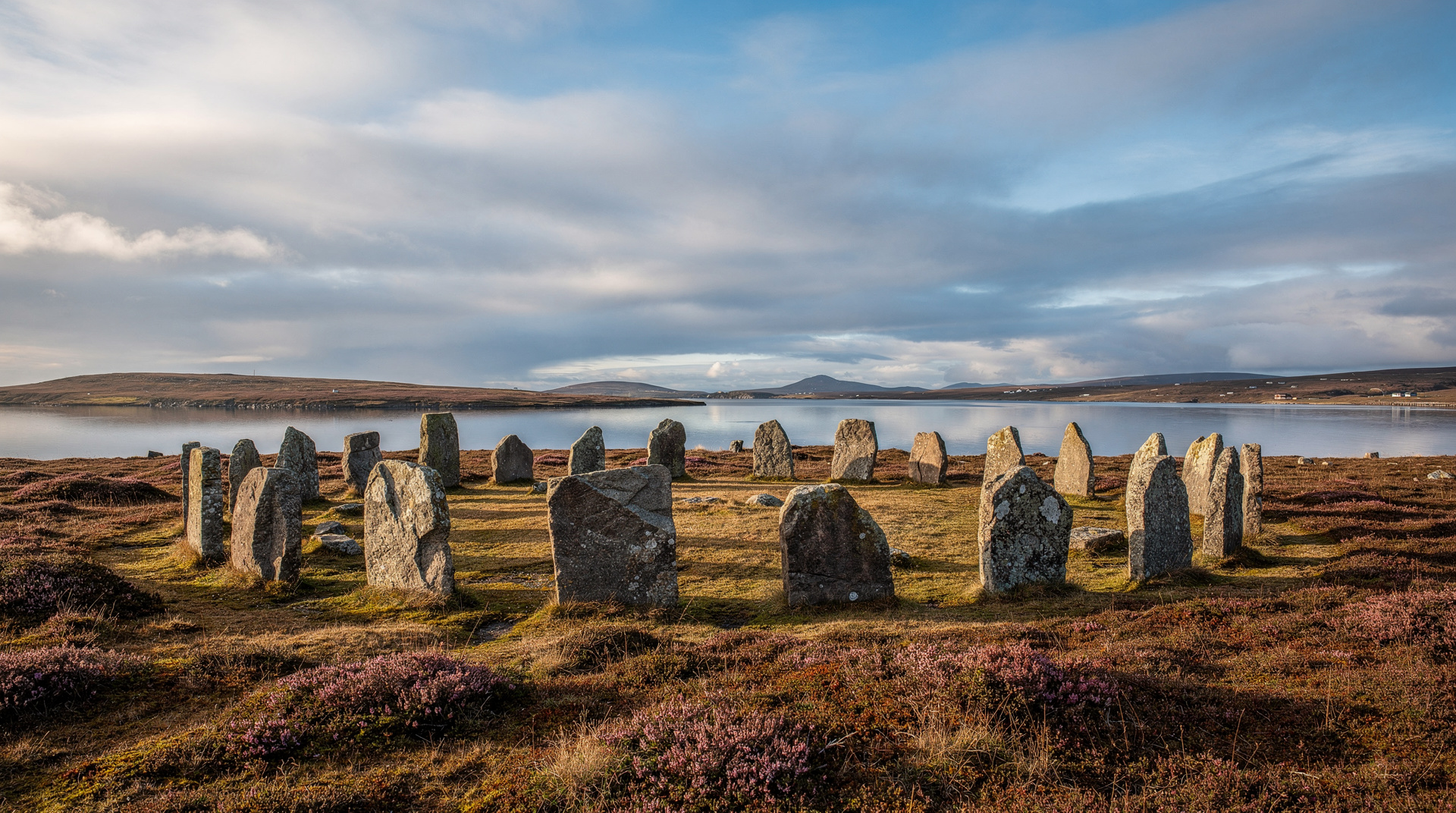
The Ring of Brodgar is a stone circle of roughly 60 original standing stones (27 still upright) in a landscape of moor and lochs on the central Orkney mainland. It was constructed around 2500 BC. What distinguishes it from Stonehenge — besides the fact that you can walk right up to and between the stones with no barrier — is its setting: the full ring on a low isthmus between Lochs Stenness and Harray, with the Orkney hills rising around it, is one of the most atmospherically complete prehistoric landscapes in Europe.
The Standing Stones of Stenness, a kilometre from Brodgar, are earlier and partially destroyed (only four original stones remain from an original setting of perhaps twelve), but include the tallest standing stones in Scotland — up to six metres high. They are set beside the loch in a way that makes the size of the individual stones genuinely arresting.
Maeshowe is a 5,000-year-old chambered cairn — a stone mound containing a burial chamber — that demonstrates advanced astronomical understanding: at the midwinter solstice, the setting sun shines directly down the entrance passage to illuminate the back wall of the chamber. It also contains the largest collection of Viking runes in the world, carved by Norsemen who broke in around 1150 AD and left inscriptions including “Ingigerth is the most beautiful of all women” and “Crusaders broke into this mound.” Entry is via guided tour only (Historic Environment Scotland). Allow 45 minutes.
These four sites, along with the nearby Ness of Brodgar excavation (currently being dug and open to visitors in season), form the Heart of Neolithic Orkney — the UNESCO designation covers the whole cluster.
Kirkwall and the Norse heritage
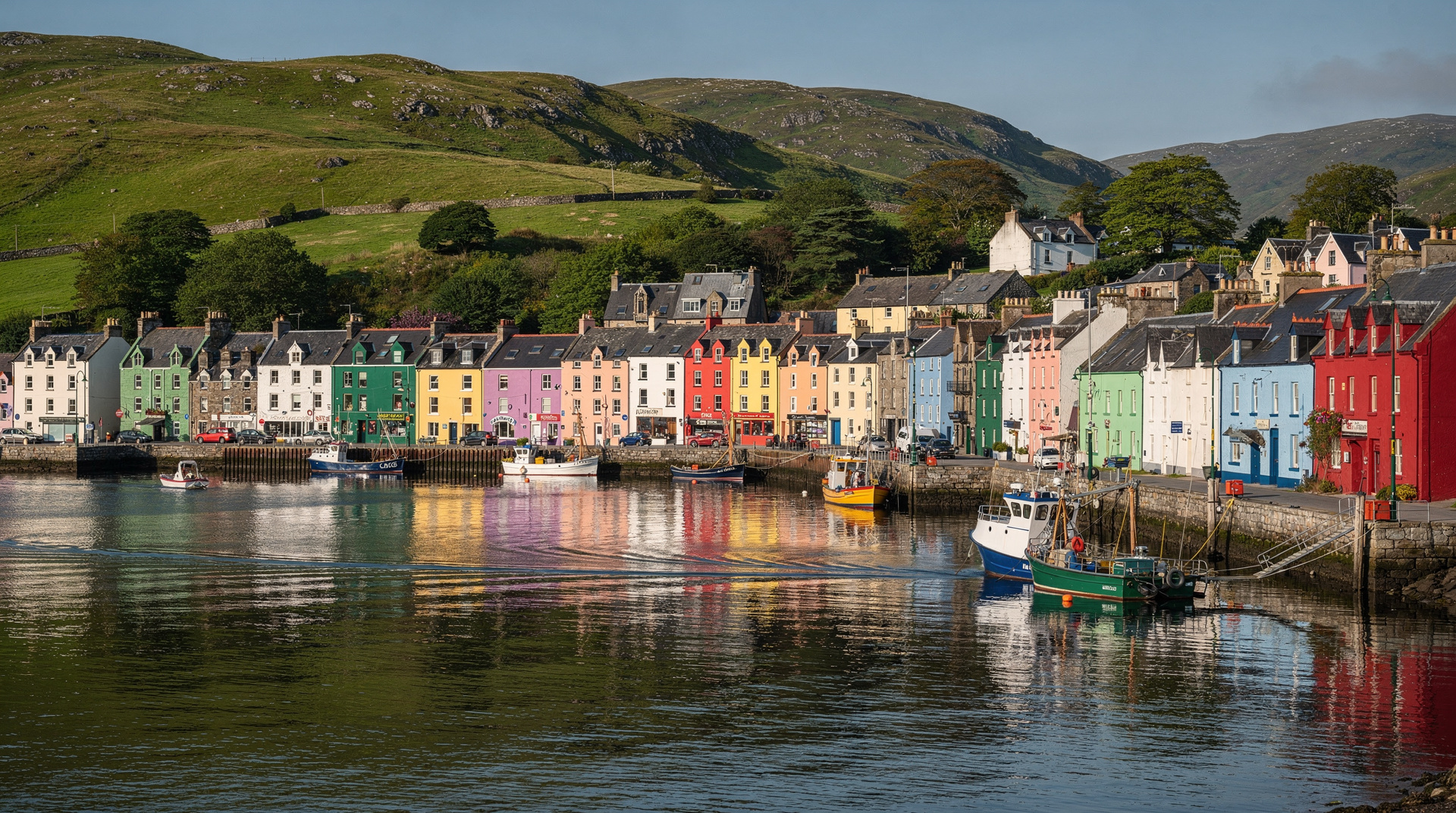
Kirkwall, the Orkney capital, is a town of about 9,000 people on the central mainland. Its streetscape is distinctly Norse rather than Scottish — narrow flagstone lanes between stone buildings, the layout of a trading town designed for the harbour rather than for agricultural consolidation. The Orkney Museum in Tankerness House gives the full archaeological and cultural context for the islands.
St Magnus Cathedral, Kirkwall, is the most complete medieval cathedral in Scotland — built from red and yellow sandstone beginning in 1137, still standing largely intact to its original height, and still in use as the Church of Scotland parish church. The bones of St Magnus, who was murdered by his cousin Hakon in 1117 and canonised shortly after, are housed within the cathedral pillars.
Orkney Distillery in Kirkwall produces the Highland Park single malt whisky — one of the best-regarded Scottish whiskies, made with Orcadian peat from the Hobbister Moor. Distillery tours and tastings run daily and are worth doing for the quality of the product and the explanation of how Orcadian peat gives a different character from Islay peat.
Scapa Flow and the Second World War
Scapa Flow, the natural harbour at the centre of the Orkney islands, was one of the most strategically important naval bases in both World Wars. The German High Seas Fleet was interned here after the 1918 armistice and was deliberately scuttled by its own crews in June 1919 — most of the wrecks remain on the seabed and are among the best recreational dive sites in Europe. In 1939, a German U-boat penetrated the harbour defences and sank HMS Royal Oak with the loss of 835 lives.
Churchill’s response — ordering the construction of the Churchill Barriers, a series of causeways linking the eastern Orkney islands — is still physically present: four concrete causeways now serve as roads. And on the island of Lamb Holm, the Italian prisoners of war who built the barriers constructed the Italian Chapel from two Nissen huts, concrete, and salvaged materials. The resulting building — with its trompe-l’oeil painted interior resembling an ornate Catholic church — is one of the most moving Second World War sites in Britain. Entry is free.
The Scapa Flow Visitor Centre at Lyness on Hoy gives the full naval history context with good exhibits including salvaged equipment from the scuttled German fleet.
Getting from Edinburgh to Orkney
By air: Loganair flies Edinburgh to Kirkwall in about 55 minutes. This is by far the quickest approach and makes independent visits viable. Book ahead as the route is popular and can be expensive at peak times. Return flights range from around £80-£200 depending on season and how far in advance you book.
By guided tour: The Orkney and the Far North 5-day tour from Edinburgh covers the journey north through Inverness and the Scottish north coast, crosses to Orkney by ferry, and visits the key Neolithic sites, Kirkwall, and the Churchill Barriers with accommodation included throughout. This is the most complete way to see the route and the islands together, and handles all the logistical complexity of ferries and remote roads.
The Orkney and Scotland’s northern coast 5-day tour takes a similar approach but with slightly different routing along the northern mainland coast — including John O’Groats and the dramatic Duncansby Head stacks — giving a fuller picture of the far north of Scotland before the ferry crossing to Stromness.
For those wanting to combine Orkney with Skye in a single extended trip, the Skye and Orkney 8-day tour is the complete Scottish islands itinerary.
Independent visit: Kirkwall and Orkney on your own
Flying to Kirkwall independently and hiring a car is entirely manageable for confident independent travellers. The main Orkney mainland is compact — most of the key sites are within 20 minutes of Kirkwall. Hiring a car at Kirkwall airport (multiple hire companies operate there) gives you full flexibility.
A three-night independent itinerary: Day one, arrive Kirkwall, afternoon at St Magnus Cathedral and Orkney Distillery. Day two, full Neolithic day — Skara Brae, Ring of Brodgar, Stenness, Maeshowe. Day three, Churchill Barriers, Italian Chapel, Scapa Flow Visitor Centre; optional ferry to Hoy for the Old Man of Hoy coastal walk. Fly back day four.
Ferries to the outer islands (Hoy, Westray, Stronsay, Eday) run from Kirkwall harbour and open up further destinations if you have more time.
Guided tour versus flying independently: the honest comparison
| 5-day guided tour from Edinburgh | Fly independently to Kirkwall | |
|---|---|---|
| Total time | 5 days including the drive north and ferry | As few as 2–3 nights is workable |
| Logistics | Fully handled — ferries, accommodation, routing | You arrange car hire, accommodation, and site bookings yourself |
| Route | Sees the north coast and Highlands en route, not just Orkney | Direct to Kirkwall; no mainland scenery included |
| Cost | £400–£600 per person, most costs bundled | Flights £80–£200 return plus £80–£120/day on the ground |
| Best for | First-time visitors, those without a car, or who want the north-coast scenery included | Confident independent travellers on a tighter timeframe |
Neither option is objectively better — the guided tour suits visitors who want the whole far-north journey handled for them, while flying independently suits those who specifically want Orkney and are comfortable organising a short island trip themselves.
Practical information for 2026
Skara Brae: Book entry online in advance in summer. The car park fills quickly in July-August. Arrive early or book timed entry.
Maeshowe: Guided tours only; pre-book on the Historic Environment Scotland website. Limited spaces per time slot.
Dark skies: Orkney is designated a dark-sky site and autumn-winter visits offer genuine Northern Lights potential. October to March is the optimal period for aurora watching; combine with the Maeshowe midwinter solstice tours which Historic Environment Scotland runs specially.
UK ETA: Visitors from many countries need a UK Electronic Travel Authorisation. See the UK ETA guide for details.
For planning context see the Orkney from Edinburgh guide and the multi-day Highland tours guide.
Frequently asked questions about Orkney
How far is Orkney from Edinburgh?
By air it is about 55 minutes to Kirkwall. By road it is roughly 300 miles to the Scrabster ferry terminal near Thurso, plus the ferry crossing to Stromness (about 90 minutes). Guided tours from Edinburgh cover the journey over the first day of a five-day programme.
Is Orkney worth visiting for non-archaeologists?
Yes. The Neolithic monuments are remarkable even without specialist knowledge — the scale and completeness of Skara Brae in particular is viscerally impressive. The Scapa Flow history, the Italian Chapel, the Norse architecture of Kirkwall, and the coastal scenery add variety. Orkney works well for history, wildlife, whisky, or landscape interests.
What is the best Neolithic site in Orkney?
Skara Brae is the most vivid — the preserved interiors make the Neolithic past feel immediate. The Ring of Brodgar is the most atmospheric in terms of landscape setting. Maeshowe is the most architecturally sophisticated (and its astronomical alignment is extraordinary) but requires a guided tour that limits flexibility. All three are worth visiting.
Can I see the Northern Lights in Orkney?
Yes, and Orkney is one of the better places in mainland Britain to do so. The islands have very limited light pollution and a clear northern horizon. Peak aurora season is October to March. No aurora sighting is guaranteed — it depends on solar activity — but the probability is higher in Orkney than anywhere else you can reach from Edinburgh without crossing to Iceland or Norway.
Is it possible to visit Orkney as a day trip?
Technically possible by flying there and back, but not a good use of a visit. The archaeology alone needs a full day and the islands deserve more time. A minimum of two nights is needed to see the key sites without rushing; three nights is more relaxed.
What whisky is made in Orkney?
Highland Park, made at the Highland Park Distillery in Kirkwall. It is one of the most consistently highly rated Scottish single malts, with a distinctive character from Orcadian peat. The distillery runs daily tours including a basic tour and an extended premium tasting. Scapa Distillery, also on the Orkney mainland, produces a lighter Highland-style whisky and also accepts visitors.
The outer islands: Hoy and beyond
Orkney is an archipelago of around 70 islands, of which about 20 are inhabited. Most visitors concentrate on the Orkney mainland, but the outer islands reward the extra effort.
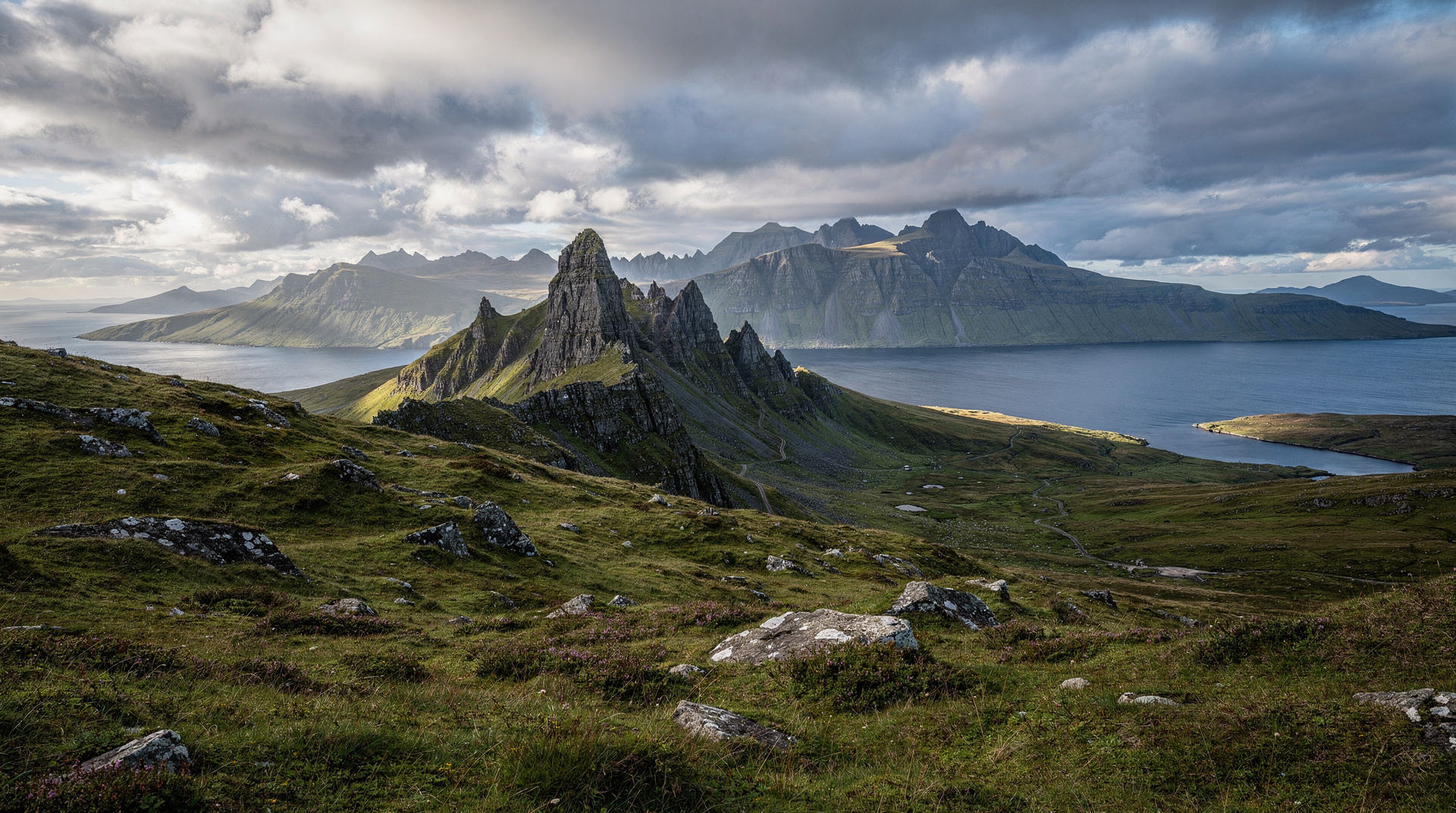
Hoy is the most dramatic: it is the only mountainous Orkney island, with the Hoy Hills rising to 479 metres at Ward Hill. The island contains the Old Man of Hoy — a 137-metre sea stack on the Atlantic coast, one of the most famous rock-climbing objectives in Britain and visible from the Scrabster-Stromness ferry crossing. The walk to the Old Man takes about 3 hours return from the Rackwick Bay road end, and the scenery — moorland, dramatic sea cliffs, the stack itself — is among the most spectacular in Orkney. CalMac runs ferries from Stromness to Hoy; day trips are possible.
Westray in the north of the archipelago is worth visiting for the Knap of Howar — two Neolithic farmhouses dating to about 3600 BC, which are the oldest standing stone buildings in northwest Europe. Access by inter-island ferry from Kirkwall (about 1.5 hours).
Papa Westray (Papay), adjacent to Westray, has the Neolithic houses of the Knap of Howar as its main attraction and also claims the world’s shortest scheduled commercial flight (1.7 miles to Westray, often taking under 2 minutes).
Orkney wildlife
Orkney has exceptional wildlife that is under-appreciated by visitors focused primarily on the archaeology. The coastal areas support grey seals (resident year-round), harbour porpoise (regularly seen from ferry crossings), and occasional orca (orcas pass through the sounds between islands, most commonly in summer). The RSPB Marwick Head reserve on the western Orkney mainland has a large seabird colony including guillemots, razorbills, fulmars, and kittiwakes, visible from the clifftop path May through July.
The short-eared owl, rarely seen in Edinburgh or the Central Belt, is relatively common on Orkney heathland. Hen harriers breed on the island. The orchid meadows in Birsay and Deerness are among the finest wildflower habitats in northern Scotland. This wildlife breadth — alongside the archaeology and naval history — gives Orkney a density of interest that rewards longer visits.
Fitting Orkney into the broader Scotland itinerary
Orkney sits far enough from Edinburgh that combining it efficiently with other Scottish island destinations requires planning. The natural combination is Orkney alongside the North Coast 500 route: fly Edinburgh to Kirkwall, spend two to three days in Orkney, then ferry south to Scrabster and drive the NC500 clockwise or anticlockwise depending on your time and interests. This gives a complete Scottish far-north circuit without retracing the same roads.
For those wanting both Orkney and Skye in a single extended trip, the guided 8-day Skye, Orkney and North Coast tour handles the logistics. See also the multi-day Highland tours guide for the full range of structured options.
What to expect from the weather
Orkney’s weather is governed by its position at the meeting point of the Atlantic and the North Sea. It is wetter than Edinburgh but, counterintuitively, rarely as cold in winter — the surrounding sea moderates temperatures. The main challenge is wind: Orkney is one of the windiest places in Britain, and wind speeds that would be unusual in Edinburgh are entirely normal here. The landscape is largely treeless as a direct result of the wind exposure, which gives it a particular open, elemental quality.
Summers are long in terms of daylight — at the midsummer solstice, Orkney has over 18 hours of usable daylight. The midsummer light quality, with its extended golden hours in the early morning and late evening, is extraordinary for photography and for the general experience of the landscape. This is partly why May-June is the recommended visiting period.
Rain is possible in any month. The practical advice is to bring layered waterproofs and not to plan outdoor activities with tight time windows — allow flexibility for weather delays on boat trips or hill walks.
Practical cost expectations for 2026
Orkney is modestly priced by Scottish tourism standards. Accommodation is cheaper than Edinburgh and Skye equivalents. Local seafood — Orkney lobster, crab, oysters, and scallops — is available at reasonable prices directly from fishmongers and small restaurants in Kirkwall. The Kirkwall hotel and B&B options are adequate to good; the St Ola Hotel near the Kirkwall harbour and the Foveran Hotel near the airport are consistent choices.
Guided 5-day tours from Edinburgh typically cost £400-£600 per person including accommodation and most transport. Independent visitors flying to Kirkwall can manage on £80-£120 per day (accommodation, food, hire car, and entry fees) outside of peak summer months.
Currency, as throughout the UK: pounds sterling. The Edinburgh currency guide covers exchange practicalities for non-UK visitors.
Planning the rest of your trip around Orkney
Orkney works best as one chapter of a longer Scottish trip rather than a stand-alone excursion. Many visitors start in the capital, so the Edinburgh travel guide for first-timers and the how many days in Edinburgh guide help you decide how much time to leave before heading north.
If the far north appeals but the islands feel too remote, the North Coast 500 from Edinburgh guide covers the mainland route that leads to the Orkney ferry. On the way, Inverness is the natural base for a night or two, and the Edinburgh to the Highlands guide sets out the road north in more detail. The five-day Edinburgh and Highlands itinerary is a gentler alternative if you want mountains and lochs without crossing the Pentland Firth.
For other island experiences closer to the capital, compare Skye and Mull and Iona before you commit. If you enjoy the historical side of Orkney, Stirling and the Edinburgh Castle guide give a very different, medieval take on Scottish history, while Rosslyn Chapel offers a short half-day with plenty of carved stonework to look at.
Whisky drinkers who enjoy Highland Park may like the understanding Scotch regions guide, which explains how island malts differ from those of the mainland. And if the weather turns on you, the Edinburgh weather guide is a useful reminder of how variable Scottish conditions can be throughout the year.
Top experiences
Bookable activities with verified prices and instant confirmation on GetYourGuide.