Orkney from Edinburgh: how to visit the islands from Scotland's capital
Edinburgh: Orkney and the Far North 5-day tour
How do I get to Orkney from Edinburgh?
Fly from Edinburgh Airport to Kirkwall (1hr, ~£80-200 return) or drive north to Scrabster (4.5hrs) and take the NorthLink ferry to Stromness (90min). Orkney requires at minimum two nights; three nights is comfortable for the main Neolithic sites. Multi-day guided tours from Edinburgh include transport and accommodation.
Orkney: why the most underrated Scottish island deserves a dedicated trip
Orkney is not well understood by most visitors to Edinburgh, who tend to assume it is a bleak, windswept outpost too remote to be worth the journey. This is incorrect on every count. Orkney has the highest density of Neolithic archaeological sites in western Europe: Skara Brae (a 5,000-year-old village in better condition than Pompeii), the Ring of Brodgar (a standing stone circle older than Stonehenge), Maeshowe (a Neolithic passage tomb with Viking runic graffiti inside it), and dozens of smaller sites spread across the Mainland and outer islands.
It also has extraordinary seabird cliffs, an island character quite distinct from mainland Scotland (the Orcadians are Orcadians first, not Scots — their Norse heritage is more relevant culturally than their position within Scotland), excellent food (particularly beef and seafood), and a landscape that shifts from dramatic coastal cliffs to green agricultural lowland in a way that has no comparison elsewhere in Scotland.
Getting there from Edinburgh is not as onerous as it appears. Flights take one hour. Ferry from Scrabster (after a 4.5-hour drive) takes 90 minutes. Guided tours handle the logistics entirely. The barrier is not distance but the need for at least two nights — which means it cannot be combined with an Edinburgh city break unless your overall Scotland trip is at least seven days.
If you are still deciding how Orkney fits around your time in the capital, the how many days in Edinburgh guide helps you work out what the city itself needs, and the Orkney destination page gives a quick overview of the islands. Arriving by air, you will also want the Edinburgh Airport to city centre guide for the start of your journey.
| Where | Northern Scotland, off the far north coast |
| Getting there | Fly (1hr, ~£80-200 return) or ferry from Scrabster (90min) |
| Time needed | 2 nights minimum, 3 nights comfortable |
| Headline sites | Skara Brae, Ring of Brodgar, Maeshowe, Italian Chapel |
| Best time | May-September for ferries, weather and daylight |
Getting to Orkney from Edinburgh
By plane
Edinburgh Airport to Kirkwall Airport (Orkney Mainland): approximately 1 hour flying time. Loganair operates this route with multiple flights per week; prices vary from £80 to £200 return depending on advance booking and season. Kirkwall is the main town on Orkney Mainland and the airport is 3 miles east of the town centre.
Flying is the fastest option and avoids a long drive north. The disadvantage is that once on Orkney, you need a hire car (available from Kirkwall) to explore the island — the main Neolithic sites are spread across the Mainland and require driving.
By ferry (Scrabster to Stromness)
Drive Edinburgh to Scrabster (near Thurso on the north coast): approximately 4.5 hours on the A9. NorthLink Ferries runs a regular car ferry from Scrabster to Stromness (on Orkney Mainland) in approximately 90 minutes. Ferries run several times daily in summer, less frequently in winter. Bringing your car on the ferry gives maximum flexibility on Orkney and is the recommended option if you are self-driving.
Alternatively, ferry from Aberdeen to Kirkwall is longer (6+ hours overnight), which is practical for those combining an east coast route with Orkney.
By guided multi-day tour
The Edinburgh Orkney and the Far North 5-day tour covers Orkney in a structured circuit from Edinburgh that includes transport, ferry crossing, accommodation, and guided visits to the main sites. This is the most practical option for visitors without a car or those who prefer not to navigate the long drive north independently.
The Orkney and Scotland’s northern coast 5-day tour adds sections of the North Coast 500 to the Orkney visit — a strong combination that gives a broader sense of the far north while centring on Orkney as the headline destination.
For those with more time and wanting to combine Orkney with Skye and the western Highlands, the Edinburgh Orkney, Skye and the Far North 8-day tour is one of the most comprehensive multi-destination tours available from Edinburgh.
What to see on Orkney
Skara Brae
The most extraordinary prehistoric village in Britain — perhaps in northern Europe. Skara Brae was occupied from approximately 3100 to 2500 BC and was buried by a sand dune until a storm revealed it in 1850. The excavated remains show eight stone houses connected by covered passages, each house with a central hearth, stone beds, and stone dressers, all in a state of preservation that makes the inhabitants feel strangely present. The inhabitants of Skara Brae were living here when the Egyptian pyramids were being built.
Entry: £14 adults online, £16 on the day (Historic Environment Scotland, 2026; lower from November to March). The adjacent Skaill House (a 17th-century mansion) is included. Allow 2 hours for the site and the adjacent museum. The site is on the western shore of the Mainland at the Bay of Skaill; the approach across the headland above the bay is dramatic.
Ring of Brodgar
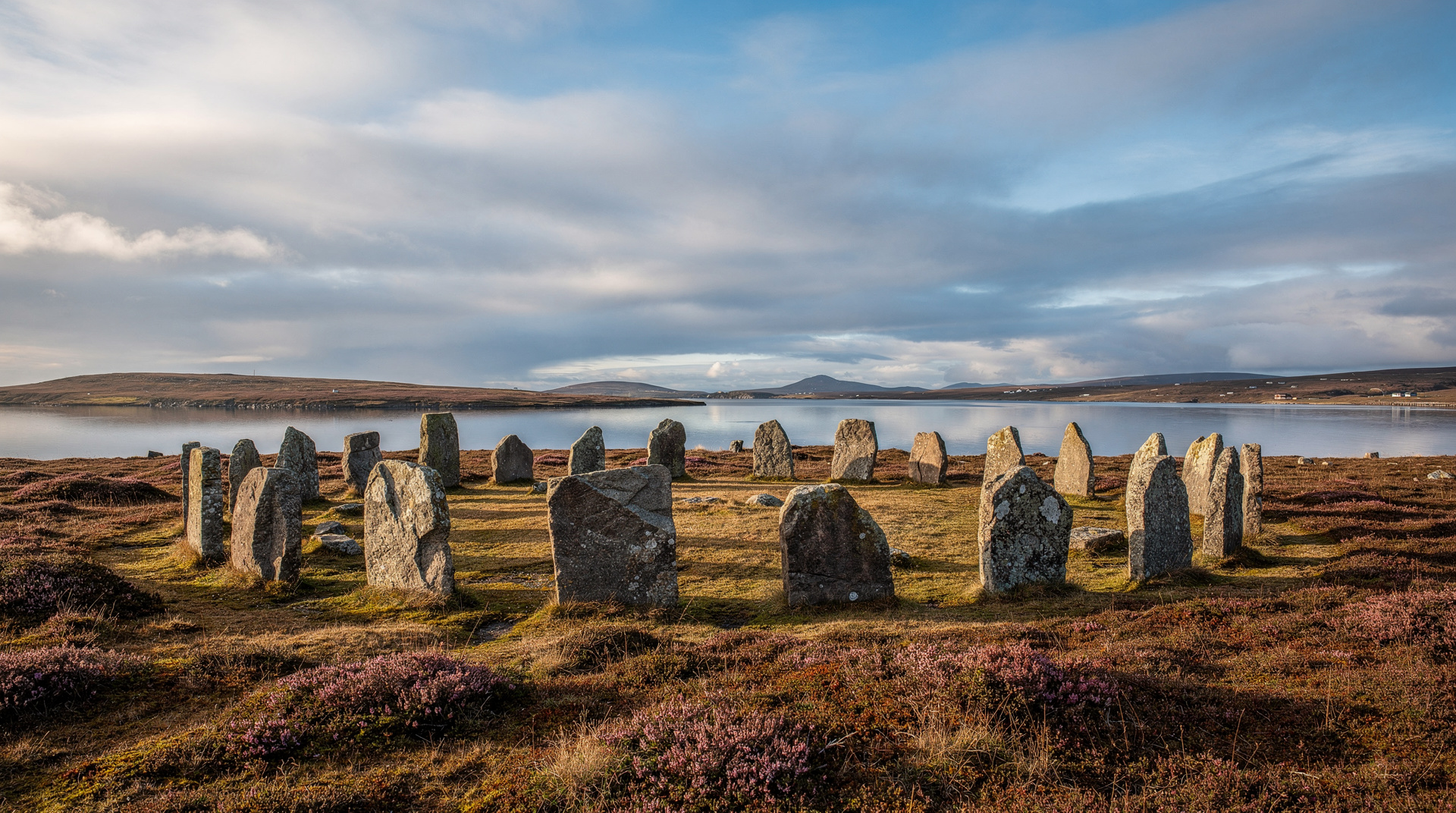
A stone circle of 36 remaining stones (originally up to 60) on a narrow isthmus between two lochs, about 8 miles from Stromness. Built around 2500 BC, it predates Stonehenge and is considered part of the Heart of Neolithic Orkney UNESCO World Heritage Site (along with Skara Brae, Maeshowe, and the Stones of Stenness). The stones stand up to 4.7 metres tall; the circle is 104 metres in diameter.
The site is open and atmospheric at any time of day. The light at sunset or in low winter sun turns the stones into extraordinary silhouettes. Free entry; car park at the site. Allow 45 minutes to an hour for a walk around the circle.
Maeshowe
A Neolithic passage tomb built around 2800 BC — a grassed mound concealing a corbelled stone chamber aligned with the winter solstice sunset. More remarkable than the Neolithic structure itself is the Viking graffiti inside: when Norse explorers broke into the tomb in the 12th century, they carved runic inscriptions on the walls recording their presence and leaving one of the largest collections of runic writing anywhere in the world. Guided tours only; must book in advance. Entry: £10 adults online, £11 on the day. The short entrance passage requires ducking; on the winter solstice, sunlight enters the passage and illuminates the back wall.
Italian Chapel
On the small island of Lamb Holm, connected to the Mainland by a causeway, Italian prisoners of war interned on Orkney during the Second World War constructed a chapel from two Nissen huts using whatever materials they could improvise. The interior was painted and decorated to resemble a proper chapel; the trompe l’oeil stonework and the ironwork screen are extraordinary examples of what skilled craftsmen can do under constraint. Free entry; donations welcome. Allow 30 minutes.
Stromness
The second town of Orkney Mainland — a Norse-grid town of flagstone streets, piers, and narrow closes running down to the harbour. More atmospheric and less modern than Kirkwall; good for walking and has the Stromness Museum (maritime and natural history, excellent) and the Pier Arts Centre (a significant collection of 20th-century British art in an unlikely setting).
Kirkwall and St Magnus Cathedral
The main town has St Magnus Cathedral — a red sandstone Norman cathedral built from 1137, making it one of the oldest cathedrals in Scotland still in use. The interior is impressive; the bones of St Magnus (murdered by his cousin Haakon in 1117) are said to be in a pillar. Free entry.
The outer islands: Hoy, Rousay, and Westray
Hoy
The most dramatically scenic of the Orkney islands — steep hills (the Ward Hill at 479 metres is the highest point in Orkney), sea cliffs, and the Old Man of Hoy, a 137-metre sea stack visible from the Scrabster ferry and accessible by a challenging 3-4 hour return walk from Rackwick Bay. Hoy is reached by ferry from Stromness (20-25 minutes to Moaness Pier) or from Houton to Lyness (40 minutes). There is basic accommodation on the island; most visitors day-trip from the Mainland.
Rousay
“The Egypt of the North” — Rousay has an extraordinary concentration of Neolithic chambered cairns (burial tombs) along its western coast, accessible on a 13-mile circular walk (the Westside Walk) that passes Midhowe Cairn (the largest stalled cairn in the Orkneys), Taversoe Tuick (a two-storey tomb), and several smaller sites. The ferry from Tingwall on the Mainland takes 25 minutes. A full day walk for those interested in Neolithic archaeology.
Westray
Westray has the famous puffin colony at Castle o’ Burrian (an accessible sea stack), accessible by a 2-mile coastal walk from the village of Westray, with puffins close enough in summer (April-August) to photograph without a long lens. The island also has Noltland Castle (a 16th-century Z-plan castle) and the Westray Wife — the oldest representation of the human face found in Scotland, a 5000-year-old Neolithic figurine. Ferry from Kirkwall: 90 minutes.
The archaeology of Orkney in context
Orkney’s extraordinary density of prehistoric monuments reflects the island’s relative abundance of building material (flat-bedded sandstone that splits into workable slabs) and the long period of Neolithic and Bronze Age settlement. The Heart of Neolithic Orkney UNESCO World Heritage Site encompasses four key monuments:
Skara Brae: The best-preserved Neolithic village in Britain (see above).
Ring of Brodgar: A stone circle and henge on the Brodgar Peninsula, one of the largest in Scotland.
Stones of Stenness: Immediately south of Brodgar, four of the original twelve stones survive at a height of up to 6 metres — the tallest standing stones in Scotland. The Watchstone, standing alone near the bridge, is 5.6 metres tall.
Maeshowe: The most sophisticated Neolithic passage tomb in Scotland, with internal drystone masonry of extraordinary quality.
These four sites, plus the Ness of Brodgar (an ongoing excavation between Brodgar and Stenness that is revealing a complex of monumental Neolithic buildings larger than the stonehenge complex), represent a landscape of Neolithic ritual and settlement unmatched in Britain. The whole area can be walked in a day.
The Ness of Brodgar excavation: This is one of the most significant active archaeological sites in Britain. Excavations began in 2003 and have revealed a complex of at least fifteen large buildings, some with painted interior walls, dating from approximately 3100-2300 BC. The site is between the Ring of Brodgar and the Stones of Stenness. During the summer excavation season (usually July-August), guided tours of the site are available and visitors can watch archaeologists working. Entry is free; donations accepted.
Scapa Flow and wartime history
The bay enclosed by the Orkney islands — Scapa Flow — is one of the great natural harbours in Britain and served as the principal anchorage of the British Grand Fleet in both World Wars. The scuttling of the German High Seas Fleet in June 1919 (52 ships sunk on the orders of German Admiral Ludwig von Reuter to prevent them falling into British hands) left a significant number of vessels on the seabed. Seven German warships remain and are designated protected war graves; four have been partially salvaged. This makes Scapa Flow one of the finest wreck diving destinations in Europe.
The Lyness Naval Museum on Hoy (accessible by ferry) is housed in a former Royal Navy pumping station and gives the most comprehensive account of Scapa Flow’s wartime role, including the sinking of HMS Royal Oak by a German U-boat in October 1939 — a loss of 833 men that shocked Britain. The Royal Oak wreck is a designated war grave; the Chaplain to the Fleet conducts a memorial service above it annually.
The Churchill Barriers (four causeways constructed 1940-1944 to close the eastern approaches to Scapa Flow following the Royal Oak sinking) are still in use as roads, connecting several of the southern islands to the Mainland. The Italian Chapel is on Lamb Holm, on the first barrier.
Planning a realistic Orkney visit
Two nights: Skara Brae, Ring of Brodgar, Maeshowe, Italian Chapel, Stromness — covers the UNESCO Heart of Neolithic Orkney and the wartime heritage in a tight but feasible two-day schedule.
Three nights: Adds Kirkwall properly, the Churchill Barriers (four causeways built across the eastern approaches to Scapa Flow to prevent German submarine entry during the Second World War — the Italian Chapel is on one of these), and the seabird cliffs at Marwick Head and Yesnaby.
Five or more nights: The outer islands. Hoy (dramatic sea stack called the Old Man of Hoy), Westray (puffin colony at Castle o’ Burrian, reached by ferry), Papa Westray (one of the oldest houses in northern Europe, the Knap of Howar, which predates Skara Brae by 500 years). These require additional ferry connections.
Whichever length you choose, build in some slack. Ferries and flights to the islands depend on the weather, so a tight schedule leaves no room for a delayed crossing. If you are travelling onward from the far north, the Inverness destination page is a useful base for the mainland leg, and the Edinburgh and the Highlands 5-day itinerary shows how a Highlands trip can be sequenced around the city. For the wider picture of the best seasons for Scotland as a whole, see the best time to visit Edinburgh guide.
Honest notes
Weather: Orkney is exposed — wind is constant, and the islands receive significant rainfall. But the weather is also extremely changeable; bright, clear periods are common even in winter. Pack waterproofs and accept that outdoor time will be weather-dependent. The quality of light on Orkney in good weather is genuinely extraordinary — long, low-angle light that photographers seek out specifically.
Driving on Orkney: The roads on the Mainland are good by Highland standards. The outer island roads are narrow. Most visitors find Orkney driving straightforward; the main challenge is single-track causeways at busy periods.
Food: Orkney beef is considered some of the finest in Scotland. Orkney seafood (crab, lobster, scallops) is excellent. Kirkwall has a reasonable restaurant selection; Stromness has good options along the main street.
Scapa Flow: The main bay between the Orkney islands was the principal British naval base in both World Wars. It is where the German Fleet was scuttled in 1919 (a deliberate act by the German admiral to prevent the ships falling into British hands). Several of the scuttled ships remain on the sea floor and are popular dive sites. The Lyness Naval Museum on Hoy tells the Scapa Flow story.
For the UK ETA requirement for visiting Great Britain, see the UK ETA guide. Currency is pounds sterling throughout Orkney; see the Edinburgh currency guide.
Orkney versus Scotland’s other island trips
Visitors weighing up an island detour from Edinburgh often compare Orkney with Skye or a Highlands-focused itinerary. They are different trips with different rewards:
| Orkney | Isle of Skye | North Coast 500 | |
|---|---|---|---|
| Character | Neolithic archaeology, Norse history, low-lying | Dramatic mountains, coastline, castles | Circular scenic driving route |
| Minimum time | 2 nights | 2-3 nights | 5-7 days |
| Getting there | Fly (1hr) or ferry from Scrabster | Drive (5-6hrs) or fly to Inverness then drive | Self-drive circuit from Inverness or Edinburgh |
| Best for | History and archaeology enthusiasts | Landscape photographers, hikers | Road-trippers wanting variety |
| Combine with | North coast, Caithness | Western Highlands, Glencoe | Whole northern Scotland |
Orkney rewards a narrower, deeper interest — if standing stones and Viking history genuinely excite you, nothing in Scotland compares. If your priority is dramatic mountain scenery, Skye from Edinburgh or the North Coast 500 from Edinburgh guide will deliver more of what you are picturing. Several operators run multi-day Highland tours from Edinburgh that combine elements of both if you have the time.
Food and where to eat on Orkney
Orkney’s food scene is better than its remoteness suggests, built on genuinely excellent local produce. Orkney beef and lamb graze on nutrient-rich pasture and are sold in Kirkwall and Stromness butchers as well as served in most restaurants. Orkney cheese (particularly the cheddar from the Orkney Cheese Company) is sold across Scotland but tastes best fresh. Seafood — crab, lobster, scallops, and Orkney’s own smoked salmon — is landed locally and features on most menus.
Kirkwall has the widest restaurant choice, from casual cafés on the harbour to a handful of proper sit-down restaurants serving Orkney beef and seafood. Stromness has fewer options but a couple of reliably good spots along the main street, including a chip shop regarded as one of the best in northern Scotland. Self-catering visitors will find well-stocked supermarkets in both towns — useful if your accommodation is a rural cottage without easy access to restaurants in the evening. If you want to know what to order before you go, the traditional Scottish food guide covers the dishes you will see on Orkney menus too.
A realistic packing list
Orkney’s weather is genuinely different from mainland Edinburgh — more wind, less shelter, and a climate that shifts quickly between bright sun and driving rain within the same afternoon. A properly waterproof (not just water-resistant) jacket and trousers are non-negotiable, as is a warm layer even in July; the wind chill on an exposed clifftop or standing stone site can be significant regardless of the calendar month.
Sturdy waterproof footwear matters more than technical hiking boots for most itineraries, since the main sites involve short walks over grass and gravel rather than serious hill terrain. A car (hired on the islands or brought via ferry) is close to essential for an independent visit; without one, plan around the more limited local bus network or book a guided tour that handles transport. Note that the advice in the do you need a car in Edinburgh guide is the opposite of what applies here: in the capital a car is a burden, while on Orkney it is the thing that makes independent sightseeing practical. The Edinburgh weather guide is a useful comparison if you are deciding what to pack for both ends of the trip.
Frequently asked questions about visiting Orkney from Edinburgh
Is Orkney worth visiting from Edinburgh?
For those with a genuine interest in archaeology, history, or remote island landscapes, Orkney is among the most rewarding destinations in Scotland. The Neolithic sites alone — Skara Brae, Ring of Brodgar, Maeshowe — would justify a visit from anywhere in Europe. For visitors primarily interested in Edinburgh city attractions and one day trip, Orkney’s distance makes it a trip in its own right rather than an Edinburgh add-on.
How long do I need on Orkney?
Two nights is the minimum for the main Neolithic World Heritage sites and Stromness. Three nights is comfortable and adds the outer reaches of the Mainland. A week allows the outer islands (Hoy, Westray, Rousay) that contain significant additional archaeology and wildlife. Most visitors find two or three nights leaves them wanting to return.
What is the best way to get to Orkney from Edinburgh?
Flying (1 hour, Edinburgh to Kirkwall) is fastest and simplest. The ferry from Scrabster (after a 4.5-hour drive north) brings your car and gives flexibility on the island. Guided tours handle all logistics and are the best option for those without a car or who prefer not to drive the distance to Scrabster.
Can I combine Orkney with the Isle of Skye on one trip?
Yes, but not conveniently as a simple circuit. Skye is on the northwest coast (reached via the A87); Orkney is reached from the far north coast (Scrabster/Thurso) or by flying from Edinburgh. The 8-day Edinburgh, Skye, Orkney and NC500 tour covers all three in a structured circuit. For self-drivers, a week combining Skye (2 nights), the NC500 western section (2 nights), and Orkney by ferry from Scrabster (2 nights) is achievable.
When is the best time to visit Orkney?
May to September for accessible sites, reliable ferry crossings, and the best odds of good weather. June has the longest days (in midsummer, it barely gets dark at all in Orkney — the “simmer dim”). July and August are the busiest months but still never overcrowded. October and November offer dramatic weather and very few tourists. Winter Orkney is for the dedicated — extraordinary for wildlife and light but requiring tolerance for wind and short days.
Do I need to hire a car on Orkney?
For an independent visit, yes — the main Neolithic sites are spread across the Mainland and public transport between them is limited. Hire cars are available in Kirkwall and can be booked ahead, particularly important in peak summer. Visitors without a car should book a guided multi-day tour, which handles all transport between sites, or base themselves in Kirkwall or Stromness and use taxis for the closer sites.
Is Orkney expensive compared to the rest of Scotland?
Accommodation and food run slightly higher than mainland Scotland due to transport costs to the islands, but not dramatically so. Entry fees to the main Neolithic sites (Skara Brae £14 and Maeshowe £10 online) are reasonable, and several major sites (Ring of Brodgar, the Italian Chapel, St Magnus Cathedral) are free. A guided multi-day tour bundles transport, accommodation, and site visits, which can work out more cost-effective than arranging everything independently, particularly for solo travellers.
Top experiences
Bookable activities with verified prices and instant confirmation on GetYourGuide.