East Neuk of Fife
The East Neuk of Fife: five historic fishing villages, the best fish and chips in Scotland, and coastal walking from Edinburgh in under 2 hours.
Edinburgh: St Andrews, Falkland Palace & East Neuk of Fife tour
Quick facts
- Best time to visit
- May–September for coastal walks and seafood
- Days needed
- 1 day
- Getting there from Edinburgh
- ~1.5–2 hrs by car or tour coach via Forth Road Bridge
- Budget per day
- £40–£80 self-guided; fish supper at Anstruther ~£10–£14
A quietly remarkable stretch of coastline
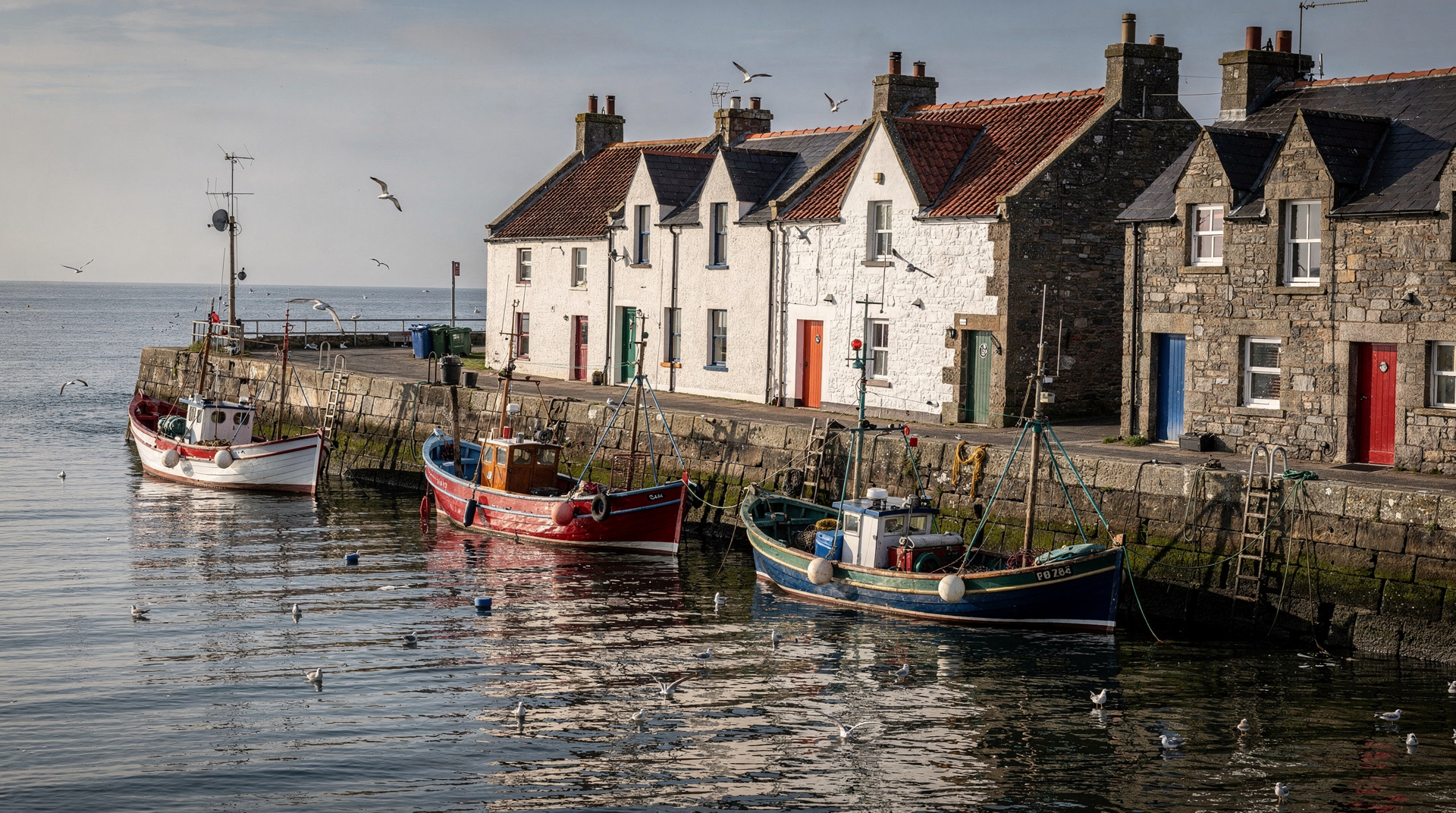
The East Neuk — an old Scots word for “corner” — is the rounded promontory that forms the southeastern tip of Fife, bounded by the Firth of Forth to the south and the North Sea to the east. Along its coast run five fishing villages that have been working the sea for over five centuries: Earlsferry and Elie, St Monans, Pittenweem, Anstruther, and Crail. They are the kind of places that appear on Scottish calendars — crow-stepped gables, painted harling, boats in harbours that still function as harbours — but have largely avoided the kind of heritage-tourism oversaturation that affects more famous coastal destinations.
| Where | Southeastern tip of Fife, ~55 miles from Edinburgh |
| Cost | Around £40–£80/person; fish supper at Anstruther ~£10–£14 |
| Time needed | A full day to see 3–5 villages properly |
| Getting there | ~1.5–2 hrs by car via the Forth Road Bridge; limited bus service |
| Best time | May–September for coastal walking and outdoor seafood |
For Edinburgh visitors, the East Neuk represents an accessible alternative to the Highland day trip: closer, quieter, genuinely beautiful, and centred on a very specific pleasure that requires no prior interest in history or walking. Anstruther’s fish and chip bar is, by many credible assessments, the best fish and chip shop in Scotland. The drive from Edinburgh takes about an hour and forty minutes. This is a worthwhile day trip for anyone who wants Scottish scenery without Highland distances.
The catch is that public transport to the individual villages is limited, so the East Neuk works much better with a car or on a guided day tour than as a pure rail-and-bus excursion.
The five villages
Crail
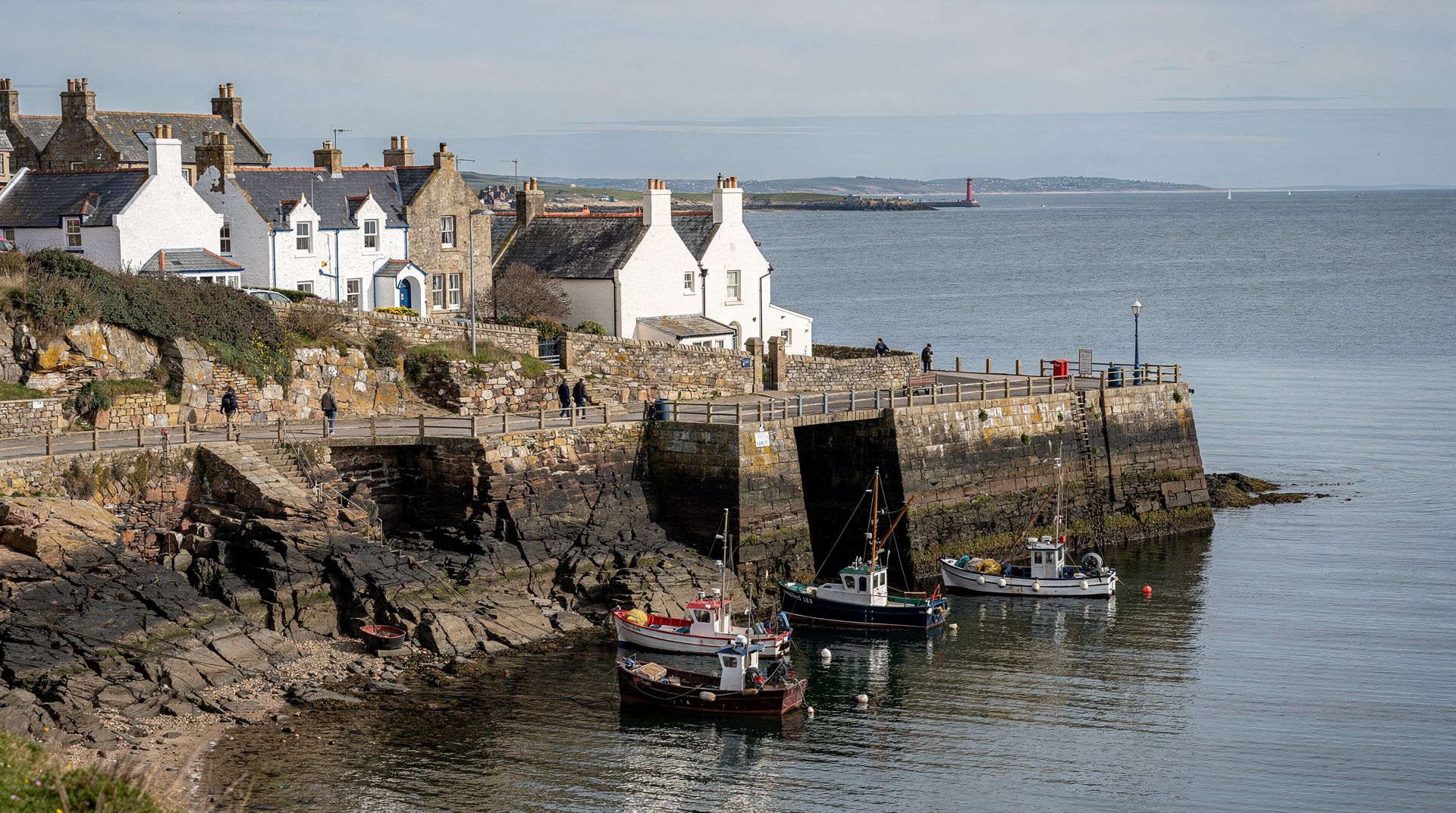
Crail is the easternmost village and often the first stop heading along the coast from St Andrews. Its harbour is the oldest in Fife — it received a royal charter in 1310 — and it is the most photogenic: a small, almost perfectly preserved stone harbour with fishing boats and lobster creels. The village above the harbour has an attractive market square and a 13th-century church. Crail has a small pottery and a lobster hut selling fresh seafood directly from the boats in summer. Allow an hour.
Anstruther
Anstruther (pronounced “Anster” locally) is the largest East Neuk town and the hub of the area. The Scottish Fisheries Museum here is excellent — covering the full history of Scottish fishing from the earliest days to the oil-rig era — and is worth 90 minutes. The harbour is working and atmospheric. And the Anstruther Fish Bar on Shore Street is the reason many people make this journey. The queue extends outside in summer but moves quickly. Order the haddock, eat it on the harbour wall, and accept that this is one of the better decisions available in day-trip Scotland. The fish is fresh, the batter is right, the chips are proper. Portions are large, prices around £10-£14 depending on what you order.
Pittenweem
Pittenweem (the name means “place of the cave”) is a working harbour town. It still lands fish at its pier, and the fishmarket operates early mornings on weekdays. The small streets above the harbour contain Kellie Lodging, a 16th-century tower house, and the cave of St Fillan, a 7th-century hermit’s cell accessible through a garden. The town also runs an arts festival every August that brings contemporary exhibitions into houses and spaces across the village — worth timing a visit around if you are in Fife in summer.
St Monans
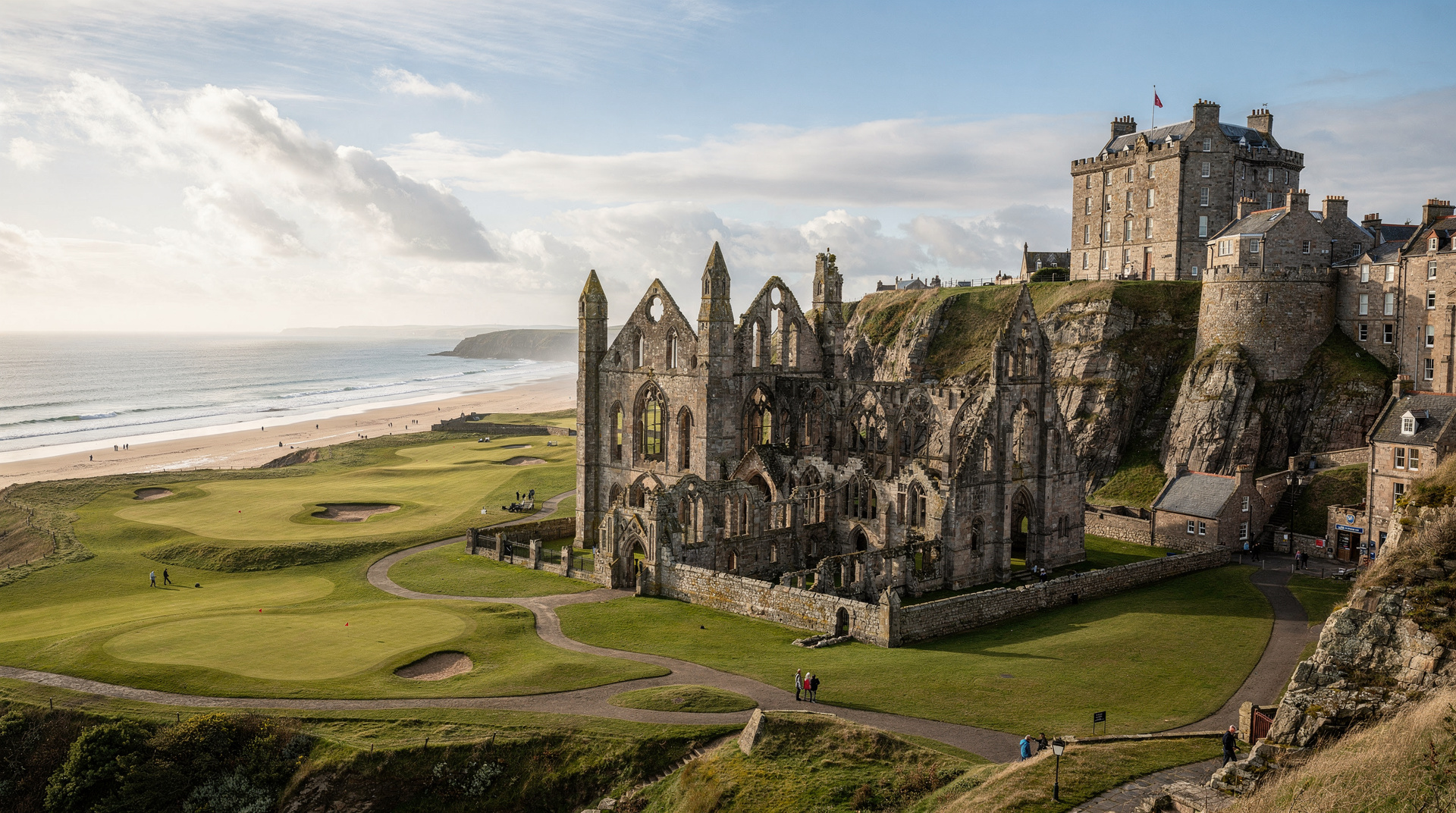
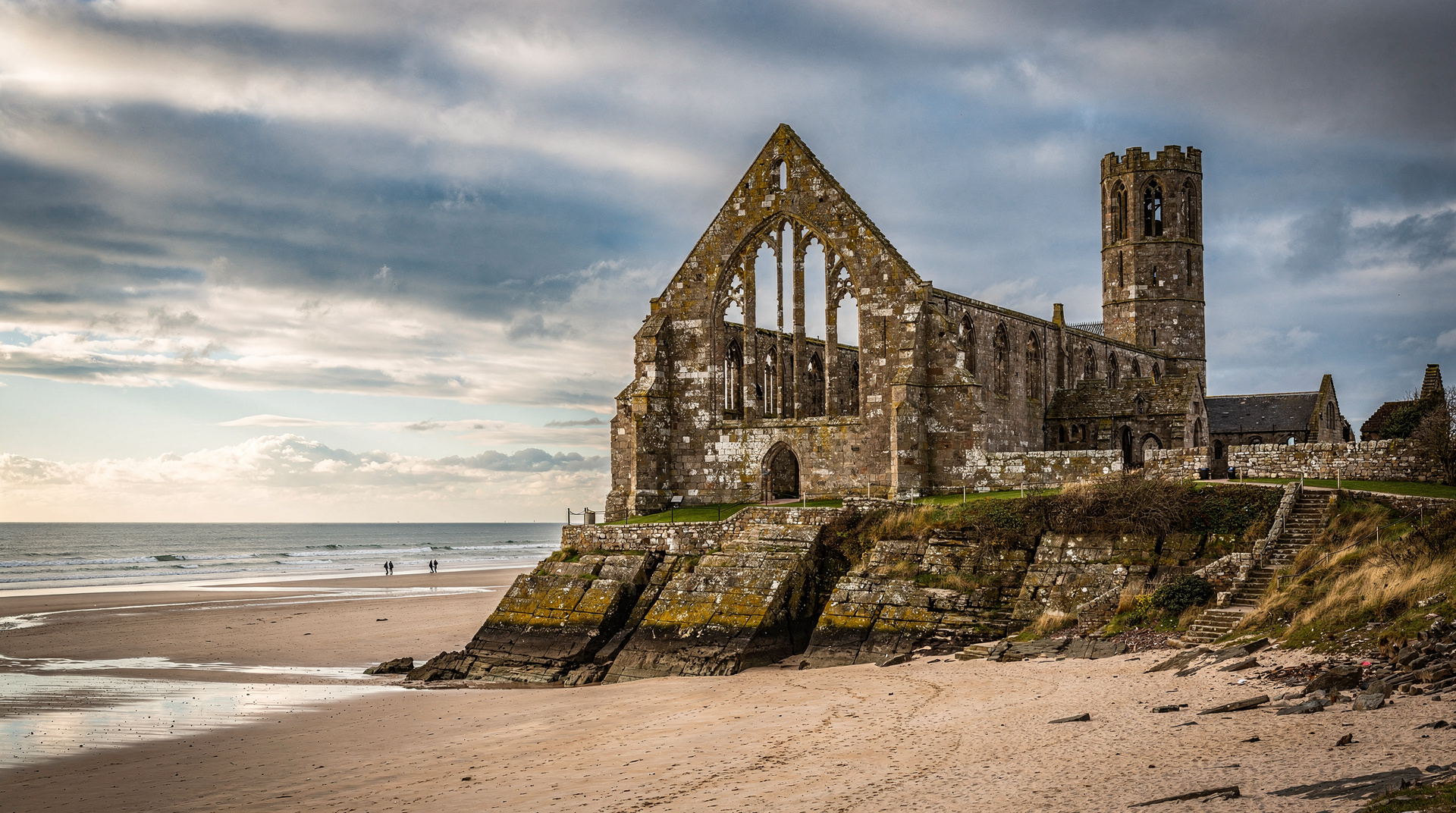
St Monans (or St Monance) is the most westerly village and has the most dramatic setting: the St Monans Parish Church sits on a rock directly above the sea, built in the 14th century by King David II in gratitude after surviving a battle wound. The story is that the arrow that wounded him was miraculously removed near this spot. The church is still in use and open to visitors. The windmill on the coastal path north of the village is a restored salt-panning windmill, one of very few survivors of the once-significant salt industry. Good coastal walking in both directions from the village.
Elie and Earlsferry
Elie is the most resort-like of the East Neuk villages, with a long sandy beach and a sailing bay. It is slightly more self-consciously pretty than the fishing villages further east, but has a good pub (the Ship Inn, which runs outdoor cricket matches on the beach in summer) and an outdoor swimming area. Earlsferry is essentially continuous with Elie. If you have children, the beach here is probably the best base in the East Neuk for an extended stop.
Getting there and getting around
By car: From Edinburgh, the most direct route is the Forth Road Bridge (A90), M90, then A91 toward St Andrews and A917 south along the coast. Anstruther is about 55 miles from Edinburgh — allow 1 hour 40 minutes in normal traffic. Most visitors drive the coastal road from Crail southwestward through the villages, which works naturally with the direction of the road.
Public transport: There is a bus service from St Andrews to Anstruther and through the villages (Stagecoach route 95), but frequency is limited. If you arrive by train to St Andrews (via Leuchars), you can reach the East Neuk by bus, but it requires patience with timetables. A car or guided tour is more practical for visiting multiple villages in a day.
Guided day tours: The St Andrews and fishing villages of Fife day tour from Edinburgh covers St Andrews and the key East Neuk villages in a single day, handling the driving and giving context to the landscape and history. This is the recommended approach for visitors without a car who want to see more than one village.
The St Andrews, Falkland Palace and East Neuk of Fife tour adds Falkland Palace to the itinerary — worthwhile if you want to understand the Fife of the Stuart kings alongside the coastal fishing tradition.
The Fife Coastal Path
The Fife Coastal Path runs 117 miles from Kincardine in the west to Newburgh in the north, but the East Neuk section — roughly from Elie to Crail — is the most accessible and rewarding stretch. The path follows the clifftops and dips through each village, giving views along the coast that are not visible from the road. A popular day-walk is the section between Anstruther and Crail (about 7 miles, 3-4 hours), which can be reversed depending on where you leave a car or catch a bus. Shorter sections around each village’s harbour are walkable in an hour without any commitment to the full path.
The best day trips from Edinburgh guide includes the East Neuk as one of the underrated alternatives to the more crowded Highland day trips. For walking context, see the walks near Edinburgh guide.
Combining with St Andrews and Falkland
The East Neuk works best combined with St Andrews, which is 20-30 minutes north by car. A full Fife day from Edinburgh might look like: depart Edinburgh 9am, arrive St Andrews 10:30am, spend the morning at the cathedral and castle, lunch in St Andrews, drive south to Anstruther by 2pm, fish and chips, walk the harbour, visit the Fisheries Museum or drive through Pittenweem and Crail, and return to Edinburgh by 7pm. That is a full and varied day with no rushing if you leave Edinburgh reasonably early.
Falkland Palace — the Stuart hunting palace in the inland village of Falkland — is 20 minutes from Anstruther by the B9131. It is in the care of the National Trust for Scotland and is one of the finest Renaissance buildings in Scotland, built by James V and visited by Mary, Queen of Scots. If you are interested in Scottish royal history, the detour adds an hour and is well worthwhile. See the related St Andrews guide for more on the northern part of Fife.
Local food and drink beyond fish and chips
The East Neuk food scene is built around what the sea produces, and the quality of raw material is high. Anstruther’s Fish Bar is the headline, but other options are worth knowing.
The East Pier Smokehouse at St Monans processes locally caught fish using traditional smoking methods and sells directly from the premises. Smoked salmon, hot-smoked mackerel, and smoked haddock are available to take away. Worth a stop even if you are not eating there as a meal.
Pittenweem Arts Festival (August): during the festival, private houses across Pittenweem open as temporary galleries showing work by local and visiting artists. The combination of contemporary art in a traditional fishing village is genuinely interesting, and the village is particularly animated during the festival week. If you are in Fife in early August, timing a visit around it is worthwhile.
The East Neuk Golf Club at Anstruther, the Balcomie Links at Crail, and the course at Elie are all playable by visitors at reasonable green fees — more accessible than St Andrews and still proper links golf above the sea.
Understanding the Kingdom of Fife
Fife is referred to as a “Kingdom” — the Kingdom of Fife — not purely out of historical romanticism but because it was historically a distinct territory with a specific royal and ecclesiastical character. The peninsula’s geography (bounded by the Forth to the south and the Tay to the north, with the North Sea to the east) gave it a natural coherence as a political unit. It was the home of the Scottish royal court for much of the medieval period, with Dunfermline as the capital, St Andrews as the ecclesiastical centre, and Falkland Palace as the royal hunting lodge.
This historical identity helps explain why the East Neuk villages have their specific character: they were the working economic base for a court-centred inland territory, providing fish, salt (the salt-panning industry at St Monans was significant), and trade access through their harbours. The crow-stepped gables and harling (roughcast plaster) of the vernacular buildings are the same architectural tradition you see in the Netherlands and Flanders — testament to the trading connections across the North Sea that sustained these towns from the medieval period through the 18th century.
The Fife Coastal Trail in depth
The Fife Coastal Trail officially runs 117 miles from Kincardine to Newburgh, but the East Neuk section between Elie and Crail (roughly 25 miles of the full trail) is what most visitors are referring to when they talk about the trail. It is waymarked throughout, follows the cliff tops and beach paths between villages, and is well-maintained by Fife Council.
For day visitors from Edinburgh, the most commonly walked section is Anstruther to Crail (approximately 7 miles, 3-4 hours including the Cellardyke harbour detour). The path passes through Cellardyke (the eastern part of Anstruther, also with a working harbour), follows the clifftop, and arrives in Crail from the north, giving first views of the harbour from above before descending into the village. This direction (Anstruther to Crail) is recommended because you arrive at Crail’s most photogenic view rather than leaving it.
Connecting with Edinburgh
The East Neuk is not on a direct rail line from Edinburgh, but Kirkcaldy (the main Fife town, 20 minutes north of Anstruther by car) is on the Edinburgh-Aberdeen rail line. Some visitors arrive at Kirkcaldy and take a taxi or the local bus south to the East Neuk. This adds complexity versus the car route but is feasible.
For those using the Edinburgh Pass or planning multiple Historic Environment Scotland sites, Falkland Palace (about 20 minutes inland from Anstruther) and Dunfermline Abbey (35 minutes west) both accept the HES Explorer Pass. The Dunfermline guide covers the western part of Fife; the St Andrews guide covers the northern edge.
The herring boom and what it left behind
The East Neuk villages reached their peak economic importance during the Scottish herring boom of the 18th and 19th centuries. Herring shoals in the Firth of Forth and the North Sea supported a large-scale fishing industry, and the East Neuk harbours were major processing and export centres. At the height of the herring fishery, hundreds of boats worked out of Anstruther and Pittenweem, and fish-gutting girls (many brought in seasonally from Highland communities) processed enormous volumes of fish.
The boom collapsed in the early 20th century as herring stocks declined and East European competition increased. What it left was the harbour infrastructure — the large quays, the fish houses, and the overall scale of the harbours — that were built to handle an industry far larger than anything operating today. This explains why Anstruther harbour, for example, is much larger than you might expect for a contemporary fishing village: it was built for an industry ten times the size of what remains.
The Scottish Fisheries Museum covers this history in detail and is one of the better economic history museums in Scotland. For visitors with an interest in how traditional industries have shaped landscape and settlement, the East Neuk is a good case study — the physical geography of the villages is a direct product of the herring trade.
Wildlife and sea life of the Firth of Forth
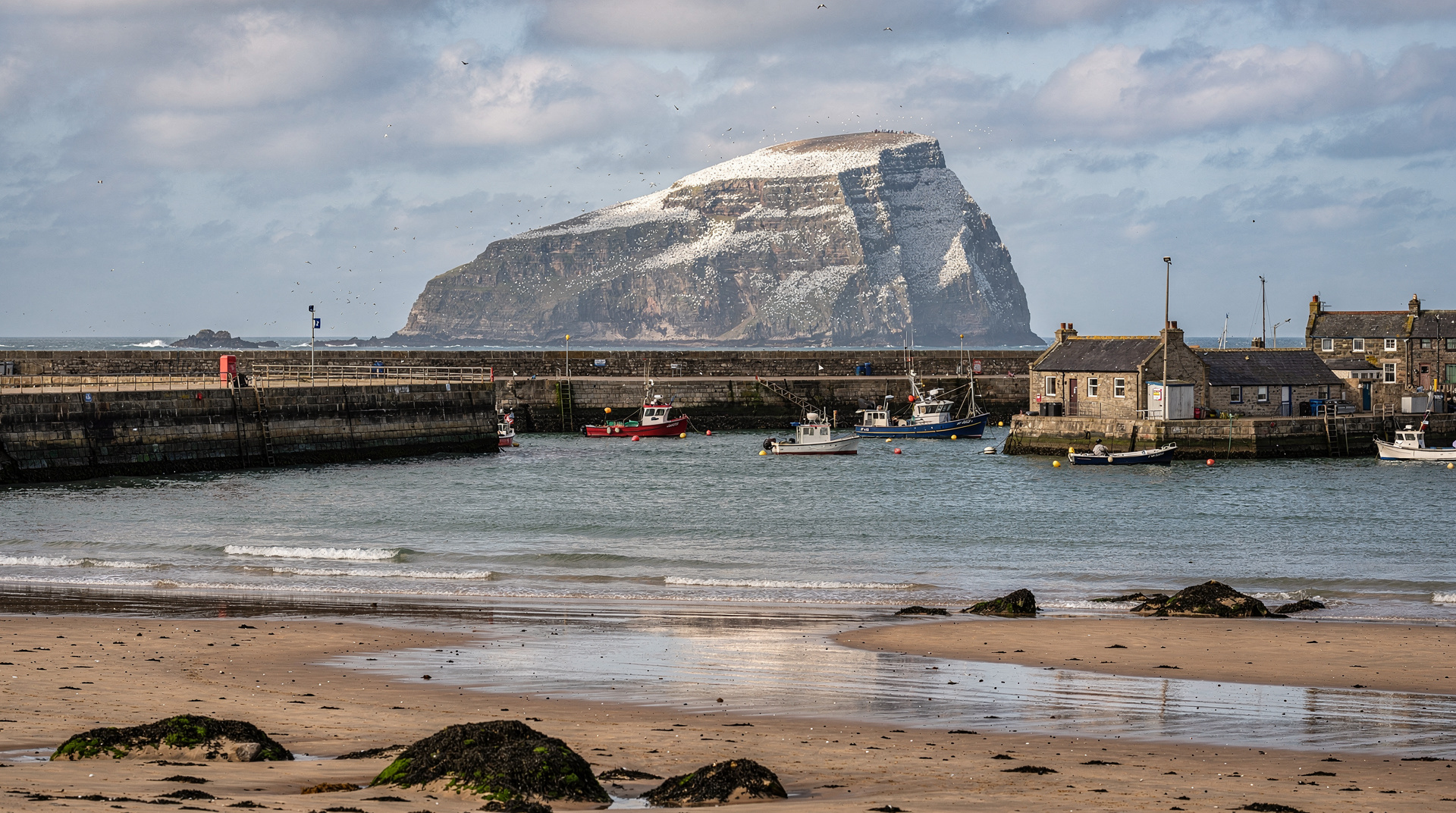
The Firth of Forth, extending from the East Neuk coast west toward Edinburgh, supports significant marine wildlife that most visitors driving between the villages do not notice. Grey seals are resident on several rocky outcrops along the coast and are often visible from the clifftop path sections. Bottlenose dolphins occasionally enter the Forth, particularly in late summer. The gannet colony on Bass Rock (visible from the East Neuk coast on a clear day) is one of the world’s largest, and gannets are commonly seen fishing offshore.
The waters around the Farne Islands (in Northumberland, to the southeast) and the May Island in the outer Firth are both protected reserves with large seabird colonies. The May Island in particular — visible as a low silhouette from the Crail coast on clear days — has puffins, guillemots, razorbills, and a significant grey seal colony. Scottish Seabird Centre boat trips from North Berwick (see the North Berwick guide) occasionally extend to the May Island in season.
Choosing which villages to prioritise
With five villages and a limited day, it helps to know each one’s strength before deciding where to linger.
| Village | Best for | Time to allow |
|---|---|---|
| Crail | Most photogenic harbour, market square | 45–60 minutes |
| Anstruther | Fish and chips, Scottish Fisheries Museum | 1.5–2 hours |
| Pittenweem | Working harbour, arts festival in August | 30–45 minutes |
| St Monans | Clifftop church, salt-panning windmill, coastal walk | 30–60 minutes |
| Elie & Earlsferry | Beach, sailing bay, family stop | 1–2 hours |
If time only allows two or three stops, Anstruther (for lunch and the museum) and Crail (for the harbour photo) are the two most commonly recommended, with Pittenweem as a worthwhile third if the arts festival or the working fish market timing lines up.
For a fully guided version that removes the driving and route-planning entirely, the St Andrews and Fife small-group day tour covers a curated selection of the East Neuk alongside St Andrews.
Planning the day around the rest of your trip
The East Neuk sits comfortably alongside other excursions, so it helps to decide what else is on your list before you commit a full day to it. The St Andrews day trip guide covers the town at the northern end of the route, and the Edinburgh, St Andrews and Fife itinerary shows how the coast and the university town can be spread across several days rather than squeezed into one. If you would rather stay on the south side of the Forth, the North Berwick day trip offers a different kind of coastal outing, with its own harbour, beach and views across the water.
For a wider view of what else is within reach of the capital, the guide to Scottish castles near Edinburgh is useful if Falkland Palace has whetted your appetite for royal history, and the family day trips guide helps if you are travelling with children and want to weigh the beach at Elie against other options. Anyone still deciding how many days to give the city itself will find the how many days in Edinburgh guide a good companion, since a Fife day is easiest to enjoy when the rest of the trip is not rushed.
If you are hesitating between this and a Highland outing, the Edinburgh to the Highlands guide lays out what the longer journeys involve, and the which Edinburgh tour to book guide compares the guided options so you can match the style of day to your own pace. For walkers, a self-guided version of the coast is also available as the Fife coastal trail walking experience from St Andrews, which suits those who would rather spend their time on the path than in a vehicle.
Practical information for 2026
Anstruther Fish Bar: Queue in peak summer; expect 10-20 minutes wait on busy days. Opens around 11:30am daily for lunch. Card payments accepted.
Scottish Fisheries Museum: Open Monday–Saturday 10am–4:30pm and Sunday 11am–4:30pm; closed on Tuesdays from November to March. Admission £11 for adults.
Crail Harbour: Free to visit. The lobster hut operates summer weekends — check locally for current availability.
Parking: Village car parks fill by mid-morning in July-August. Arrive early or walk from the edge of the village.
Weather: East Coast weather — bright in June-September, misty with haar in spring. Windier than it looks. Bring a windproof layer regardless of forecast.
Currency: Pounds sterling (£) throughout. See the Edinburgh currency guide for exchange advice.
UK ETA: International visitors — see the UK ETA guide for requirements.
Frequently asked questions about the East Neuk of Fife
How do I get from Edinburgh to the East Neuk of Fife?
The practical options are car or guided day tour. By car it is about 55 miles, taking 1 hour 40 minutes via the Forth Road Bridge. Public transport is possible — train to St Andrews (change at Leuchars) then bus south — but frequency is limited and you will struggle to visit multiple villages without a car. A guided day tour handles the logistics and is recommended if you do not have a car.
Which East Neuk village is best to visit?
Anstruther is the most complete package — harbour, museum, fish and chips. Crail has the most photogenic harbour. Pittenweem has the most authentic working-harbour feel. For beaches, Elie is the best. Most visitors with a car will drive the coastal road through all five in a day, spending 30-60 minutes in each.
Is the fish and chips at Anstruther really worth making the trip?
Yes, if you like fish and chips. The Anstruther Fish Bar regularly features on best fish and chip lists across the UK, and the quality of the fish (haddock sourced locally, battered fresh) is consistent. It is not cheap by chippy standards, but it is not tourist-trap pricing either. On a warm day, eating on the harbour wall is genuinely pleasant.
Can I walk between the East Neuk villages?
Yes, the Fife Coastal Path connects all five villages. The Anstruther to Crail section (7 miles) is the most popular day walk. The full path between all five villages is about 15-16 miles — long for a day trip but achievable if you start early and arrange transport back from your end point.
What is the Scottish Fisheries Museum?
It is a well-curated museum in Anstruther covering the full history of Scottish fishing, from the earliest coastal communities through the herring boom of the 18th-19th centuries to the modern white fish and shellfish industry. The collection includes boats, equipment, navigational instruments, and personal accounts from fishing families. Worth 90 minutes for anyone with even passing interest in maritime history.
Is the East Neuk worth it without a car?
It is harder but not impossible. Trains reach St Andrews via Leuchars, and the Stagecoach 95 bus runs from there into the East Neuk, but timetables are limited and you will realistically only manage one or two villages rather than the full coastal route. Visitors without a car are better served by a guided day tour such as the St Andrews and Fife small-group tour, which handles the driving between villages.
Top experiences
Bookable activities with verified prices and instant confirmation on GetYourGuide.