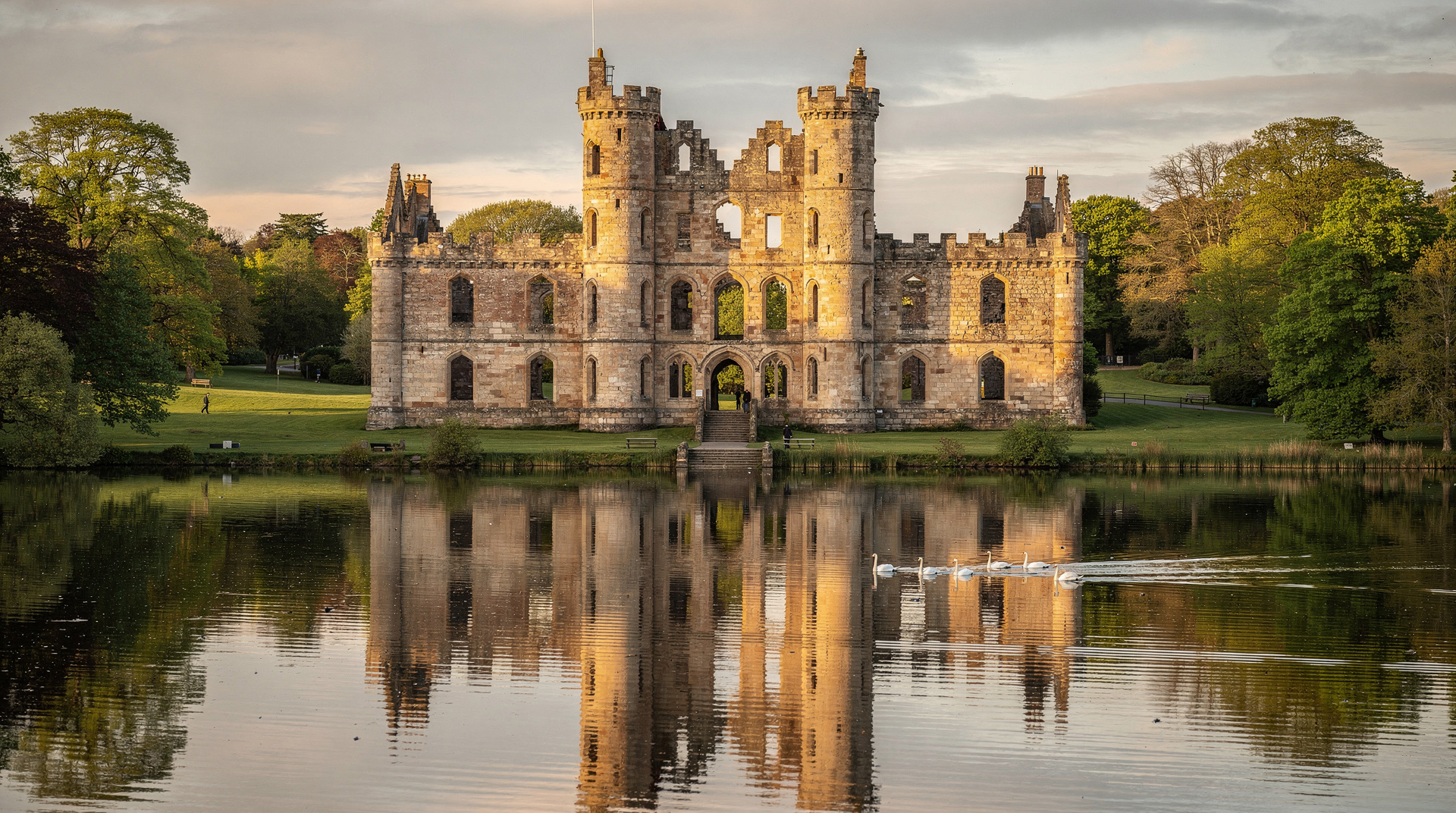
Dunfermline
Dunfermline: Scotland's ancient capital, the royal abbey, the birthplace of Andrew Carnegie, and a half-day trip from Edinburgh in under 30 minutes.
Edinburgh: St Andrews, Dunfermline Abbey & scenic walk tour
Quick facts
- Best time to visit
- Year-round; Pittencrieff Park best in spring and summer
- Days needed
- Half day
- Getting there from Edinburgh
- ~30 min by train from Edinburgh Waverley (Queen Margaret station)
- Budget per day
- £20–£50; abbey free (donations welcome), Carnegie museum free
Scotland’s ancient capital and what remains
Dunfermline was, for roughly three centuries between the 11th and 14th centuries, the capital of Scotland and the burial place of its kings. Twenty-two Scottish royals are buried in or associated with Dunfermline Abbey, including Robert the Bruce — whose heart was buried at Melrose Abbey but whose body lies beneath the present church, marked by a brass inscription in the floor. Malcolm III and his wife Saint Margaret, who effectively established Dunfermline’s importance, are both buried here. It is, in other words, a genuinely significant place in the long story of Scotland, and it sits 30 minutes by train from Edinburgh Waverley.
| Where | Fife, ~16 miles / 30 min by train from Edinburgh Waverley |
| Cost | Around £20–£50/person; abbey free (donations welcome), Carnegie museum free |
| Time needed | Half day (3–4 hours for abbey, palace and museum) |
| Getting there | ScotRail to Queen Margaret station, then a 15-min walk |
| Best time | Year-round; combine with St Andrews for a fuller Fife day |
Most Edinburgh visitors do not go to Dunfermline. This is partly because it lacks the visual spectacle of Stirling or the coastal setting of St Andrews, and partly because it is less heavily marketed. But for anyone with an interest in the medieval history of Scotland — the period when the country was consolidating its identity against English pressure, fighting the Wars of Independence, and producing figures like Robert the Bruce and William Wallace — Dunfermline gives you the primary burial site and one of the most complete monastic complexes in Scotland.
It also happens to be the birthplace of Andrew Carnegie, the steel magnate and philanthropist who was born in a weaver’s cottage here in 1835 and eventually became the wealthiest man in the world before giving most of it away. The Carnegie Museum is free and worth visiting if you find the story of industrial-age philanthropy interesting.
The abbey complex
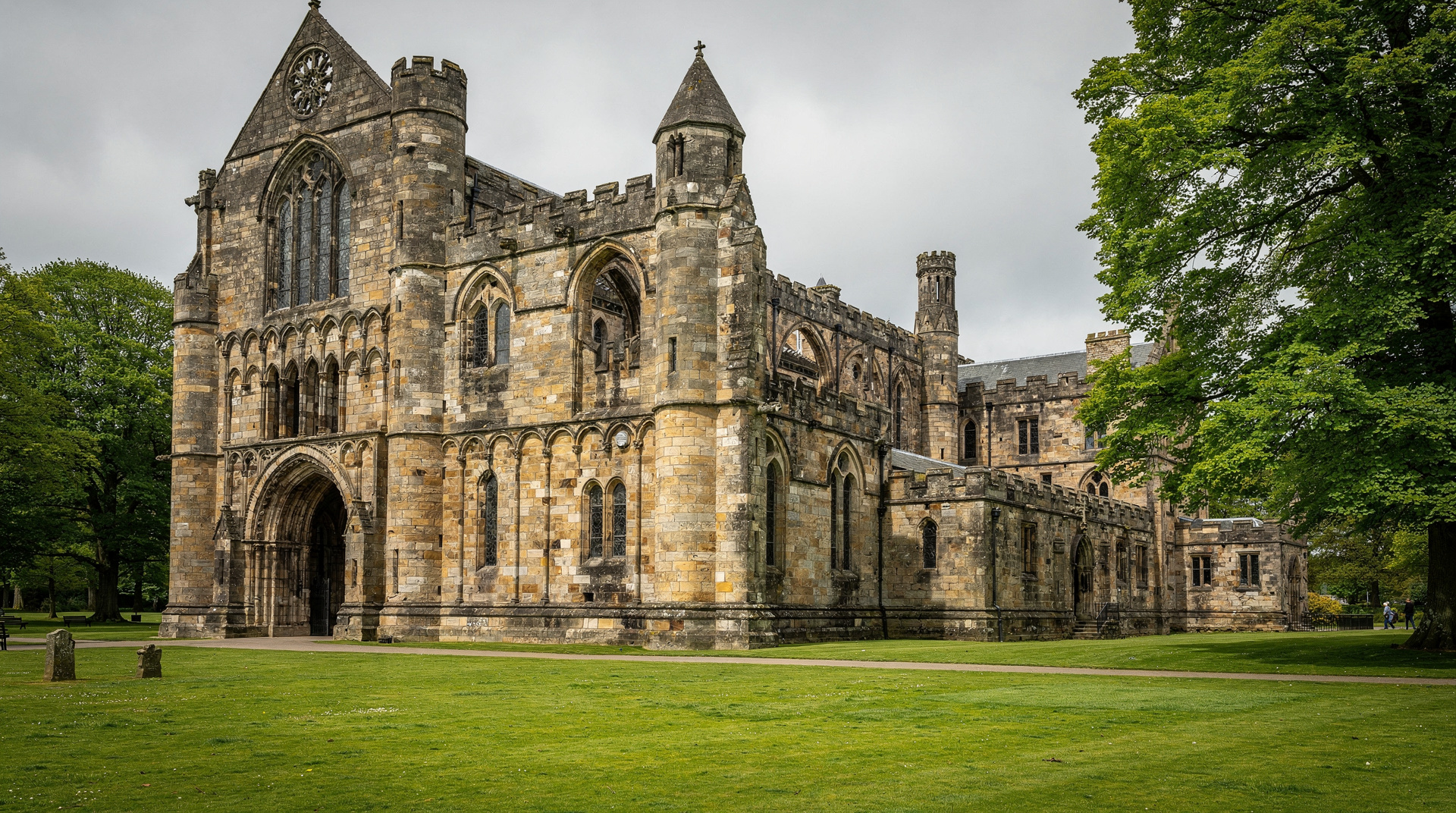
Dunfermline Abbey and Palace complex occupies the high ground at the centre of the town. The complex has three main components: the Abbey Church (still an active parish church), the ruined nave of the medieval abbey, and the remains of the royal palace.
The surviving nave of the medieval Benedictine abbey, begun by Saint Margaret in the 11th century and expanded several times, is a substantial structure — roofless but largely intact in its walls, with massive Romanesque columns similar in style to Durham Cathedral. The adjacent parish church, rebuilt in 1821, incorporates the medieval choir and contains the tomb of Robert the Bruce. Entry to the abbey ruins is free, donations welcome (Historic Environment Scotland); the parish church is free.
The royal palace ruins — built and used by Scottish kings from the 12th century through to the early 17th century, when James VI was born here in 1566 — stand alongside the abbey. The remaining walls include sections of the great hall and the royal kitchens. Charles I was the last monarch born at Dunfermline (1600), which gives the palace a long and directly royal history.
The whole complex, including the gardens and Pittencrieff Park (a public park immediately adjacent, gifted to the town by Andrew Carnegie in 1903), can be explored in two to three hours.
Andrew Carnegie and the museum
Carnegie was born in 1835 in a one-room weaver’s cottage in Moodie Street, which still stands and forms part of the Carnegie Birthplace Museum. The museum is free, run by a charitable trust, and covers his extraordinary story: from a childhood in genuine poverty in Dunfermline, emigration to the United States aged 13, work as a bobbin boy in a cotton mill, rise through the telegraph and railway industries, and eventual creation of Carnegie Steel, which he sold in 1901 for the equivalent of tens of billions of modern dollars.
He then spent the rest of his life systematically giving the money away, building 2,500 public libraries worldwide, including many in Scotland. The Carnegie Library in Dunfermline itself, still operating, was one of the first.
The museum is well-presented and gives a clear account of both his rise and his controversial philanthropy. It sits in the cottage and an adjacent larger building. Allow 60-90 minutes. Entry is free.
Getting there from Edinburgh
Dunfermline is one of the easiest day-trip destinations from Edinburgh: ScotRail runs frequent trains from Edinburgh Waverley to Dunfermline Queen Margaret station, taking around 30 minutes. From the station it is a 15-minute walk to the abbey complex. The service is regular (roughly every 30 minutes) and inexpensive.
By car from Edinburgh, the route via the Forth Road Bridge is approximately 16 miles — allow 35-40 minutes. Parking in the town centre is straightforward on weekdays.
The St Andrews, Dunfermline Abbey and scenic walk tour from Edinburgh combines both Fife destinations in a single day with guided commentary — a good option if you want to understand the historical context of both places and do not have a car.
Combining Dunfermline with other Fife destinations
Dunfermline works well as a half-day addition to a longer Fife visit. The most natural pairing is with St Andrews, about 35 minutes northeast by car (via the M90 and A91). A full Fife day might mean the morning in Dunfermline — abbey, palace, Carnegie Museum — and the afternoon in St Andrews for the cathedral and coastal walk.
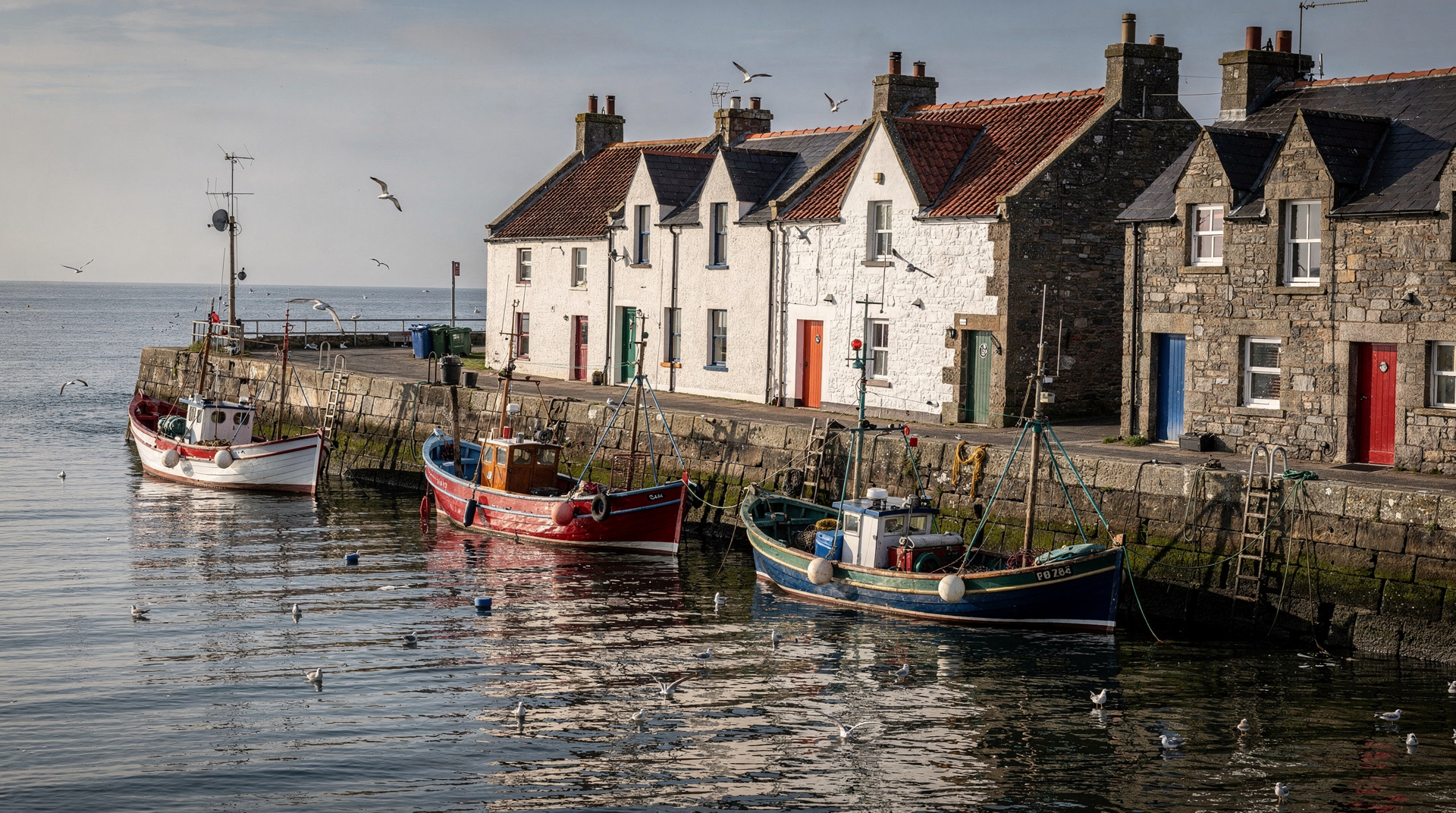
Alternatively, Dunfermline pairs well with the East Neuk fishing villages, driving east from Dunfermline toward Kirkcaldy and then south to Anstruther. This covers more of Fife’s range in a single day — the royal historical capital in the west and the fishing coast in the east.
For those on the Edinburgh-to-Fife trip considering trains, note that Linlithgow (the birthplace of Mary, Queen of Scots) is also on the Edinburgh to Dunfermline rail corridor, making it easy to stop at Linlithgow Palace on the way out or back.
What Dunfermline is not
It is worth being honest: Dunfermline is not a scenic destination. The town centre around the abbey is functional rather than beautiful, and the area south of the abbey complex is a typical post-war Scottish town with nothing remarkable. The attraction is specifically the abbey, the palace ruins, the Carnegie material, and Pittencrieff Park. If you are looking for a picturesque Scottish town with medieval streets and cafés, St Andrews is a better choice. If you are looking for significant royal history and a legitimate claim to be Scotland’s first capital, Dunfermline is genuinely interesting and entirely undervisited.
Saint Margaret and her significance
Saint Margaret is the only Scottish royal to have been canonised by the Catholic Church. She was an English princess — great-niece of Edward the Confessor — who came to Scotland after the Norman Conquest when her family fled England. She married Malcolm III around 1070 and used her influence to bring the Scottish church into closer alignment with Roman practice, introducing continental religious customs and founding the priory at Dunfermline (the precursor to the abbey). She also had a practical social concern, founding hostels for pilgrims and establishing daily feeding of the poor as a court practice.
Margaret died in 1093, three days after her husband was killed in battle at Alnwick — she died, it is recorded, on hearing the news. She was buried at Dunfermline, and her tomb became a pilgrimage site even before her official canonisation in 1249. The abbey that her son David I subsequently built on a much larger scale was in part an expression of filial piety toward her memory.
The story of Margaret is interesting beyond its religious dimension as a story of cultural encounter: the meeting of an Anglo-Saxon princess raised at continental courts with the Gaelic kingship tradition of Scotland, and the synthesis she helped create. The visitor panels at the abbey cover this history in accessible detail.
The story of Scotland’s Wars of Independence
Dunfermline and its abbey are closely bound up with the Wars of Independence (1296-1328), the series of conflicts with England that defined Scottish national identity and produced Robert the Bruce as Scotland’s defining national hero. Edward I of England sacked Dunfermline in 1303, damaging the abbey significantly. Bruce’s patronage of the abbey was in part a conscious act of national symbolism: rebuilding and embellishing the church that had been desecrated by England’s king.
When Bruce died in 1329 and was buried here, it completed a circle: Scotland’s ancient royal burial church had been attacked by the English, restored by Scotland’s greatest king, and now housed his remains. For visitors who want to understand why these ruins matter in a way that goes beyond architectural interest, this context is essential.
The Wars of Independence are covered in the Edinburgh context too — the Jacobites and Edinburgh guide covers the later Jacobite period, while the Edinburgh Castle guide covers the castle’s role in the medieval wars. Dunfermline gives the earlier, foundational chapter.
Getting more from a Fife day
Dunfermline pairs naturally with several nearby destinations. For those specifically following the medieval history of Scotland, the combination of Dunfermline (11th-14th century royal capital), St Andrews (medieval ecclesiastical capital), and Stirling Castle (Renaissance royal court) gives a three-chapter tour of Scottish royal history across different periods and character types. See the St Andrews guide and the Stirling guide for those chapters.
The Edinburgh, St Andrews and Fife four-day itinerary includes Dunfermline in the programme for those who want a structured multi-day Fife trip. The Borders Railway extension from Edinburgh toward Tweedbank (for Melrose) passes through different Lothian and Borders country — see the Scottish Borders guide if you are considering extending south.
For a broader day-trip overview that places Dunfermline in context relative to other Edinburgh-region destinations, the best day trips from Edinburgh guide covers all the main options with honest time and value assessments.
Carnegie’s global legacy and what it means for Dunfermline
Andrew Carnegie’s philanthropic legacy is visible in Dunfermline in concrete ways beyond the birthplace museum. The Carnegie Dunfermline Trust, established in 1903 with an endowment of Carnegie’s Dunfermline estate (including Pittencrieff Park), continues to fund education, the arts, and social welfare in the town. The Carnegie Hall (Dunfermline’s main performance venue), the Carnegie Library, and the Carnegie Leisure Centre all carry his name and funding legacy.
This is worth noting because it gives Dunfermline’s connection to Carnegie a different character from the typical industrial-era philanthropist story: he did not just build libraries worldwide and move on, he established an enduring institution specifically focused on improving life in the town where he was born. For visitors who follow the Carnegie story closely, the Dunfermline Trust’s annual report gives a picture of how an 1890s endowment continues to function in a 21st-century Scottish town.
The broader Carnegie story is best understood as a specifically Scottish-American phenomenon. The mass emigration from Scotland to America in the 19th century created networks of Scottish communities across the United States who retained strong cultural identities and produced an outsized proportion of influential Americans in industry, politics, and culture.
Carnegie is the most famous; Andrew Mellon (banker and art collector), Alexander Graham Bell (inventor of the telephone, born in Edinburgh), and John Muir (environmentalist, born in Dunbar) are part of the same pattern. The National Museum of Scotland in Edinburgh has a good gallery on the Scottish diaspora that gives this context — see the National Museum guide for what to see there.
Abbot House and the medieval town
Abbot House, a 15th-century painted stone building near the abbey grounds, is one of the oldest intact buildings in Dunfermline. It was used in the medieval period as a residence for the Abbey’s lay administration and was restored in the 1990s as a heritage centre. Currently (2026) it operates as a community space; check locally for current exhibition status. The painted exterior — vivid pink harling that is very much the medieval tradition — is distinctive and makes it easy to identify from the street.
The medieval street pattern of Dunfermline — High Street, New Row, Guildhall Street — is substantially intact in its layout if not in its buildings. The town’s medieval prosperity was based on the abbey’s pilgrimage trade and the linen-weaving industry that sustained the town economically long after the Reformation reduced the abbey’s religious significance. Dunfermline was the centre of Scottish linen production from the 17th century and employed most of the town’s population in the industry through the early 20th century. Carnegie’s father was a linen weaver, which is why the family emigrated when the power loom made handloom weaving economically nonviable in the 1840s.
Dunfermline, St Andrews or Stirling: which royal history stop
Fife and Central Scotland offer three distinct “chapters” of Scottish royal history within striking distance of Edinburgh, and visitors with only one day to spare often ask which to prioritise.
| Dunfermline | St Andrews | Stirling | |
|---|---|---|---|
| Era | 11th–14th century royal capital | Medieval ecclesiastical capital | Renaissance royal court |
| Main sight | Abbey, royal palace ruins, royal tombs | Cathedral ruins, castle, university | Stirling Castle, Bannockburn |
| Distance from Edinburgh | ~30 min by train | ~1.5 hrs by car/train+bus | ~1 hr by car or train |
| Setting | Functional town, not scenic | Picturesque coastal town | Dramatic hilltop castle town |
| Best for | Robert the Bruce, medieval royal burials | Golf, cathedral ruins, seaside walk | Castle architecture, Wars of Independence sites |
A guided day combining two of these is a genuinely efficient way to cover a lot of Scottish history: the Scotland medieval history day tour and the Fife coastal trail and St Andrews tour both route through this part of the country and take the planning off your hands if you would rather not drive between the three.
Practical information for 2026
Dunfermline Abbey ruins: Open daily 10am-4:30pm from 1 April to 30 September; Tuesday-Saturday 10am-4pm from 1 October to 31 March (closed Sunday and Monday); closed 25 December to 4 January. The abbey church is a working church, so hours may vary with services. Historic Environment Scotland managed. Entry is free (donations welcome).
Carnegie Birthplace Museum: Open daily 11am-4pm, last entry 3:20pm. Free entry (donations welcome). Highly recommended even for visitors with limited interest in industrial history.
Pittencrieff Park: Free, open daily. Good for a picnic and a loch walk after the abbey visit.
Eating: The town centre has standard café options. The Carnegie Birthplace Museum café is a reasonable choice. For a better lunch, the wine bar and restaurant options on Carnegie Drive near the town centre are more interesting.
UK ETA: International visitors should check the UK ETA guide for requirements.
Currency: Prices in pounds sterling. See the Edinburgh currency guide for exchange advice.
Frequently asked questions about Dunfermline
Why is Dunfermline significant in Scottish history?
Dunfermline was the capital of Scotland from roughly the 11th to the 14th century and the burial site of the Scottish royal dynasty. Twenty-two royals associated with Scotland are buried in or connected to Dunfermline Abbey, including Robert the Bruce, Malcolm III, and Saint Margaret (the only Scottish royal to be canonised). Both James VI and Charles I were born at Dunfermline Palace.
Is Robert the Bruce really buried at Dunfermline?
His body is, yes. His heart was separately buried at Melrose Abbey in the Borders — following his dying wish to have it taken on crusade — but his body was interred at Dunfermline Abbey after his death in 1329. The precise location within the choir was rediscovered in 1818 during construction work and is now marked with a brass plate in the floor of the parish church.
How long should I spend in Dunfermline?
A thorough visit to the abbey ruins, palace, and Carnegie Birthplace Museum takes three to four hours. The abbey complex alone — ruins, church, and grounds — is about two hours. If you are combining with St Andrews or the East Neuk, allow a morning or afternoon here.
Is the Andrew Carnegie museum worth visiting?
Yes, especially if you are interested in Scottish emigrant stories, American industrial history, or philanthropy. Carnegie’s story is extraordinary by any measure — from poverty in Dunfermline to the wealthiest man in the world, and then systematic charitable giving on an unprecedented scale. The museum is free and well-presented.
Can I visit Dunfermline easily from Edinburgh by public transport?
Yes. It is one of the easiest day-trip destinations from Edinburgh: a 30-minute train from Waverley to Dunfermline Queen Margaret, then a 15-minute walk to the abbey complex. Trains run roughly every 30 minutes. No pre-booking needed in most cases.
Is Dunfermline worth it if I only have time for one Fife day trip?
If picturesque streets and coastal scenery matter more to you than royal history specifically, St Andrews is the better single choice. If your priority is genuine, undervisited Scottish royal history — the burial site of Robert the Bruce, Scotland’s medieval capital — Dunfermline delivers that in half the time and at a fraction of the crowds. Combining the two in one day, via the Fife coastal route, is the best option if your schedule allows it.
Top experiences
Bookable activities with verified prices and instant confirmation on GetYourGuide.