St Andrews
Plan your St Andrews day trip from Edinburgh: the cathedral, golf courses, beaches, and honest advice on getting there in 1.5 hours.
Edinburgh: St Andrews and fishing villages of Fife day tour
Quick facts
- Best time to visit
- May–September; July for the Open Championship in some years
- Days needed
- 1 day
- Getting there from Edinburgh
- ~1.5 hrs by train (change at Leuchars) or direct coach
- Budget per day
- £60–£120 self-guided; day tours from £35 per person
What makes St Andrews worth a day trip from Edinburgh
St Andrews is doing several things at once. It is the home of golf in a very literal sense — the Royal and Ancient Golf Club was founded here in 1754, and the Old Course, freely walkable when no tournament is on, is a pilgrimage site for anyone who has ever held a club. It is a medieval cathedral town with some of the most substantial ecclesiastical ruins in Scotland. It is a functioning university town — the University of St Andrews is Scotland’s oldest, dating from 1413, and counts Prince William among its alumni. And it sits on a headland where the North Sea meets the East Sands and the West Sands in a way that makes the light extraordinary on a clear day.
For Edinburgh visitors, St Andrews sits at a sweet spot: far enough to feel genuinely different, close enough to do comfortably as a day trip. The train from Edinburgh Waverley to Leuchars takes about an hour, and the connecting bus into St Andrews runs every 15-20 minutes. By car, the Forth Road Bridge and M90 make it a clean 1 hour 20 minute drive on a quiet morning.
This guide covers the cathedral ruins and castle, the Old Course and golf museum, where to eat without overpaying, the beaches, and whether to go independently or on a guided tour.
| Where | Fife, across the Forth from Edinburgh |
| Time needed | Full day (around 6 hours in town) |
| Cost | £60-120 self-guided; day tours from £35pp |
| Getting there | ~1hr15 by train+bus, or ~1hr20 by car |
| Best time | May-September; avoid Open Championship years for crowds |
Getting from Edinburgh to St Andrews
The standard public transport route is: ScotRail from Waverley to Leuchars (about 55 minutes, roughly every 30-60 minutes depending on time of day), then the no. 99 Stagecoach bus into St Andrews town centre (about 10 minutes). The combined journey takes around 1 hour 15 minutes door-to-door from central Edinburgh. Return fares vary; booking ahead typically saves money. Check Scotrail.co.uk for current timetables and Citylink for the direct X59 coach option.
By car from Edinburgh, the route via the Forth Road Bridge (A90), M90, and A91 is approximately 56 miles. In normal traffic you should allow 1 hour 20 minutes. The town centre has limited parking; the large pay-and-display at Canongate (near the cathedral) is usually the best bet. Parking is charged in summer.
Guided day tours from Edinburgh pick up centrally and drive directly; the St Andrews and fishing villages of Fife day tour is the most popular option, combining St Andrews with the East Neuk coastal villages in a single day.
The ruins: cathedral and castle
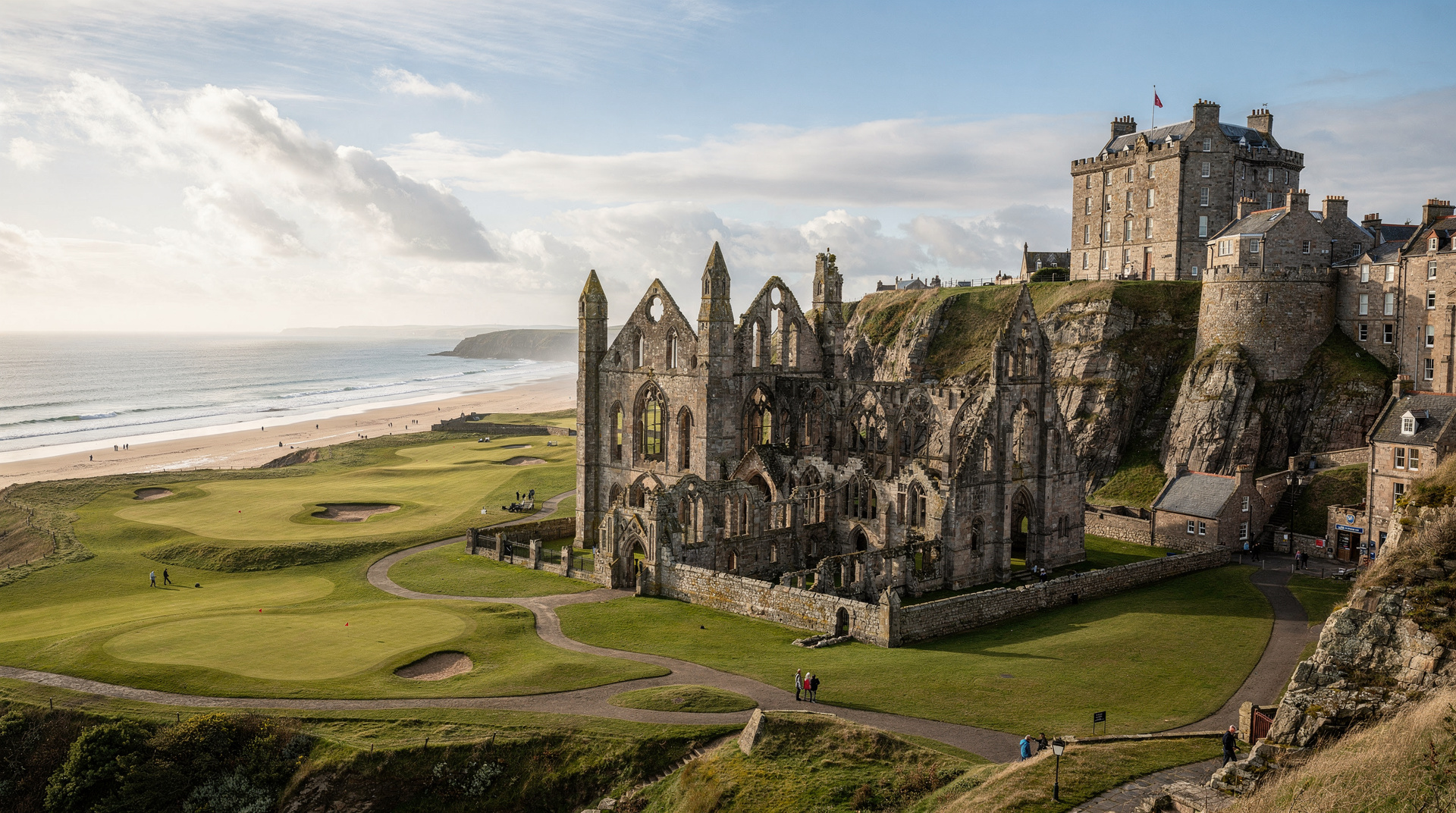
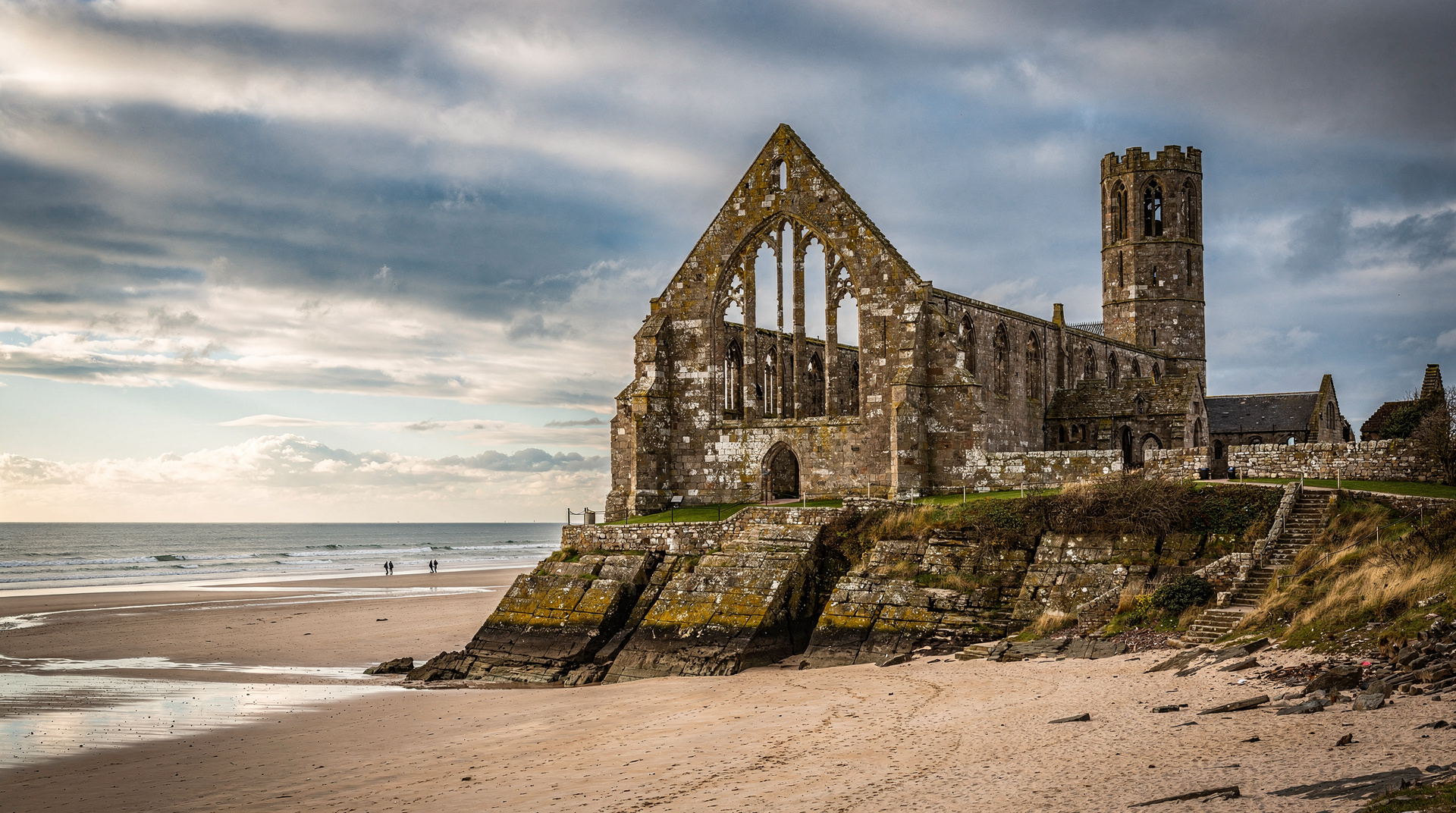
St Andrews Cathedral was, at its completion in 1158, the largest church ever built in Scotland. What you see today is a magnificent ruin — the east gable and sections of the nave walls still standing to full height, giving a visceral sense of the scale of the original building. It was stripped of its roof and fittings during the Reformation in 1559, and decay over the subsequent centuries reduced it to its current state. Historic Environment Scotland manages the site; the grounds are free to visit, and free guided tours (donations welcome) end with a climb of St Rule’s Tower, which predates the cathedral and offers an excellent elevated view over the ruins and the sea. Check the official site for tour availability.
St Andrews Castle, a short walk along the coastal path from the cathedral, is a proper medieval ruin on a sea cliff. What distinguishes it is its bottle dungeon — a bottle-shaped pit carved into the rock into which prisoners were lowered and from which escape was essentially impossible — and the elaborate network of counter-mines beneath the grounds, dug during a 1546-47 siege. The mine and counter-mine tunnel system is walkable and genuinely unusual as a visitor experience.
Both sites are worth two to three hours combined, including the tower climb at St Rule’s and the mine exploration at the castle.
The Old Course and golf heritage
Non-golfers underestimate how interesting the Old Course is as a landscape, particularly outside tournament season when the public right of way across the links allows free access. The course is one of the defining golf landscapes in the world: flat, open, shared fairways, the famous Road Hole (17th), the Swilcan Bridge, and the view back along the course from the 18th green toward the town. If you walk across it on a clear morning before play begins, it makes sense in a way that photographs do not quite convey.
The British Golf Museum, adjacent to the Old Course, covers the history of the game from its origins on the links at St Andrews through to the modern professional game. It is better than you might expect from a specialist museum — the collection is thorough and the building good. See the museum’s official site (R&A World Golf Museum) for the current price. Allow 90 minutes.
Playing the Old Course is possible but requires a ballot, substantial cost (green fees around £220-£295 per person in 2026), and advance planning. The New Course and Jubilee Course are more accessible and significantly cheaper. Most day-trip visitors walk the links rather than play them, which is entirely free.
The town: university quarter and beaches
The medieval street grid of North Street, South Street, and Market Street connects the cathedral precinct at one end with the West Port (a surviving medieval gate) at the other. The streets are lined with university buildings, independent shops, and enough cafés to keep an Edinburgh-level coffee standard. The town is small enough to walk entirely in a comfortable morning.
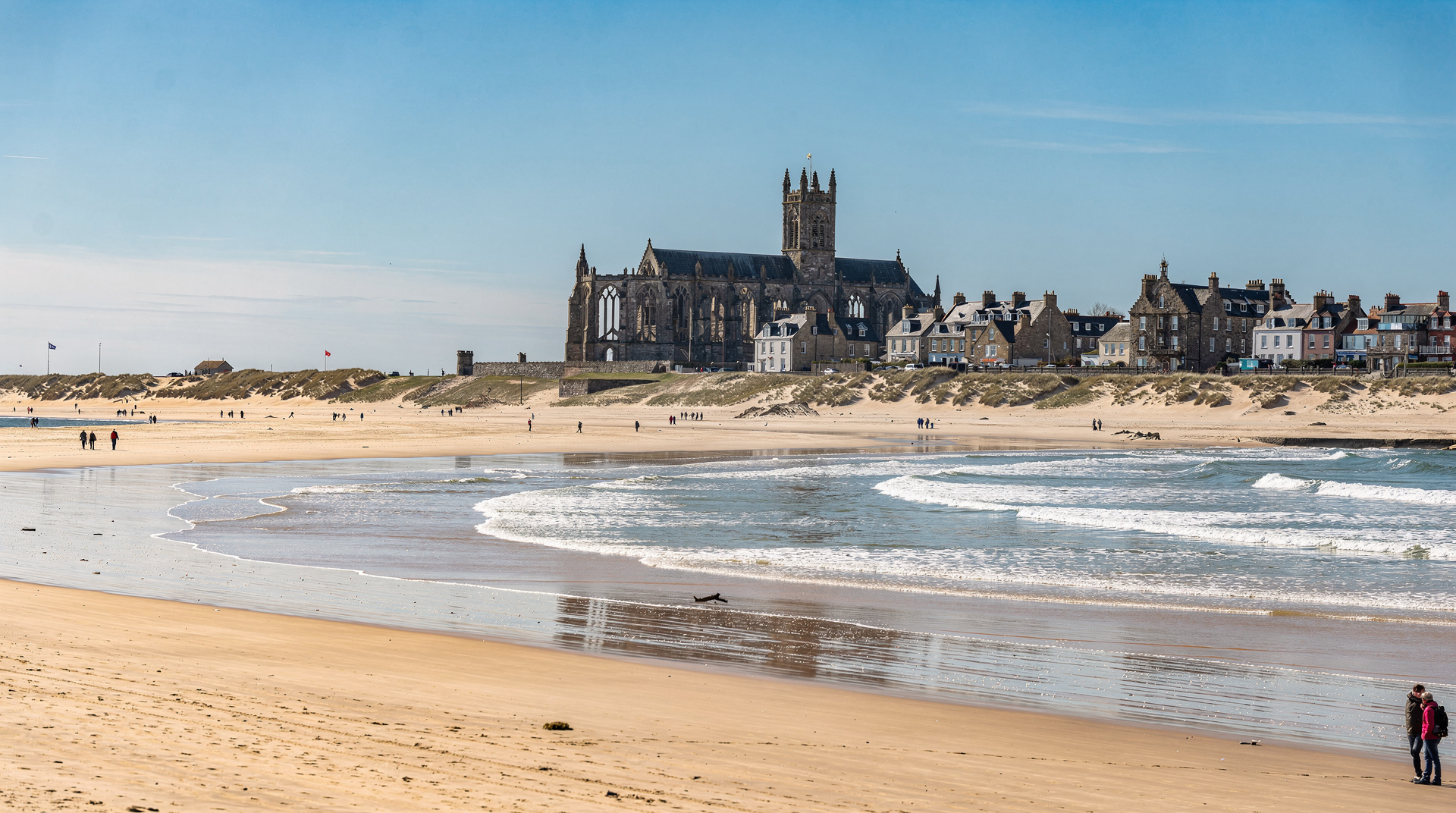
The East Sands is the quieter beach, tucked below the cathedral and castle, sheltered and usually much less busy than the main beach. Good for a walk even in variable weather. The West Sands, the long beach north of the town, was used as the setting for the opening sequence of Chariots of Fire, and extends for about two miles. At low tide it is wide, flat, and genuinely impressive in scale. When the haar (sea fog) rolls in from the North Sea, the beach acquires an atmosphere that is very specifically Scottish East Coast.
For eating, St Andrews has enough independent restaurants that you can do better than tourist-trap pricing. Forgan’s on South Street is reliable for Scottish produce without inflated prices. The Byre Theatre café, Broch, and several coffee shops along Market Street and South Street are solid options for lunch.
Combining St Andrews with the East Neuk
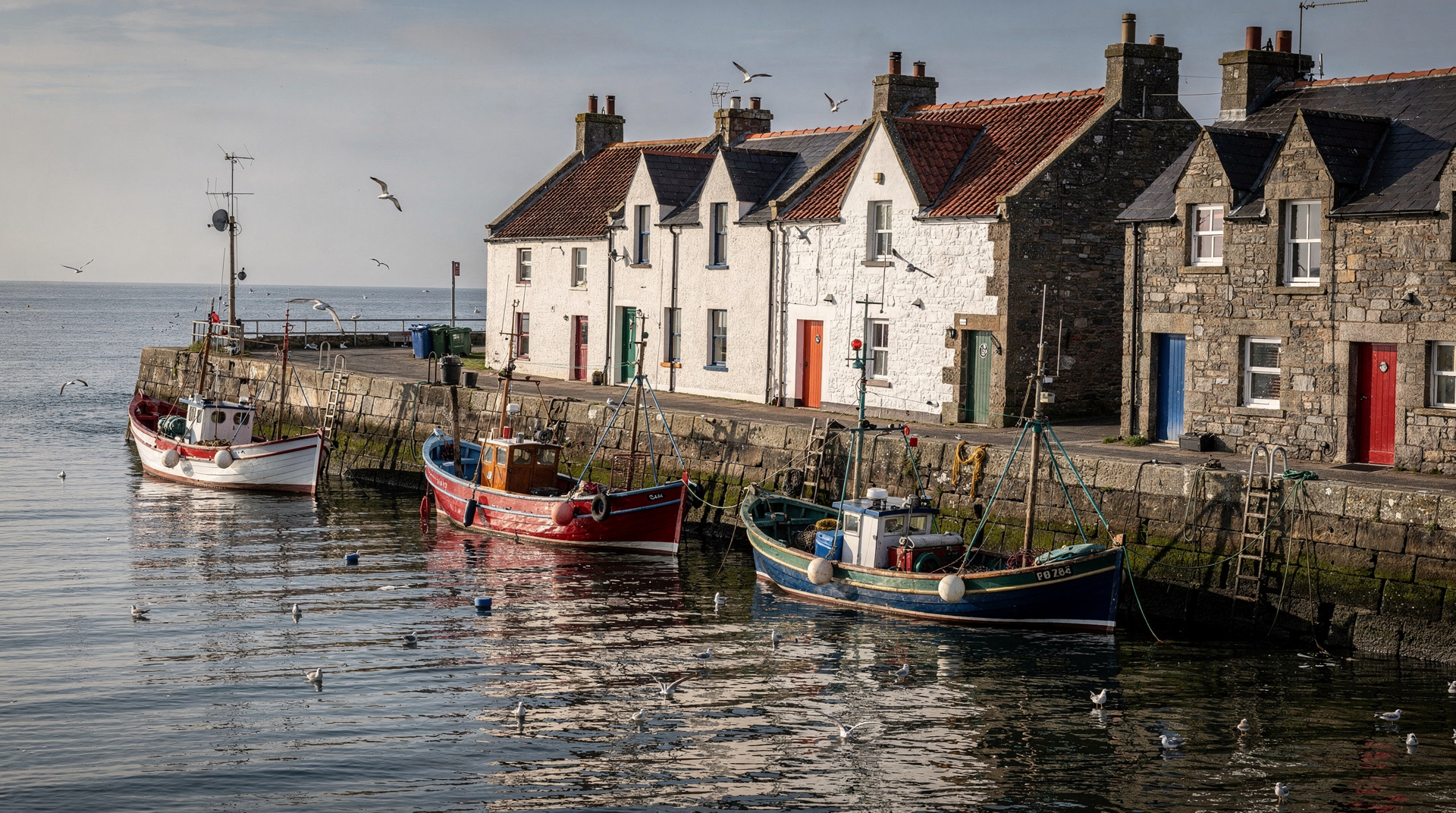
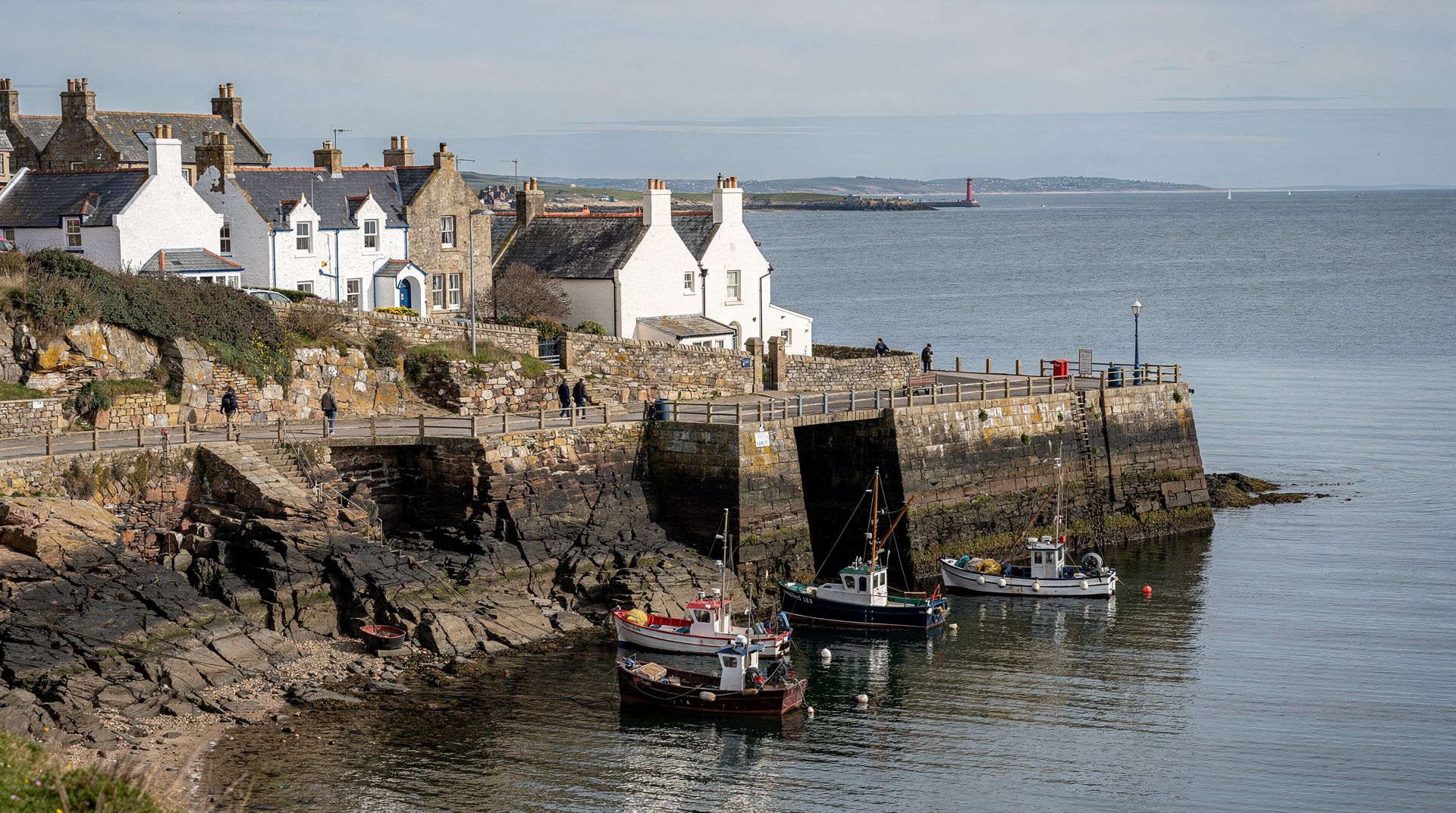
St Andrews makes natural sense combined with the East Neuk fishing villages — Anstruther, Crail, Pittenweem — which are 20-30 minutes south by car along the B9131 and B9171. The East Neuk is a distinct and genuinely beautiful piece of Fife: harbours with boats still working, traditional Scottish vernacular architecture (crow-stepped gables, painted harling), and the Famous Fish & Chip Bar at Anstruther, which claims to be Scotland’s best-rated chippy. If you have a car, the two-site combination is strongly recommended over visiting St Andrews alone.
The St Andrews, Falkland Palace and East Neuk of Fife tour covers all three areas in a guided day — useful if you do not have a car, though the pace will be quicker than a self-drive. Falkland Palace, the hunting palace of the Stuart kings in the inland village of Falkland, adds a different dimension and is worth an hour if it fits your interests in Scottish royal history.
Guided tour vs independent visit
If you are interested primarily in the cathedral and castle, can navigate Scottish trains, and are comfortable walking an unfamiliar town, the independent route is perfectly manageable and gives you freedom over timing. Allow about six hours in St Andrews itself for the cathedral, castle, golf museum, beach walk, and lunch.
If you want to see the East Neuk villages, Falkland Palace, and other Fife highlights in a single day without a car, a guided day tour makes much more sense. The St Andrews and Fife’s fishing villages small-group tour keeps group sizes manageable and covers the coastal villages properly. The small-group format also gives better access to driver-guide commentary on the history of the Kingdom of Fife, which is richer than most visitors realise.
For families or those for whom the drive itself is part of the experience, the drive across the Forth Road Bridge and through the Fife countryside is pleasant — and the views from the bridge over the Firth of Forth, with the Forth Rail Bridge (a Victorian engineering masterpiece, listed as a UNESCO World Heritage Site) visible alongside it, make the crossing worth doing in good light.
Independent vs guided, at a glance
| Independent | Guided day tour | |
|---|---|---|
| Flexibility | Full control of timing | Fixed schedule |
| East Neuk / Falkland | Needs a car | Included on some tours |
| Cost | £60-120 self-guided | From £35pp |
| Commentary | Self-directed (museum panels) | Local guide throughout |
| Best for | Confident with trains, want freedom | No car, want Fife covered in one day |
Getting around once you arrive
St Andrews town centre is compact enough that a car is a liability rather than an asset once you are there — the medieval street grid was never designed for modern traffic, and the pay-and-display car parks fill quickly in summer. Everything covered in this guide (cathedral, castle, Old Course, golf museum, beaches, university quarter) sits within a 15-20 minute walk of the town centre, so plan to park once (or arrive by train and bus) and walk for the rest of the day. Comfortable shoes matter more than in central Edinburgh — the coastal path between the cathedral and the castle and the walk out to the West Sands both involve uneven surfaces.
The Himalayas: St Andrews’ famous putting green
Beside the 18th green of the Old Course, a small, unassuming patch of turf called the Himalayas is one of St Andrews’ most enjoyable low-key attractions. Run by the Ladies’ Putting Club since 1867, it is a wildly undulating 18-hole putting green open to the public for a modest fee (walk-up, no booking, roughly £4-5 per round). It takes 30-45 minutes, is genuinely funny to play badly, and gives non-golfers a way to stand on ground immediately beside the most famous course in the world without a ballot or a green fee running into hundreds of pounds. It is one of the best-value things to do in the town and is easy to miss if you do not know to look for it.
St Andrews Botanic Garden
A short walk south of the town centre on Canongate, the University of St Andrews’ Botanic Garden covers around 18 acres of themed plantings, glasshouses, and a peat garden that is unusual for a garden of its size. Entry costs a few pounds and it is rarely crowded, making it a pleasant, quiet counterpoint to the cathedral ruins and the golf crowds — particularly useful on a day when the wind off the North Sea makes the exposed links and beaches less appealing. Allow 45 minutes to an hour.
Practical information for 2026
Entry costs: St Andrews Cathedral free; St Andrews Castle £10 online (£11 at the gate, £5 for children aged 7-15). For the British Golf Museum, see the official R&A World Golf Museum site. The Old Course and beaches are free to enter.
Opening times: Most sites operate 9:30am-5:30pm in summer, shorter in winter. Check Historic Environment Scotland’s website closer to your visit as hours change seasonally.
Weather: St Andrews sits on the North Sea coast, which means a specific brand of Scottish weather: bright and surprisingly pleasant in June and September, cold and frequently haar-bound in winter. Wind is almost always present on the links. Bring a windproof layer regardless of forecast.
UK ETA: Visitors from many countries now require a UK Electronic Travel Authorisation to enter Great Britain. See the UK ETA guide for details on cost and process.
Currency: All prices in British pounds sterling (£). No euros accepted. See the Edinburgh currency guide for practical exchange advice.
Fitting St Andrews into an Edinburgh trip
St Andrews works well as the day-two or day-three excursion from Edinburgh for visitors spending several days in Scotland. It pairs naturally with a day in Stirling — two very different types of Scottish history — or with a lazy morning in Edinburgh and afternoon departure if you have a flexible schedule. The Edinburgh, St Andrews and Fife four-day itinerary builds a complete Fife programme around the town and surrounding villages.
For day-trip planning across Edinburgh’s wider environs, the best day trips from Edinburgh guide covers the full list with honest time and budget assessments. The St Andrews day trip guide covers the transport logistics in more detail, including train times and advance booking tips.
Related destinations with a similar independent spirit: East Neuk of Fife, Dunfermline, Stirling.
Frequently asked questions about St Andrews
How long does it take to get from Edinburgh to St Andrews?
By train it is about 1 hour 15 minutes, changing at Leuchars for a short bus connection into town. By car via the Forth Road Bridge it takes around 1 hour 20 minutes in normal traffic. Guided day tours from Edinburgh typically take a similar time on the outward journey.
Is St Andrews worth visiting if you do not play golf?
Absolutely. The cathedral ruins are among the best in Scotland, the castle’s bottle dungeon and mine tunnels are genuinely unusual, the beaches are excellent, and the town itself is attractive and compact. Golf adds a layer for enthusiasts but the site works well for anyone interested in Scottish medieval history, architecture, or coastal scenery.
Can you walk on the Old Course at St Andrews?
Yes. There is a public right of way across the links. When the course is not in play — typically early mornings and Sundays — walking across the course is free and permitted. You can cross the Swilcan Bridge, see the Road Hole, and walk the 18th fairway. Check with the R&A for current access restrictions during tournament periods.
What is the best beach near St Andrews?
The West Sands is the main beach — long, flat, impressive at low tide, and famous from Chariots of Fire. The East Sands below the cathedral is smaller, more sheltered, and usually quieter. Both are free and walkable. The West Sands is better for a long walk; the East Sands is better for a quick seaside stop near the ruins.
Is it better to visit St Andrews independently or on a guided tour?
For the town itself and the medieval sites, independently is perfectly straightforward and gives you flexibility. If you want to combine St Andrews with the East Neuk fishing villages or Falkland Palace in a single day and do not have a car, a guided tour is the practical choice. The St Andrews day trip guide breaks down both options with current transport costs.
Where should I eat in St Andrews?
Forgan’s on South Street is a reliable choice for locally sourced Scottish food. The Seafood Ristorante on the Scores (sea cliff road) is excellent but expensive. For lunch on a budget, the cafés along Market Street and South Street serve good sandwiches and soup. Anstruther in the East Neuk (if you are combining destinations) has the Famous Fish and Chip Bar — genuinely worth the 20-minute drive south.
What else can I see near St Andrews in Fife?
The East Neuk fishing villages (Anstruther, Crail, Pittenweem) are 20-30 minutes south by car and make a natural pairing. Falkland Palace, the Stuart hunting palace, is about 20 minutes inland. Dunfermline, Scotland’s ancient capital with its royal abbey, is 35 minutes west. See the East Neuk of Fife guide for the coastal villages and the Dunfermline guide for the western part of Fife.
Is there anything fun to do in St Andrews if I’m not playing golf and don’t want ruins?
Yes — the Himalayas putting green beside the Old Course is a genuinely enjoyable, low-cost activity for non-golfers (around £4-5, no booking needed), and the Botanic Garden south of the centre gives a quiet, uncrowded hour away from the main sights. Both pair well with a beach walk on the West Sands.
Do I need a car once I arrive in St Andrews?
No. The town centre is compact and entirely walkable — the cathedral, castle, Old Course, golf museum, beaches, and university quarter are all within a 15-20 minute walk of each other. A car is only useful if you plan to continue on to the East Neuk villages or Falkland Palace afterwards; otherwise, arriving by train and bus and walking for the day is simpler than dealing with St Andrews’ limited summer parking.
The university and academic life
The University of St Andrews, founded in 1413, is the oldest university in Scotland and the third oldest in the English-speaking world. It has approximately 9,000 students and a reputation disproportionate to its size — consistently ranked among the top ten UK universities and internationally known partly due to the attendance of Prince William and Catherine Middleton, who met here as students. The university population gives the town a different energy from purely heritage tourist destinations; the cafes, bookshops, and the general atmosphere are calibrated to a student population as much as a visitor one.
The main university buildings face onto North Street and College Street. The Younger Hall — the main graduation hall — has tours during certain periods. St Salvator’s Chapel, the university’s principal chapel built in 1450, is among the oldest buildings in the university and is open to visitors. The entrance forecourt of St Salvator’s contains the initials of Patrick Hamilton, the first Scottish Protestant martyr, burned at the stake on this spot in 1528 — students traditionally avoid stepping on the initials for fear of exam failure.
The Bute Medical Building and the School of Chemistry on North Street are notable modern buildings integrated into the medieval street. The contrast between the medieval core, the Victorian buildings, and the occasional piece of contemporary architecture gives the university a pleasant visual variety.
Planning around the Open Championship
The Old Course at St Andrews has hosted the Open Championship more than any other venue. When the Open is at St Andrews (it rotates among courses — the last St Andrews Open was 2022 and the next is scheduled for 2030), the town becomes one of the busiest places in the UK, with over 200,000 people attending during the week. Accommodation prices triple or quadruple. If you are planning a visit during an Open year, be aware of the impact on town centre access, accommodation, and the general experience.
In non-Open years, the town is entirely manageable even in peak summer, though weekends in July-August can see significant coach tour groups at the cathedral. The golf tourism around the Open creates residual interest throughout the year.
St Andrews in Scottish history: the Reformation
St Andrews played a central and violent role in the Scottish Reformation of the 1560s. The archbishop of St Andrews, Cardinal David Beaton, was assassinated in his castle in 1546 — his attackers then held the castle for a year before being taken by a French fleet and sent to the galleys (John Knox, the future Reformation leader, was among the prisoners). Knox later returned to Scotland and preached at St Andrews in 1559, directly triggering the destruction of the cathedral and the Augustinian priory in one of the most significant acts of iconoclasm in Scottish history.
The ruins you see today are largely the result of that episode and the subsequent centuries of neglect — the cathedral was used as a quarry for building material in the town. The destruction was thorough: of what had been Scotland’s largest and most lavishly furnished church, almost nothing survives except the stone structure. The visitor experience at the ruins is, in part, a meditation on what iconoclasm means in practice — not just the removal of images but the systematic dismantling of an entire visual culture.
Top experiences
Bookable activities with verified prices and instant confirmation on GetYourGuide.