North Berwick
North Berwick from Edinburgh in 40 minutes: puffin boat trips to Bass Rock, Tantallon Castle, the best beaches in East Lothian, and honest visitor tips.
Edinburgh: puffin boat trip & Tantallon Castle (North Berwick)
Quick facts
- Best time to visit
- May–August for puffins; June–September for beaches
- Days needed
- Half day to 1 full day
- Getting there from Edinburgh
- ~40 min by direct train from Edinburgh Waverley
- Budget per day
- £30–£70; Tantallon Castle £7.50
The best short escape from Edinburgh
North Berwick is, on any objective assessment, one of the best half-day trips available from a British city. A 40-minute direct train from Edinburgh Waverley deposits you in a small East Lothian seaside town with a Victorian high street, two beaches, a seabird centre, one of Scotland’s most dramatically positioned castles, and the possibility of watching puffins at close range from a boat. The whole thing costs almost nothing if you bring your own lunch — a return train ticket and a walk along the beach are the core of the experience.
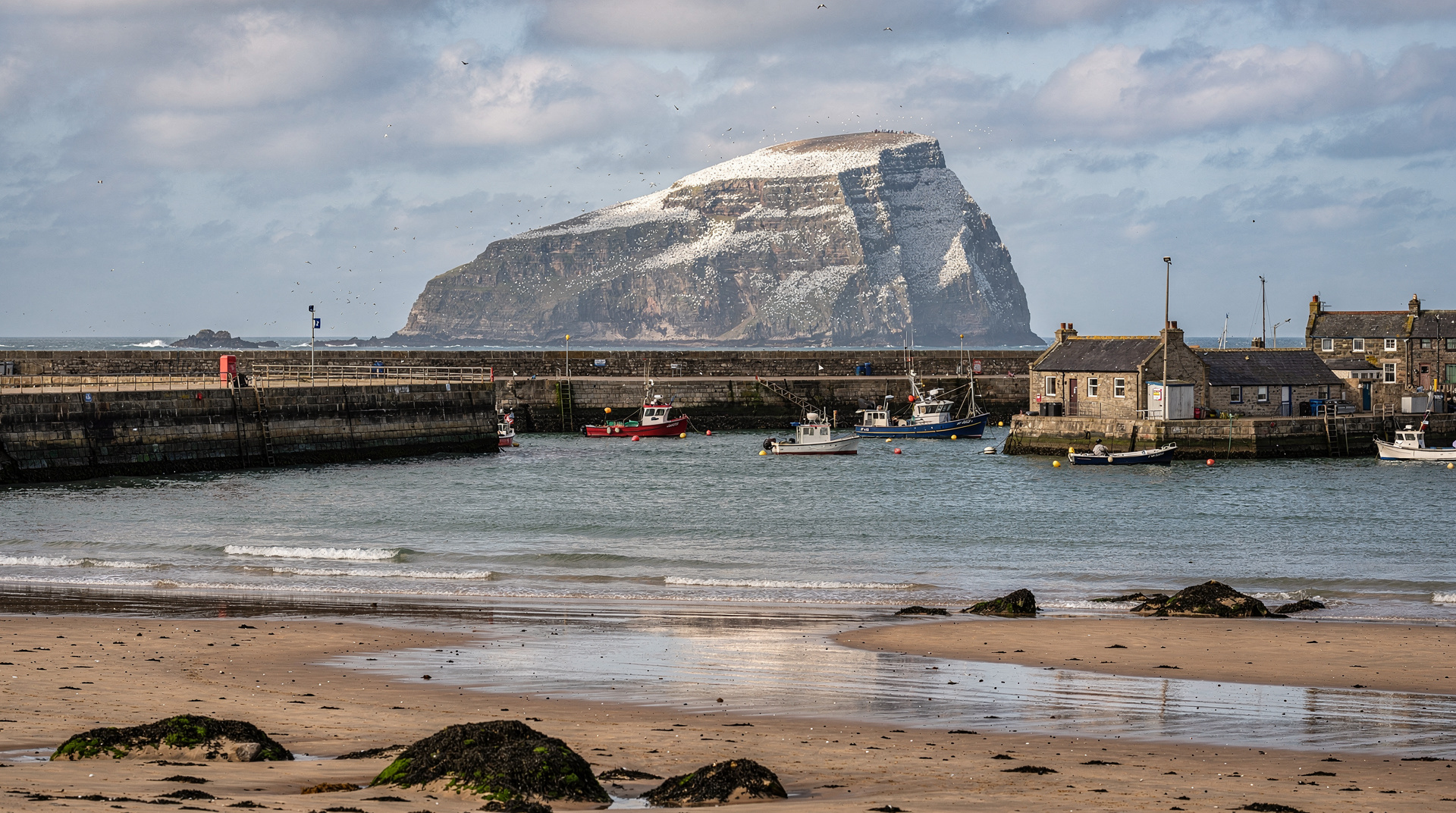
Most Edinburgh visitors who end up at North Berwick arrive because they have read about Bass Rock — the volcanic plug island 2 miles offshore that supports the world’s largest single-rock gannet colony. Around 100,000 gannets nest on Bass Rock between January and October, turning the black rock white with birds. Boat trips from North Berwick Harbour run May through September, weather permitting, and allow close-up views of the gannet colony and, in the right season, puffins.
The rest of the day — Tantallon Castle, the beaches, the town — fills out naturally around the boat trip.
| At a glance | |
|---|---|
| Where | East Lothian coast, about 25 miles east of Edinburgh |
| Time needed | Half day to a full day |
| Getting there | ~40 min direct train from Edinburgh Waverley |
| Typical cost | £30–£70 including train, boat trip and castle entry |
| Best time | May–August for gannets and puffins; June–September for beach weather |
| Do not skip | Tantallon Castle — the clifftop setting is genuinely dramatic |
Getting from Edinburgh to North Berwick
ScotRail runs direct trains from Edinburgh Waverley to North Berwick, taking about 40 minutes. Services run roughly every hour during the day; frequency increases in summer. The station is in the town centre, a short walk from the harbour. Return fares are typically £10-£18 depending on when you book.
By car the route is the A1 east from Edinburgh, then the A198 coastal road to North Berwick — about 25 miles and 45 minutes in normal traffic. Parking in the town centre fills quickly on summer weekends; the beachside car parks are larger but still busy on fine days.
The puffin boat trip and Tantallon Castle tour from Edinburgh is the recommended option if you want to combine the boat trip and castle visit with an organised day from the city — it handles the logistics and gives wildlife commentary on the Bass Rock crossing.
Bass Rock: gannets and puffins
Bass Rock is the main event for many visitors. The Northern gannet colony here is one of the largest in the world — visible from the shore as a white mass on an otherwise black volcanic island. The noise and smell from the colony are remarkable even at a distance; up close, by boat, the visual spectacle is extraordinary.
The Scottish Seabird Centre in North Berwick Harbour runs seasonal boat trips to Bass Rock from May through September (weather and sea conditions permitting). The standard option is a circumnavigation of the island, which brings you close enough to see the birds in detail and to appreciate the scale of the colony. Landing trips are available on some departures but require advance booking and are more expensive. Current fares are on the official Scottish Seabird Centre website.
Puffins at North Berwick: Puffins nest on the Craigleith island (visible from the beach) and around the Firth of Forth area, though Bass Rock itself is primarily gannets. The Scottish Seabird Centre operates specific puffin-watching boat trips in May-July when the colonies are active. If puffins are your specific interest, confirm with the centre before booking which trips include the puffin breeding areas.
The Seabird Centre also has a shore-based observation deck with live cameras pointed at the Bass Rock colony — useful if sea conditions prevent boat trips. Current entry prices are on the official Scottish Seabird Centre website.
Tantallon Castle
Tantallon Castle sits on a sea cliff 3 miles east of North Berwick and is one of the most dramatically positioned castle ruins in Scotland. The massive curtain wall — 15 feet thick, 50 feet high, built from red sandstone — faces inland across a dry ditch, while behind it the castle sits on a cliff with three sides dropping sheer to the sea. It was built in the late 14th century as the seat of the Red Douglases and was besieged repeatedly, including by James V in 1528. It was finally destroyed by Cromwell’s forces in 1651.
The ruins today show the full height of the curtain wall and tower, and the interior has enough surviving structure to understand the original layout. The view from the clifftops — Bass Rock to the northeast, the Firth of Forth, the Fife coast in the distance — is exceptional. Entry is £7.50 for adults when booked online (Historic Environment Scotland).
Getting from North Berwick town to Tantallon without a car requires a 3-mile walk along the coastal path or a taxi. The coastal path is pleasant and takes about 45-60 minutes each way. By car it is 10 minutes.
The town and beaches
North Berwick itself is a well-kept Victorian seaside town with a High Street of independent shops, a good fishmonger, and several decent cafés and restaurants. The Steampunk Coffee on Quality Street is reliably good. For lunch, the Lobster Shack (seasonal, outdoor) beside the harbour serves fresh-caught seafood at reasonable prices; the Kafe Sorrento on High Street is a consistent and popular option.
The East Beach is the main sandy beach, directly in front of the town — long, East Lothian flat-sand quality, clean. In good summer weather it is genuinely beautiful and relatively uncrowded compared to beach destinations closer to major cities. The West Bay is smaller and more sheltered.
Between the two beaches is the North Berwick Law — a volcanic hill (187 metres) with a path to the top offering panoramic views over the town, the Firth of Forth, and East Lothian. The walk takes about 45 minutes return and the summit has a whalebone arch (replica of the original). It is worth doing in clear conditions.
Combining North Berwick with East Lothian
North Berwick sits at the heart of East Lothian, which has more to offer than most Edinburgh visitors realise. The John Muir Way (a long-distance coastal path) passes through the area; the medieval town of Haddington (15 minutes inland by car) is pleasant; Dirleton Castle (a 13th-century ruin in a village 3 miles west of North Berwick) is a good second castle visit if you are not going to Tantallon.
For those combining North Berwick with the Borders coast — Dunbar and Alnwick/Northumberland to the south and east — the Alnwick and Northumberland guide continues the coastal journey. The North Berwick day trip guide covers the transport and timing in more detail.
If you would rather not juggle timetables, a guided day taking in North Berwick, Dunbar and Alnwick strings the coast together in one go. Travellers who want castles and sandy beaches without driving can also look at an organised East Lothian tour of beaches and castles. Both suit people who prefer to be driven and told the story along the way. For a wider choice of excursions, the which Edinburgh tour to book guide and the scottish castles near Edinburgh guide help you compare options.
East Lothian’s wider attractions
North Berwick is the jewel of East Lothian, but the county has a surprising amount to offer beyond the town itself. East Lothian is Scotland’s sunniest and driest county — a meteorological fact that has made it a market gardening and agricultural heartland, and gives it a different character from the Highland landscapes tourists typically associate with Scotland.
Dirleton Castle, about 3 miles west of North Berwick on the B1345, is a 13th-century castle ruin managed by Historic Environment Scotland (entry £4.50 online while part of the ruins is closed for conservation work). It is smaller and less dramatic than Tantallon but set in a pleasant village with a village green and a good pub (the Open Arms Hotel). Worth a 45-minute stop if you are exploring the area by car.
Gullane Bents is a sequence of sandy beaches west of North Berwick, with the Muirfield golf course (one of the Open Championship venues) running behind the dunes. The beach is wider and less busy than North Berwick’s and has a good beach car park.
Haddington, the East Lothian county town about 15 miles southwest of North Berwick, is an attractive Georgian market town on the River Tyne with a very complete medieval church (St Mary’s Collegiate Church — known as the “Lamp of Lothian” — is the longest parish church in Scotland). It is worth 90 minutes if you enjoy well-preserved market towns and have transport.
Dunbar, south along the A1, is a working coastal town with a ruined castle harbour and the birthplace of John Muir (the Scottish-American naturalist who founded the US national park movement). The John Muir Birthplace museum is free.
East Lothian also pairs naturally with the rest of the Edinburgh region. If you are building a longer stay, the Edinburgh in 2 days itinerary and the Edinburgh in 3 days itinerary leave room for a seaside half day, while Leith and Portobello offer a gentler taste of the Forth coast closer to the city. Whisky drinkers can also read about distilleries near Edinburgh before choosing how to fill the rest of the day.
Golfing on East Lothian links
East Lothian calls itself “Golf Coast” and the claim is not entirely marketing hype: the county has more golf courses per capita than anywhere in the world except perhaps Fife. The links courses along the coast — Muirfield (private, limited access), North Berwick West Links (municipal, very playable), Glen Golf Club, Gullane No. 1, 2, and 3, and several others — range from prestigious to thoroughly accessible. For visitors who play, North Berwick’s West Links course (the town’s municipal course, playable by visitors) is a genuine links experience at a reasonable price without needing to book months ahead. Green fees vary from about £30 to £100 depending on the course and season.
The best day trips from Edinburgh guide includes North Berwick in the coastal day-trip section. The broader Portobello Beach guide covers Edinburgh’s own coastal option for those who want a seaside experience without the train journey.
The North Berwick Witch Trials
North Berwick has a darker historical chapter worth knowing about. In 1590, a large group of people — mostly from East Lothian — was accused of witchcraft in the so-called North Berwick Witch Trials, one of the most famous witch trial cases in Scottish history. The accused were charged with attempting to murder King James VI (later James I of England) by raising a storm to sink his ship as he returned from Denmark with his new bride. The trial was politically motivated and involved torture to extract confessions, but it genuinely gripped James VI, who wrote a treatise on demonology partly inspired by it.
The trials are significant for their historical influence: James VI’s personal obsession with witchcraft shaped the witch-hunting culture he brought to England when he took the English throne in 1603, and his Daemonologie (1597) directly influenced the witch-hunt climate that Shakespeare drew on for Macbeth. North Berwick’s connection to this history is commemorated in the town’s witchcraft museum material and local heritage panels.
If the history of the accused interests you, the witches of Edinburgh guide follows the same chapter of Scottish belief and persecution back in the capital.
Whale watching and marine wildlife
The Firth of Forth and the waters around Bass Rock support a wider range of marine wildlife than most Edinburgh visitors realise. The Scottish Seabird Centre runs marine wildlife boat trips specifically targeting cetaceans — bottlenose dolphins, harbour porpoise, minke whale, and occasional orca pass through the outer Forth. These trips are seasonal (summer) and weather-dependent, but the wildlife potential justifies the trip for anyone with a serious interest in marine mammals.
The gannet colony on Bass Rock is itself a significant wildlife spectacle. An estimated 100,000+ Northern gannets use the island as a breeding colony annually, making it the largest accessible single-rock gannet colony in the world. Gannets are dramatic birds — up to 2 metres wingspan, diving from height at up to 100km/h to catch fish — and the sound and density of the colony at close range on a boat trip is a genuinely immersive wildlife experience.
North Berwick season by season
Timing matters more here than for most Edinburgh day trips, because the headline attraction — the Bass Rock boat trips — is genuinely seasonal.
| Season | Boat trips | Wildlife | Beach |
|---|---|---|---|
| Jan–Apr | Limited or none | Gannets begin returning to Bass Rock from February | Cold, quiet, good for a bracing walk |
| May–Jul | Full schedule | Peak gannet activity; puffin viewing at its best in May–June | Improving but still cold for swimming |
| Aug–Sep | Full schedule, booking recommended | Gannets still present in large numbers; puffins mostly dispersed by August | Warmest sea temperatures of the year |
| Oct–Dec | Reduced or weather-dependent | Gannets departing; some resident birds year-round | Bracing, uncrowded, dramatic in a storm |
For a first visit with wildlife as the priority, May to early July is the honest recommendation — it is the only window that reliably combines gannets, puffins, and settled enough weather for the crossing to run.
Fitting North Berwick into an Edinburgh itinerary
Check the forecast the evening before; the Edinburgh weather guide explains how quickly conditions change, and the best time to visit Edinburgh guide helps you decide which season suits a coastal outing. Trains and buses are covered in the getting around Edinburgh guide, and the Edinburgh train day trips blog post shows how North Berwick compares with other rail-friendly escapes.
North Berwick works well as a half-day addition to an Edinburgh city day. Leave Edinburgh mid-morning after a city-centre morning, arrive North Berwick for lunch, do the seabird centre and a beach walk in the afternoon, and be back in Edinburgh for the evening. The train frequency makes this flexible — you can leave when ready rather than planning around a single service.
For families, the combination of the beach and the seabird centre is particularly well suited to children: the seabird centre has interactive exhibits, the boat trips give a wildlife experience at a level children enjoy, and the beach at North Berwick is safe and clean. The family day trips from Edinburgh guide gives more detail on age appropriateness for the boat trips and timing recommendations.
For day-trip planning across all Edinburgh-region destinations, the best day trips guide covers North Berwick alongside Rosslyn, the Borders, and the Fife coast with honest comparative assessments. The North Berwick day trip guide covers transport logistics, current boat trip prices, and how to combine North Berwick with Tantallon and Dirleton in a single day.
Practical information for 2026
Boat trips: Book in advance for summer weekends. The Scottish Seabird Centre (seabird.org) handles bookings. Weather cancellations are possible — the centre will rebook or refund.
Tantallon Castle: Check Historic Environment Scotland website for current opening times. Generally open April-September daily 9:30am-5:30pm; shorter winter hours.
Timing: Arrive early morning on summer weekends to get parking. Weekday visits are significantly quieter.
Currency: Everything in pounds sterling (£). See the Edinburgh currency guide for practical advice.
UK ETA: If visiting from outside the UK, check the UK ETA guide for requirements.
Frequently asked questions about North Berwick
How long does it take to get from Edinburgh to North Berwick?
About 40 minutes by direct train from Edinburgh Waverley. Services run roughly every hour. By car it is 25 miles and takes about 45 minutes. North Berwick is the closest significant seaside destination from Edinburgh.
When is the best time to see puffins at North Berwick?
Puffins are present in the Firth of Forth area from late April through July. Peak viewing on boat trips is May to early July when the breeding season is at its height. After July the birds begin dispersing. The Scottish Seabird Centre advises on current puffin-specific trip availability.
Do I need to pre-book the boat trips?
Yes, particularly in summer. The seabird centre limits boat trip numbers and popular departure times sell out, especially on weekends and bank holidays. Book online at seabird.org.
Is Tantallon Castle worth visiting?
Yes. The setting — massive curtain wall on a sea cliff with Bass Rock visible offshore — is genuinely dramatic, and the ruin is well-preserved. It is a 3-mile walk from the town centre along the coastal path, or a short drive. Allow 1-1.5 hours at the castle.
What else can I do in North Berwick?
The Scottish Seabird Centre shore exhibits and live cameras are worth seeing even without a boat trip. The climb to North Berwick Law is 45 minutes and gives excellent views over the town, Bass Rock, and East Lothian. The beaches are suitable for swimming in summer (cold but clean). The town has good independent shops and several decent cafés. Dirleton Castle (3 miles west, £4.50 online entry) adds a second castle to the day if you have a car. For wider East Lothian exploration, the best day trips guide covers North Berwick alongside other Lothians destinations.
Is North Berwick a good day trip from Edinburgh in winter?
Yes, though with different expectations. The seabird centre and beaches are accessible year-round. Boat trips to Bass Rock run in winter on weather-permitting schedules, and gannets are resident on the rock almost year-round. The town is quieter in winter, which some visitors prefer. Tantallon Castle is open year-round (shorter winter hours) and the coastal walk to it is clear outside of the worst storms.
Top experiences
Bookable activities with verified prices and instant confirmation on GetYourGuide.