Best haggis in Edinburgh: where to try Scotland's national dish
Edinburgh: food tour with Scotch, haggis, secret dish & more
Where can I get the best haggis in Edinburgh?
The best haggis in Edinburgh is at The Scran and Scallie in Stockbridge or Wedgwood on the Canongate. Avoid most Royal Mile tourist restaurants — they typically serve bulk-produced haggis with little character. For an introduction, the Cannonball Restaurant near the castle does a reliable traditional version.
| Best sit-down | The Scran and Scallie (Stockbridge) or Wedgwood (Canongate) |
| Near the castle | Cannonball Restaurant, Castlehill |
| Cost | Around £14-20 mains; £3-5 for supermarket MacSween haggis |
| Avoid | Most Royal Mile tourist restaurants — bulk-produced, little character |
| Peak occasion | Burns Night, 25 January — book weeks ahead |
Scotland’s most misunderstood dish
Haggis is simultaneously Scotland’s most famous food and its most frequently misrepresented one. Abroad, it is treated as a gag — offal in a sheep’s stomach, something to dare tourists to eat. In Scotland, it is a genuinely beloved dish eaten regularly by people who are not performing national pride for anyone. Understanding the gap between these two versions of haggis is the first step toward eating it well in Edinburgh.
The real thing — properly made, well-seasoned, served at the right temperature — is earthy, rich, and satisfying. The flavour combines lamb offal (heart, liver, lungs) with oatmeal, onion, and a blend of spices that varies by producer. The texture is coarser than a pâté but looser than a sausage. It is not subtle food, and it is not supposed to be.
The tourist version — a pale disc served on a plate with a photograph of a Highland cow on the menu — is frequently neither well-made nor well-seasoned, bought in bulk from a supplier and heated rather than cooked. The gap between these two things is larger than it is for almost any other dish.
What haggis, neeps and tatties actually means
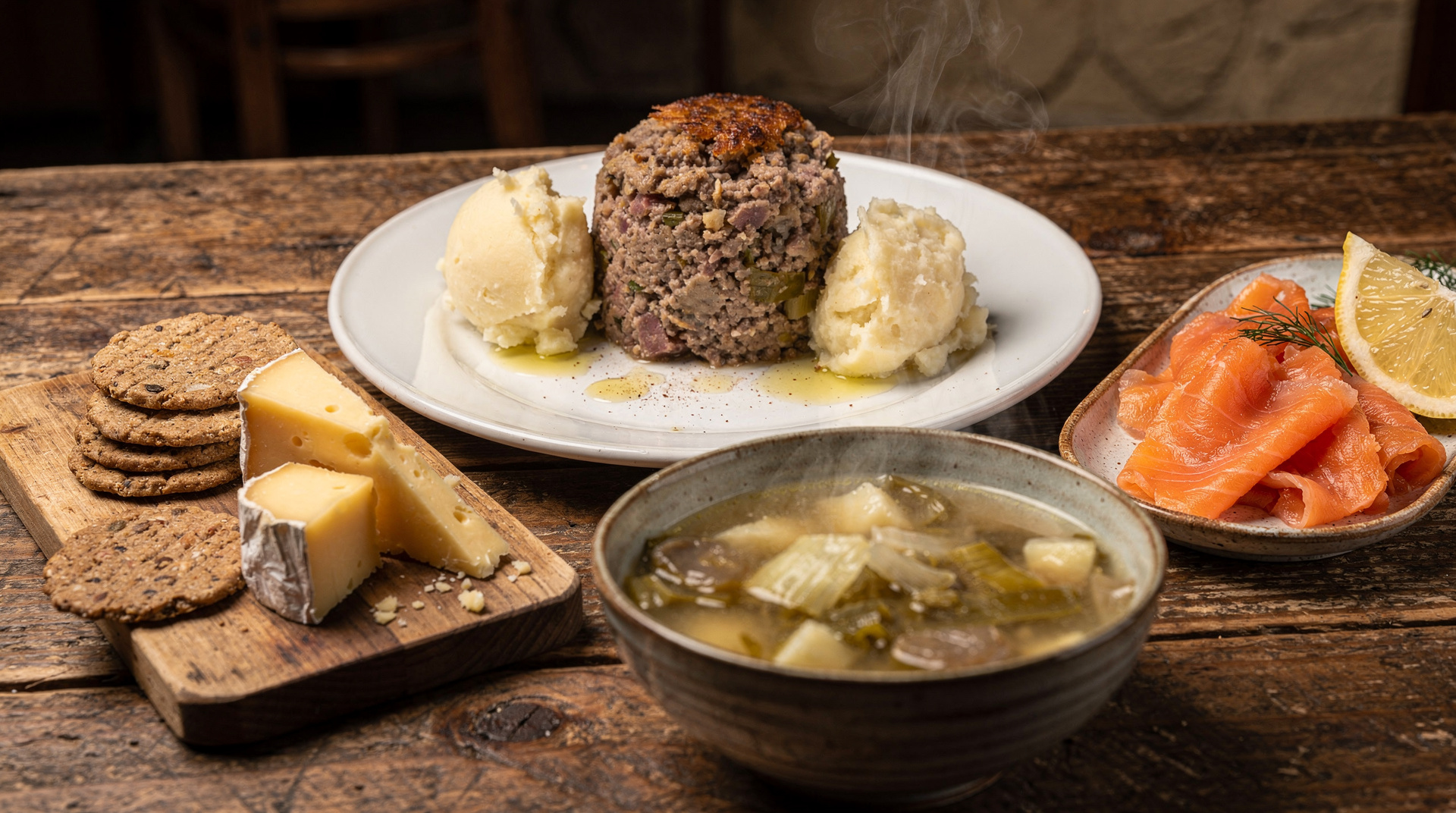
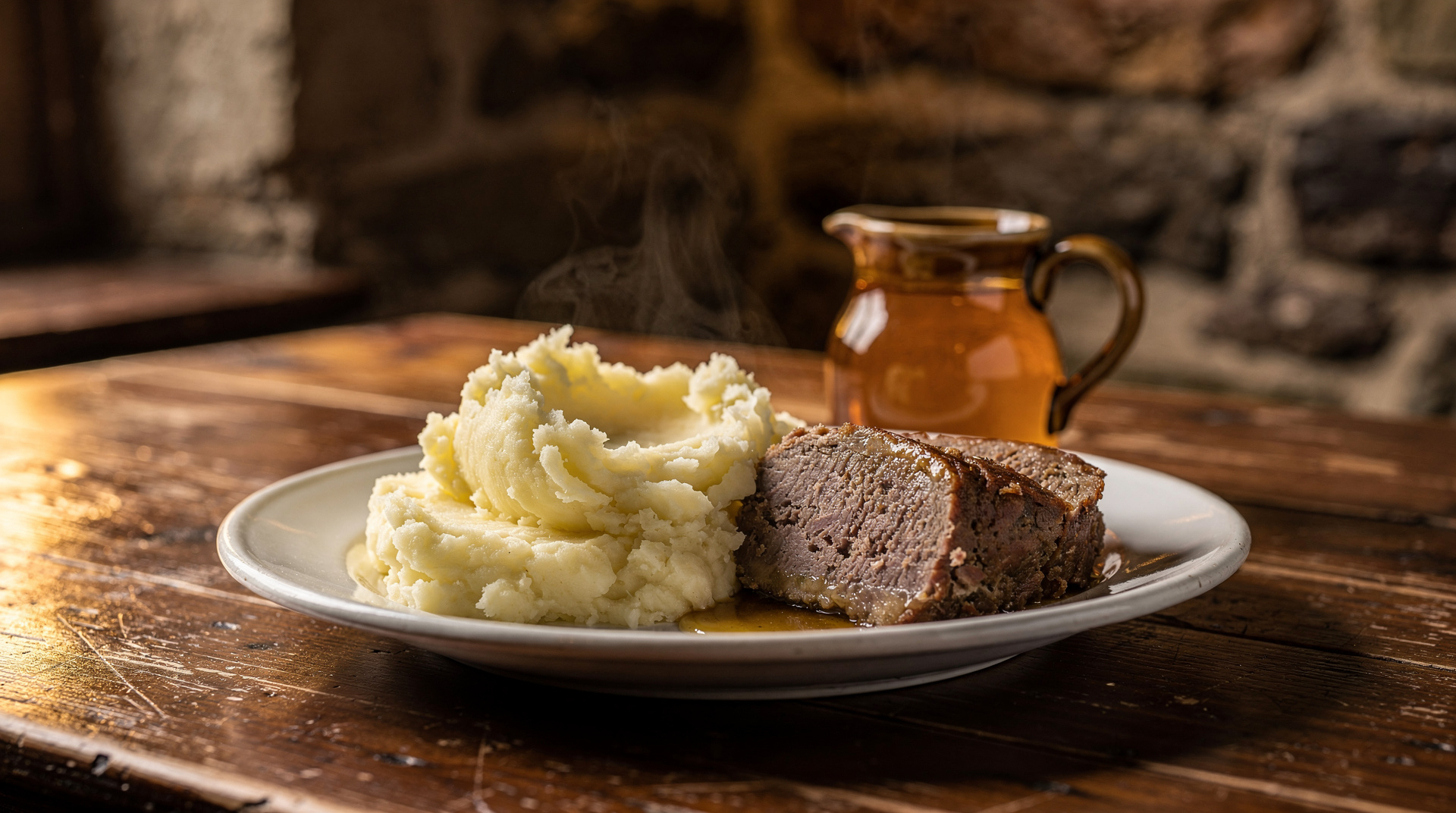
The traditional presentation is haggis with neeps and tatties — neeps being turnip (sometimes called swede outside Scotland), tatties being potatoes. A cream or whisky sauce is common, and Burns Night (25 January) is the canonical occasion for the full ceremony, complete with poetry and a dram. In restaurants, you will find the combination served in various ways: mashed together, layered in a tower, or deconstructed across the plate. The tower presentation is particularly common in tourist-facing places and has essentially no bearing on quality.
The whisky sauce, when made well, is the key to elevating the dish. A splash of decent single malt reduced with cream adds a warmth that ties the earthiness of the haggis to the sweetness of the turnip. A bad whisky sauce tastes like sweetened gravy. You can judge a restaurant’s seriousness about the dish by whether their sauce uses real whisky (you can smell it) or flavouring.
Where to find genuinely good haggis
The Scran and Scallie, Stockbridge
Tom Kitchin’s gastropub at 1 Comely Bank Road is consistently the answer when locals are asked where to send visitors for good Scottish food at accessible prices. The haggis comes as a substantial main course and as a component in other dishes, most famously in the scotch egg. The version here is made from quality ingredients, seasoned properly, and served with the care the dish deserves. Mains around £14–£18. Book ahead at weekends.
Wedgwood, Canongate
Paul Wedgwood’s restaurant at 267 Canongate (the lower end of the Royal Mile, past most of the tourist concentration) is the best place on or near the High Street for serious Scottish food. The haggis here appears in both classic and more inventive forms — occasionally as a starter with a contemporary twist. The broader menu is excellent and the two-course set lunch (around £23) is outstanding value. Wedgwood himself is often in the kitchen, which matters in a restaurant of this size.
Cannonball Restaurant, Castlehill
For visitors who want haggis close to the castle, Cannonball Restaurant at 356 Castlehill is the most reliable option near the tourist centre. It is not cheap (mains from £18) and the location means it attracts its share of tourists, but the quality is consistently above the Royal Mile average. The haggis is sourced properly and the presentation is straightforward rather than gimmicky.
The Witchery, Castlehill
The Witchery (352 Castlehill) is Edinburgh’s most theatrical dining experience and not particularly cheap (two courses from around £45), but it does haggis well as part of a broader Scottish-ingredients menu. The dining rooms, in a sixteenth-century building at the top of the Royal Mile, are genuinely spectacular. Go for the experience as much as the food and the haggis specifically.
Amber Restaurant at the Scotch Whisky Experience
The restaurant at the Scotch Whisky Experience (354 Castlehill) pairs haggis specifically with whisky in a way that makes sense educationally. You can do a combined experience — see how whisky is made and eat haggis with a paired dram. The food quality is solid rather than remarkable but the concept is coherent and the setting is interesting. See the Scotch Whisky Experience review for the full picture.
Haggis on food tours
The most time-efficient way to eat haggis well in Edinburgh is on a food tour that includes it as one of several stops. The Edinburgh food tour with Scotch, haggis and more is explicitly structured around haggis as a centrepiece, combining it with other Scottish dishes and a dram of whisky in a context that makes the cultural significance clear rather than treating it as a dare. The guide will explain what you are eating and why it matters, which genuinely improves the experience.
For a more comprehensive exploration of Scottish food, the Edinburgh food tasting tour with a local covers a broader range of dishes and gives more context about where each ingredient comes from.
The best haggis outside restaurants
MacSween of Edinburgh (based in Loanhead, south of the city) is Scotland’s most respected haggis producer and available in most supermarkets in Edinburgh. If you are self-catering or want to take haggis home (it travels well vacuum-packed), MacSween is the brand to buy. They also make a vegetarian version that is genuinely good rather than a token offering.
Farmers’ markets in Edinburgh — notably the Saturday Castle Terrace market and the Sunday Stockbridge market — sometimes have haggis from smaller producers. These are worth trying if you encounter them.
Vegetarian haggis: the honest assessment
Vegetarian haggis, made from vegetables, pulses, and oatmeal, has no connection to the traditional dish except the name and spicing. That said, it is a genuinely good food product in its own right — earthy, well-seasoned, and more interesting than most meat-free alternatives. MacSween’s vegetarian haggis is the best-known version and widely available. Many Edinburgh restaurants serve it as a matter of course because the demand from vegetarian and vegan visitors has made it worth stocking.
For more on plant-based eating in Edinburgh, see the gluten-free and vegan Edinburgh guide.
Burns Night: the best time to eat haggis
If you happen to be in Edinburgh on or around 25 January, Burns Night gives you access to haggis in its most elaborate setting. Restaurants across the city run special menus, often including the full ceremony — Address to a Haggis (a Robert Burns poem read aloud before the dish is cut), a three-course meal with whisky pairings, and sometimes live music. Prices for a Burns Night dinner typically run £35–£60 per person. The atmosphere in a good venue is genuinely celebratory. See the best time to visit Edinburgh guide for how Burns Night fits into Edinburgh’s seasonal calendar.
The food tour alternative: combining haggis with the city’s history
One underrated aspect of eating haggis in Edinburgh is that the dish is deeply embedded in the city’s social history. Robert Burns, who wrote the Address to a Haggis in 1787, was lionised by Edinburgh’s literary society during his winter in the city in 1786–87. The connection between haggis, whisky, and Scottish national identity as a cultural construct is genuinely interesting. A good food guide — as on any of the tours above — will explain this context while you eat, which makes the meal considerably more than a tick-box experience.
The Edinburgh food tours compared guide covers the main tour operators with specific advice on which suits different types of visitors.
The producers: who makes Edinburgh’s haggis
Understanding who makes the haggis you are eating tells you more about quality than the restaurant menu usually will.
MacSween of Edinburgh is Scotland’s most respected commercial haggis producer. Their factory in Loanhead (south Edinburgh) produces the haggis sold in most Scottish supermarkets and used by many Edinburgh restaurants. MacSween haggis is reliably made from quality ingredients with consistent seasoning. It is a commercial product but an honest one.
Macsween produces two main versions: the original (with lamb lung, heart, liver, and oatmeal) and the vegetarian (with kidney beans, lentils, mushrooms, and oatmeal). The vegetarian version won the Vegetarian Society’s approval and is genuinely good.
Crombie’s of Edinburgh (97a Broughton Street, New Town) makes their own haggis in-house in the tradition of a proper Scottish butcher. Their version uses a higher proportion of liver than some commercial products, giving it a more intense, more old-fashioned flavour. Not for everyone, but authentically traditional.
FM’s Butchers (various Edinburgh locations) and several other Edinburgh butchers produce haggis for local retail. Quality varies; asking the butcher directly about the recipe is the most reliable quality indicator.
Haggis in Edinburgh’s pub and bar culture
The pub is where most visitors first encounter haggis in an informal setting. The dish appears on pub menus across Edinburgh, usually as a main course or a starter, and the gap in quality between pub versions is enormous. The rule of thumb is the same as for restaurants: the closer to the Royal Mile tourist trail, the lower the quality. Pubs that serve their local community rather than passing visitors have more incentive to buy decent haggis and cook it properly.
The Bow Bar (80 West Bow) does not serve food beyond crisps and nuts, so it will not help you here. But the Stockbridge Tap (2 Raeburn Place) does a very respectable haggis with neeps and tatties as a pub lunch option. The King’s Wark in Leith (36 The Shore) is similarly reliable.
Pubs that advertise haggis prominently in their window signage on the Royal Mile should generally be approached with caution. The advertising suggests the kitchen is aware that tourists want to see it on the menu; that awareness does not reliably translate into care about the dish itself.
Haggis as a component dish
One of the most interesting recent developments in Edinburgh’s food culture is the use of haggis as a component in dishes that are not the traditional neeps and tatties presentation. The most successful version is the haggis scotch egg at The Scran and Scallie — a hard-boiled egg encased in haggis meat and fried in breadcrumbs, served with a mustard sauce. It is a genuinely brilliant dish.
Other haggis component dishes appearing on Edinburgh menus include haggis bon bons (deep-fried haggis balls, usually served as a starter), haggis in a filo pastry parcel, haggis with a poached egg and hollandaise for brunch, and haggis as a stuffing for rolled chicken or beef. The quality of these derivative dishes depends entirely on the quality of the haggis being used — good haggis in a bon bon is excellent; supermarket haggis fried in breadcrumbs is uninteresting.
Where to buy haggis to take home
Several Edinburgh suppliers will sell haggis for you to take home or cook yourself:
MacSween of Edinburgh (their products are in most Waitrose, Tesco, M+S, and Sainsbury’s branches in Edinburgh) produces the UK’s most respected commercial haggis. Their traditional haggis cooks in the bag in about forty-five minutes of simmering. Their vegetarian version is similarly widely available. MacSween haggis in vacuum packaging will survive a one-to-two day journey home if kept cool.
The Edinburgh Farmers’ Market (Castle Terrace, Saturdays) occasionally has haggis from smaller producers. The quality is typically higher than the commercial brands but supply is inconsistent.
Crombie’s of Edinburgh (97a Broughton Street, New Town) is an old-fashioned butcher that makes its own haggis in-house. If you are in the New Town area, this is the best source of fresh haggis for cooking at home. It will keep refrigerated for a few days.
The cultural context: why haggis matters
The annual Burns Supper on 25 January is the event that explains haggis’s cultural position best. When Robert Burns wrote his Address to a Haggis in 1787, he was writing a mock-heroic poem that celebrated a peasant dish against the pretensions of French cuisine — it was a statement about Scottish national character as much as about food. The poem has been recited at Burns Night dinners every year since, and the ritual of standing while a piper leads the haggis into the dining room on a silver platter, then reciting the Address before cutting it open, is one of Scotland’s most genuinely felt national ceremonies.
Understanding this history changes the experience of eating haggis in Edinburgh. It is not just a strong-flavoured dish from offal; it is a piece of cultural assertiveness that has survived for over two centuries because it genuinely resonates. The best haggis in the best setting — a proper Burns Night dinner, a January night in Edinburgh, with whisky — is an experience that has very little to do with tourism and a great deal to do with what it means to be Scottish.
See the best time to visit Edinburgh guide for more on Burns Night and Scotland’s other seasonal celebrations.
Haggis and Scottish food tours
For visitors who want guidance through Edinburgh’s Scottish food landscape rather than navigating it independently, a dedicated food tour is the most efficient way to encounter haggis in context. The tour guides on Edinburgh’s food experiences are generally knowledgeable about the history as well as the food — you will learn about Burns, about MacSween, about the difference between good and mediocre haggis while you eat.
The Edinburgh food tours compared guide covers the main options in detail. The haggis-and-Scotch tour is specifically designed around the canonical Scottish food experience, while longer tours provide more context about Edinburgh’s contemporary food scene alongside the traditional dishes.
Fitting haggis into a wider Edinburgh eating plan
Haggis works best as one meal among several rather than the centre of a trip. Our where to eat in Edinburgh guide places it alongside the city’s other strengths, and the traditional Scottish food guide covers the rest of the national repertoire, so you can build a few days of eating that does not repeat itself.
If you are staying near the water, Leith is a natural place to eat well away from the Royal Mile crowds, and the best restaurants in Leith guide is a good starting point. Stockbridge, home of The Scran and Scallie, rewards a wander on its own: see the Stockbridge neighbourhood page for what else to do before or after lunch.
For pub settings, the best pubs in Edinburgh guide helps you pick somewhere that treats its kitchen seriously, and the warning in the Royal Mile tourist traps guide applies to haggis as much as to anything else. If you are tempted by the first restaurant you pass, read the guide to eating on the Royal Mile first.
If you would rather have the evening organised for you, a Scottish dinner with live folk music brings the food and the atmosphere together in one booking, which suits visitors who want the full experience without researching venues.
Finally, if haggis is part of a broader first visit, the first-time Edinburgh travel guide and the Edinburgh foodies blog post show how to slot meals around sightseeing so that you eat well without losing half a day to it.
Where to eat haggis: quick comparison
| Venue | Style | Price | Best for |
|---|---|---|---|
| The Scran and Scallie | Gastropub, scotch egg | £14-18 | Best all-round; locals’ pick |
| Wedgwood | Fine dining, inventive | ~£23 set lunch | Serious food, Royal Mile-adjacent |
| Cannonball Restaurant | Traditional, castle views | From £18 | Convenience near the castle |
| The Witchery | Theatrical, historic building | From £45 for two courses | Special-occasion dining |
| Stockbridge Tap / King’s Wark | Pub lunch | Standard pub pricing | Casual, local pub atmosphere |
Pairing haggis with whisky
The classic Scottish pairing is haggis with a dram of whisky, and understanding why the combination works improves the meal. A Highland or Speyside single malt with some sweetness (a sherry-cask expression, for instance) complements the richness of the offal and the warmth of the spices without competing with them; a heavily peated Islay whisky can overwhelm the dish’s more delicate oatmeal notes, though some diners specifically enjoy that contrast. Restaurants with a serious whisky list — Amber at the Scotch Whisky Experience, or Wedgwood’s broader wine and spirits programme — will usually suggest a pairing if asked, and it is worth asking rather than defaulting to whatever whisky sauce accompanies the dish.
For a more structured introduction to the pairing, the Edinburgh whisky guide covers tasting fundamentals that make ordering a considered dram with your meal far less intimidating.
Dietary considerations beyond vegetarian
Traditional haggis is not suitable for several common dietary requirements beyond vegetarianism, and it is worth knowing the specifics before ordering. It is not halal or kosher (lamb offal prepared in a standard UK abattoir does not meet either standard unless specifically certified, which is rare for haggis). It typically contains oatmeal, so it is not gluten-free unless a restaurant specifically states otherwise — some venues now offer a gluten-free haggis using a certified oat product, and it is worth asking directly rather than assuming. It is not dairy-free by default either, since the traditional whisky sauce is cream-based; a dry-served haggis without the sauce is usually possible on request.
For visitors with specific allergies or dietary restrictions, Wedgwood and The Scran and Scallie are both known for handling special requests professionally, since their kitchens are used to a demanding local clientele rather than a purely tourist one. The gluten-free and vegan Edinburgh guide covers the fuller picture for Scottish food and dietary needs across the city.
A short glossary for ordering haggis confidently
Neeps: Turnip (called swede in some parts of England), mashed and served alongside haggis. Tatties: Potatoes, usually mashed. Dram: A serving of whisky, traditionally poured without strict measurement. Address to a Haggis: Robert Burns’s 1787 poem, recited before the dish is cut at a Burns Supper. Bon bon: A deep-fried ball of haggis, usually served as a starter or pub snack. Knowing these terms removes any hesitation about ordering confidently, whether at a formal Burns Night dinner or a casual pub lunch.
Frequently asked questions about haggis in Edinburgh
What does haggis taste like?
Haggis has a rich, earthy flavour from the lamb offal, with warmth from the spices and a textural interest from the oatmeal. It is more similar to a well-seasoned sausage meat than to a pâté. People who dislike offal in other forms often find haggis acceptable because the spicing and oatmeal modify the flavour substantially. The best comparison is to a very good, coarsely-textured herb sausage with a more complex, almost gamey quality.
Is haggis safe to eat?
Yes, completely. Haggis sold in restaurants and supermarkets in the UK is subject to standard food safety regulations. The sheep’s stomach casing (used in traditional haggis) is edible and safe. Commercially produced haggis uses a synthetic casing that you would not normally eat. There is nothing unusual about the safety profile.
Can I take haggis home?
Vacuum-packed haggis from a UK supermarket or the Edinburgh Farmers’ Market will keep well in a cool bag for a day or two of travel. However, there are import restrictions in some countries — notably the USA, where haggis containing sheep lung is banned. Check the regulations for your home country before packing it in your luggage.
How much does haggis cost in Edinburgh?
A haggis, neeps and tatties main course in a mid-range Edinburgh restaurant typically costs £14–£20. Tourist-facing restaurants on the Royal Mile may charge £18–£24 for a similar portion. MacSween haggis in a supermarket costs around £3–£5 for a portion that serves two.
Is the vegetarian haggis worth trying?
Yes, genuinely. It bears little resemblance to the traditional dish in terms of ingredients but uses the same spicing profile and the same oatmeal base, which gives it a similar textural and flavour character. Most Edinburgh restaurants that take food seriously now offer it as a permanent menu item rather than a special request.
Top experiences
Bookable activities with verified prices and instant confirmation on GetYourGuide.