Edinburgh whisky tasting: complete guide to every option
Edinburgh: the Lost Close underground Scotch whisky tasting
What is the best whisky tasting experience in Edinburgh?
For beginners, the Scotch Whisky Experience gives the broadest regional overview. For atmosphere, the Lost Close underground tasting is hard to beat. For brand storytelling and rooftop views, Johnnie Walker Princes Street. For serious independent drams without a tour, Cadenhead's or the Bow Bar.
Edinburgh and whisky: why the city matters
Edinburgh is not a whisky city in the same way Dufftown or Campbeltown is — there is no great concentration of distilleries within the city limits. What Edinburgh has instead is something arguably more useful for the whisky-interested visitor: the commercial and cultural infrastructure that has surrounded Scotch whisky since the nineteenth century. The bonded warehouses of Leith, the headquarters of the major producers, the independent bottlers that have operated here for generations, and a density of knowledgeable bars and tasting venues that has no parallel anywhere else in Scotland.
This guide covers every serious whisky tasting option in the city, from the big commercial experiences to the small guided sessions to the best bars to simply drink in.
| Best for beginners | Scotch Whisky Experience |
| Best atmosphere | Lost Close underground tasting |
| Best for enthusiasts | Cadenhead’s, Bow Bar, expert-led sessions |
| Typical cost | Around £25-65 per person |
| Minimum age | 18, ID may be checked |
The major tasting experiences
The Scotch Whisky Experience
The original and still the most comprehensive introduction to Scotch whisky for visitors. The Scotch Whisky Experience at the top of the Royal Mile has been running since 1988 and is genuinely brand-neutral — it covers all four Scottish whisky regions (Highland, Lowland, Speyside, Islay) without pushing any particular producer’s agenda.
The tasting sessions run at three price levels. The Silver Tour (£25 per adult, 50 minutes) includes one tasting. The Gold Tour (£39.75, 75 minutes) includes five tastings. A Taste of Scotland (£95, 3 hours) pairs six whiskies with a three-course meal.
Best for: first-time whisky visitors wanting a clear structural understanding of Scotch. Read the full Scotch Whisky Experience review for detail.
Johnnie Walker Princes Street
Opened 2023 in a renovated Princes Street building. Eight floors of brand experience, immersive storytelling about the Walker family and the history of blended Scotch, and a rooftop bar with exceptional views. The tasting sessions focus exclusively on Diageo’s portfolio.
The Explorers’ Quaich is the standard option and the Whisky Maker’s Blend goes deeper into the craft of blending; see current prices on the official Johnnie Walker Princes Street site. The rooftop bar is separately accessible without a tour booking.
Best for: visitors who enjoy brand experience design, want the rooftop view, or are interested specifically in blended Scotch. Read the full Johnnie Walker Princes Street review.
The Lost Close, South Bridge
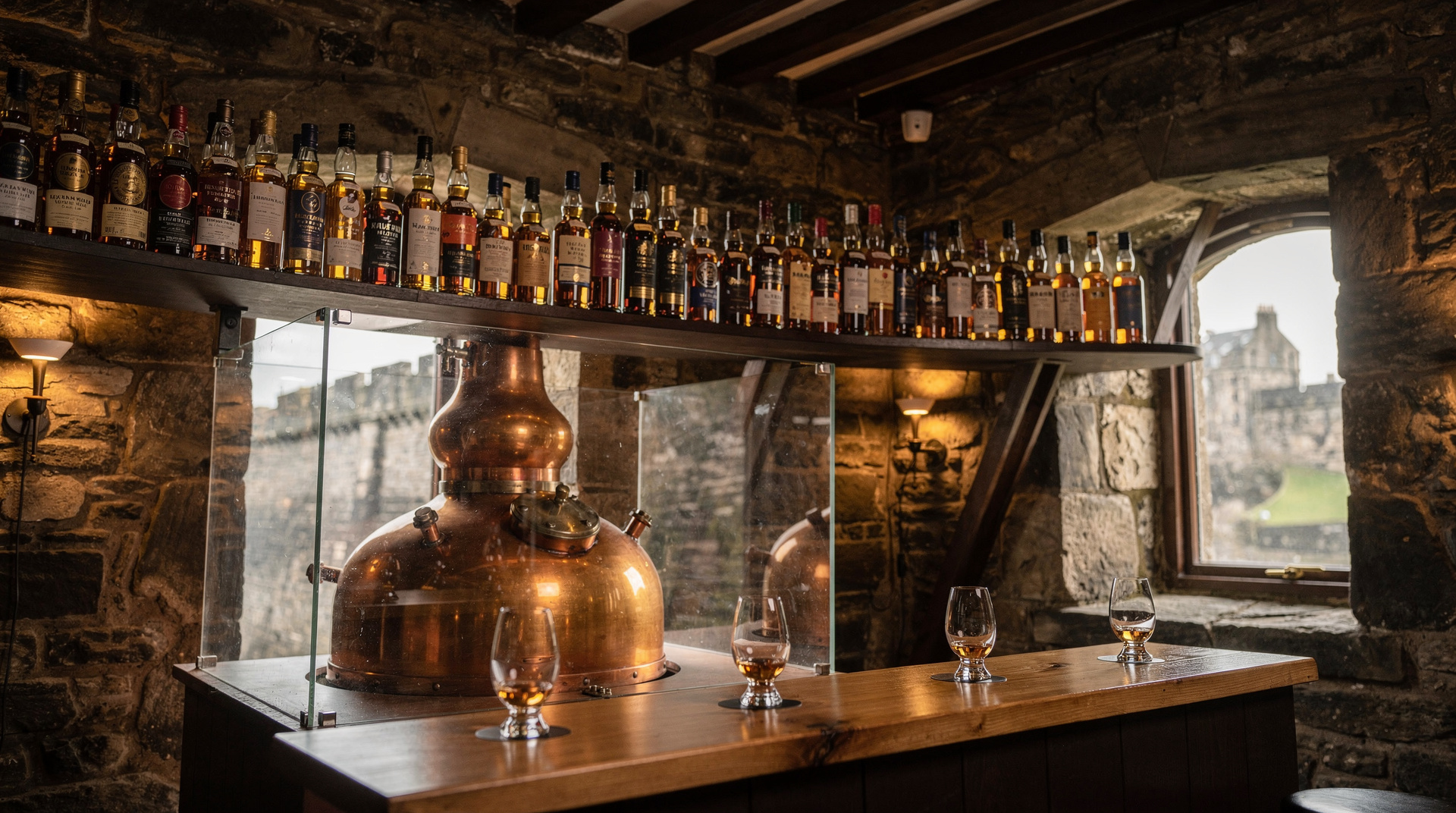
The Lost Close underground Scotch whisky tasting is in many ways the most distinctive whisky experience in Edinburgh. Held in the vaulted stone cellars beneath the South Bridge — the same underground spaces that the ghost tour operators use for their evening sessions — the tasting combines a genuine Old Town setting with an independently curated selection of Scotch.
Groups are small (typically 8–12 people), the drams are chosen specifically for educational contrast rather than brand promotion, and the guide’s approach is more conversational and less theatrical than the larger venues. You learn about whisky through tasting rather than through presentation. The atmosphere — stone vaulted ceilings, candlelight, slightly cool air — is genuinely atmospheric without being gimmicky.
Prices run around £45–£55 per person. Book well in advance in summer.
Whisky is not the only tasting worth an evening here, and English vineyards have improved enough in twenty years that the pairing with Scottish cheese is no longer a novelty: an English wine and Scottish cheese tasting is the alternative when a third dram would be one too many.
History of whisky small-group tour
The small-group history of whisky tour with tasting takes a different approach: more time on the historical context of Scotch whisky production, the social history of drinking in Scotland, and the economics that shaped the industry. The tasting component covers three to four expressions and typically includes at least one aged expression alongside younger standard bottlings.
Best for: visitors who like their drinking accompanied by context and narrative. Group sizes are small and the format is closer to a seminar with samples than a performance with drinks.
Scottish whisky expert sessions
The Scottish whisky experience with a local expert is designed for visitors who already know something about Scotch and want to take the conversation further. Sessions cover production in more technical detail, explore independent bottlings alongside distillery releases, and include whiskies from smaller or less mainstream producers that the large commercial experiences tend not to include.
Prices and availability vary by operator; expect around £45–£65 per person for a 90-minute to two-hour session.
Whisky and walking: combining history with tasting
Edinburgh’s Old Town contains centuries of whisky history within a very short walk. Several guided experiences combine the walking tour format with tastings at relevant venues:
The Edinburgh whisky and folklore tour visits several Old Town locations with significant whisky connections — former distillery sites, smugglers’ routes, bonded warehouse remnants — and includes drams at each stop. It runs 2–3 hours and is excellent for visitors who want both the physical Edinburgh context and the drinking.
The Harry Potter walking tour with whisky tasting pairs two of Edinburgh’s most popular tourist interests in a combination that sounds slightly incongruous but works well in practice.
Whisky bars for self-directed tasting
If you prefer to explore at your own pace without a tour structure, Edinburgh’s whisky bars offer exceptional depth at everyday prices. The full guide is at best whisky bars in Edinburgh, but the highlights:
The Bow Bar (West Bow, near the Grassmarket): ~300 malts, genuinely knowledgeable staff, pub prices. The best independent whisky bar in Scotland by most accounts.
Cadenhead’s Whisky Shop (Canongate): Scotland’s oldest independent bottler. Tasting before buying, unusual single cask expressions, expert staff. Not technically a bar but a serious tasting destination.
Whiski Bar (High Street): Good curated flights, tourist-friendly location, solid selection.
Boisdale (St Andrew Square): 400+ whiskies in a full-service restaurant with live jazz. The premium end of the Edinburgh whisky bar scene.
Most of Edinburgh’s serious whisky bars cluster around the Grassmarket and the Old Town, within a short walk of each other, which makes a self-directed bar crawl genuinely practical on foot. The best bars Edinburgh guide covers the wider bar scene if whisky isn’t your only interest for the evening.
Whisky and food: pairing beyond the standard tasting
A smaller but growing niche in Edinburgh’s whisky scene pairs specific expressions with food rather than treating tasting as a standalone activity. Several of the city’s better restaurants offer whisky flights alongside a tasting menu, matching, for example, a peated Islay dram with smoked fish or a sherried Speyside with a rich dessert.
This is a more involved (and expensive) way to explore whisky than a standalone tasting, but for visitors who already enjoy pairing wine with food, it’s a natural extension. The Scotch Whisky Experience’s A Taste of Scotland is the most accessible version of this without needing a restaurant reservation; some of Edinburgh’s fine-dining rooms offer bespoke whisky pairings if you contact them in advance of your visit.
Buying whisky to take home
Most visitors who develop an interest in Scotch during their trip want to bring a bottle home, and Edinburgh has good options for this beyond duty-free at the airport. Cadenhead’s and the specialist shops on the Royal Mile carry single-cask and independent bottlings not available in most countries’ general retail, which makes them a genuinely better buying opportunity than a supermarket or standard off-licence.
The Edinburgh shopping guide covers where to find specialist retailers alongside the city’s wider shopping scene. If you’re travelling internationally, check your destination country’s duty-free allowance before buying multiple bottles — most tasting venues and shops can advise on this, and Edinburgh Airport’s own duty-free whisky selection is genuinely strong if you run out of time in the city itself.
Private and bespoke tasting options
For visitors who want a whisky experience that is not available through the standard commercial channels, Edinburgh has private and bespoke options at the premium end.
Several of the specialist retailers and bars (Cadenhead’s, the Bow Bar) will arrange private tastings for groups if contacted in advance. These typically run for a private group of 4–8 people, involve expressions chosen specifically for the group’s interests and experience level, and cost around £60–£100 per person. They are significantly more tailored than any commercial tasting session and are worth considering for whisky enthusiast groups who want the Edinburgh whisky experience at its most focused.
The Scotch Whisky Experience A Taste of Scotland is the commercial equivalent of a bespoke tasting — the closest thing to a private session available without going off the commercial grid. It covers food pairing alongside the whisky.
For visitors with a specific distillery interest — “I want to explore the unpeated Speysides” or “I want to compare 20-year-old expressions from three different regions” — the Lost Close underground tasting can sometimes accommodate bespoke requests if booked with enough lead time. Contact the operator directly before booking through the commercial booking systems.
The Edinburgh private luxury whisky, food and wine tasting tour covers the premium end of guided private tastings, combining whisky with food and wine pairing in an exclusive setting. This is the highest-production-values option currently available through GetYourGuide for Edinburgh whisky.
Whisky tasting for groups and special occasions
Edinburgh’s whisky venues handle group bookings well, and a tasting session works better than most alternative activities for a stag do, hen do, work trip, or birthday group that wants to do something together that isn’t purely a pub crawl. Private sessions at Cadenhead’s or the Bow Bar, or a booked-out slot at the Lost Close, typically need two to four weeks’ notice for groups of eight or more in peak season, and less for smaller groups or quieter months.
Most operators can adjust the format slightly for a celebration — a toast, a short personalised introduction, or a bottle to take away as a keepsake — if you mention the occasion when booking. For a genuinely memorable group afternoon, pairing a tasting with lunch nearby on the Royal Mile or in the Old Town keeps the group together without a long transfer between venues.
Building a whisky day in Edinburgh
A well-structured Edinburgh whisky day could run as follows:
Morning (10am–noon): Begin with the Scotch Whisky Experience Silver or Gold session for the regional overview. This gives you a framework for everything that follows. The barrel ride is quicker than you fear and the tasting room is genuinely useful.
Lunch (noon–1:30pm): Eat somewhere that is not the Scotch Whisky Experience’s restaurant. Walk down the Royal Mile to the Grassmarket, 10 minutes on foot, and try Maison Bleue or The White Hart Inn for good food at non-tourist prices.
Afternoon (2pm–5pm): Walk back up through Victoria Street to the Bow Bar. Order two or three drams from regions you found most interesting during the morning session. The staff will help you identify examples that represent the regional character at its most distinct.
Evening (6pm–9pm): The Lost Close underground tasting if you booked it in advance. If not, continue to Cadenhead’s before closing (6pm) to browse and potentially buy, then dinner in the Old Town.
For a whisky-focused four-day Edinburgh visit including day trips to working distilleries, see the whisky lovers Edinburgh itinerary.
Matching your experience to your knowledge level
Complete beginner: Start with the Scotch Whisky Experience Silver or Gold. Follow it with an evening at the Bow Bar where the staff will help you build on what you learned. Read understanding Scotch regions before you go for context.
Some background knowledge: The Lost Close underground tasting is the better choice — it assumes you know basic vocabulary and takes the conversation further. The Whisky Maker’s Blend session at Johnnie Walker is worth adding if blended Scotch interests you.
Enthusiast: Skip the commercial experiences and spend your time at Cadenhead’s, the Bow Bar, and Boisdale. Consider one of the expert-led small-group sessions. Plan day trips to working distilleries — Glenkinchie (Lowlands) is 25 minutes from Edinburgh; the Borders distilleries are an easy half-day trip.
Matching your experience to your knowledge level, at a glance
| Level | Best starting point | Follow up with |
|---|---|---|
| Complete beginner | Scotch Whisky Experience Silver/Gold | An evening at the Bow Bar |
| Some background | Lost Close underground tasting | Whisky Maker’s Blend at Johnnie Walker |
| Enthusiast | Cadenhead’s or an expert-led session | A distillery day trip |
How to use tastings to develop your palate
One of the practical benefits of Edinburgh’s density of whisky tasting options is the opportunity to develop a genuine palate over the course of a few days. This is less mysterious than it sounds, and does not require formal training.
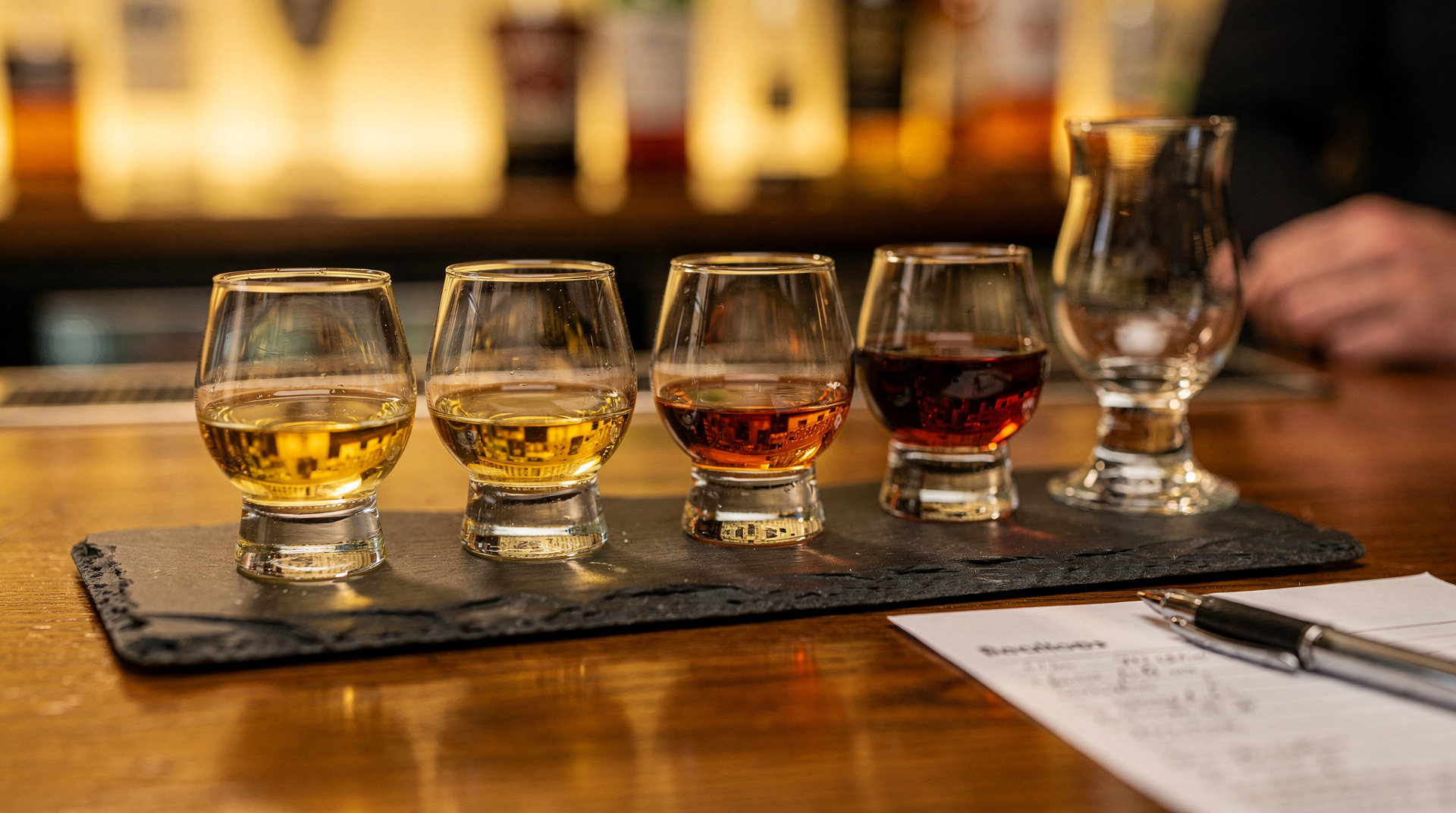
The principle is contrast: taste expressions that are as different from each other as possible, in sequence, with time between each. A Glenlivet 12 (light, sweet Speyside) followed by a Laphroaig 10 (heavily peated Islay) reveals more about both expressions than tasting two similar Speysides in sequence. The Scotch Whisky Experience’s regional tasting is structured around this principle; the staff at the Bow Bar will help you build a contrast flight if you ask.
Note what you actually smell and taste, not what you think you should be smelling and tasting. Whisky tasting notes use shorthand (citrus, vanilla, smoke, spice) that sometimes implies more precision than the experience warrants. If a dram smells to you like a bonfire at the seaside, that is a perfectly accurate description — it probably is a peated coastal malt, and your nose got it right.
Pay particular attention to the finish — the flavour that develops after swallowing. This is where more complex expressions often deliver their most interesting notes, and it is the most neglected aspect of amateur tasting. A whisky with a long, evolving finish is usually a more complex and better-made expression than one with a flat or brief finish.
Whisky vocabulary: a brief glossary
If the tasting sessions use vocabulary you have not encountered before, here is the minimum you need:
Dram: A measure of whisky. In Scottish pubs, a standard measure is 25ml. Some bars offer 35ml; rare and premium expressions are sometimes served in smaller measures (10–15ml) at serious bars.
Cask strength: Whisky bottled directly from the barrel without dilution, typically 55–65% ABV. These expressions are more intense and usually more complex than standard-strength bottlings (40–46% ABV). Add water to taste.
Single malt: Made from malted barley at a single distillery. “Single” refers to the distillery, not the cask. Can be (and usually is) a blend of multiple casks from the same distillery.
Independent bottling: Whisky bought in cask from a distillery by an independent company (Cadenhead’s, Gordon and MacPhail, Signatory) and bottled under their own label. Often unfiltered, often cask strength, often excellent value.
NAS: No age statement. The whisky is aged but the minimum age is not stated on the label. Quality varies; not inherently inferior to age-stated expressions but worth asking about.
Peating level: Measured in parts per million (ppm) of phenol in the malt. Unpeated or lightly peated (0–5 ppm) includes most Speyside; medium peated (10–25 ppm) includes Highland Park; heavily peated (25–50 ppm) includes Caol Ila; very heavily peated (50+ ppm) includes Ardbeg and Laphroaig.
Day trips for distillery visits
Edinburgh’s position in the Lowlands means several working distilleries are within straightforward day-trip range. The distilleries near Edinburgh guide covers these in detail, including Glenkinchie, Deanston, Glengoyne, and the newer craft distilleries in the Borders.
For whisky day trips further afield — the Speyside trail, Islay — the Speyside whisky trail guide and whisky day trips from Edinburgh guide cover the logistics.
For the most complete picture of Edinburgh’s whisky geography, the understanding Scotch regions guide explains the five regions, their flavour profiles, and why the geography matters. It is useful background reading before visiting any of the distilleries or tasting experiences covered in this guide.
Planning your whisky exploration: a practical checklist
For visitors who want to approach Edinburgh whisky systematically rather than stumbling into it, here is a practical pre-visit checklist:
Before you arrive: read the understanding Scotch regions guide to get the regional vocabulary. Note one or two whiskies you have previously enjoyed (or specifically disliked); this information is more useful than a blank slate for a good guide.
First day: the Scotch Whisky Experience or the Lost Close tasting. These give you the structure and the vocabulary for everything that follows.
Second day: independent bar exploration at Cadenhead’s and the Bow Bar. Use what you learned on day one to navigate the selection. Ask the staff to recommend something in the style that interested you most.
Third day (if your interest is significant): a day trip to a working distillery. Glenkinchie for the Lowland context; Deanston or Blair Athol for the Highland counterpoint.
Throughout: keep notes, however informal. The difference between “this one is better” and “this one has more dried fruit with a longer finish” is the difference between casual drinking and genuine appreciation — and the latter is more enjoyable even if it sounds more pretentious.
Edinburgh’s whisky events calendar
Edinburgh’s whisky scene is not only in bars and visitor centres. The city hosts several significant whisky events throughout the year that are worth knowing about if your visit overlaps with them.
Whisky Fringe (August, during the Edinburgh Fringe): Run by Cadenhead’s and other independent operators, the Whisky Fringe occupies the same August calendar as the main festival and offers a series of masterclasses, tastings, and special bottling releases. Tickets sell out; book well in advance.
Scotch Whisky Experience masterclasses: Regular evening and weekend masterclasses at the Scotch Whisky Experience explore specific themes — rare malts, distillery characters, cask comparisons — in more depth than the standard tasting sessions. Check their website for the current schedule.
Whisky Advent Calendar (December): Several Edinburgh shops and bars run whisky advent calendar programmes in December, releasing a new dram each day in the run-up to Christmas. Drinkmonger’s calendar and the Scotch Whisky Experience’s programme are worth looking at if December is your visit window.
Distillery open days: Several of the distilleries near Edinburgh run annual open days or harvest events that are not part of the standard tour programme. These are worth checking if you are planning a whisky-focused visit and can be flexible on dates.
Frequently asked questions about whisky tasting in Edinburgh
How much does whisky tasting cost in Edinburgh?
The major commercial experiences (Scotch Whisky Experience Silver, Johnnie Walker) run from £25 per person at the Scotch Whisky Experience (Silver Tour); for Johnnie Walker, see current prices on the official Johnnie Walker Princes Street site. More intimate guided sessions (Lost Close, expert-led) cost £45–£65. Drinking in bars costs £5–£20 per dram depending on the expression and the venue.
Do I need to know about whisky before booking a tasting experience?
No. Every Edinburgh tasting option accepts complete beginners. Tell the guide your experience level and they will calibrate accordingly.
What is the minimum age for whisky tastings?
- All tasting venues in Edinburgh require proof of age if there is doubt, in line with Scottish licensing law.
Can I do more than one whisky experience in a day?
Yes, though pacing yourself matters. The major commercial experiences include 2–4 drams. Visiting two in one day is manageable if you eat properly and drink water. Combining a morning experience with an afternoon bar visit is a standard Edinburgh whisky day structure.
Is Edinburgh or Speyside better for whisky tourism?
They serve different purposes. Edinburgh is best for overview, context, and bars with broad selections. Speyside is best for distillery visits and understanding single malt production at its source. If you have the time, visit both — Edinburgh first for context, Speyside for immersion.
Are whisky tours suitable for people who do not drink whisky?
The walking tours that combine history and tasting can be done by non-drinkers who are just interested in the history. The tasting-specific sessions are less suited to non-drinkers. Some venues offer alternatives (juice, water) but it would be an odd use of a tasting session.
Can I buy whisky in Edinburgh to take home?
Yes. Cadenhead’s and other Royal Mile specialist shops carry independent and single-cask bottlings you won’t find in general retail, which makes buying in Edinburgh genuinely worthwhile rather than just convenient. Check your home country’s duty-free allowance before buying more than one or two bottles, and remember that Edinburgh Airport’s own whisky selection is a strong backup if you run out of time in the city.
Is it worth combining a whisky tasting with a meal?
For visitors who already enjoy food and wine pairing, yes — several Edinburgh restaurants offer whisky-paired tasting menus that add a genuinely different dimension to both the food and the drams. For a first whisky experience, though, a standalone tasting session is the better and cheaper way to build your basic vocabulary before adding food into the mix.
Top experiences
Bookable activities with verified prices and instant confirmation on GetYourGuide.