Glasgow day trip from Edinburgh: what to see and honest advice
Glasgow: city centre guided walking tour
How do I do a day trip to Glasgow from Edinburgh?
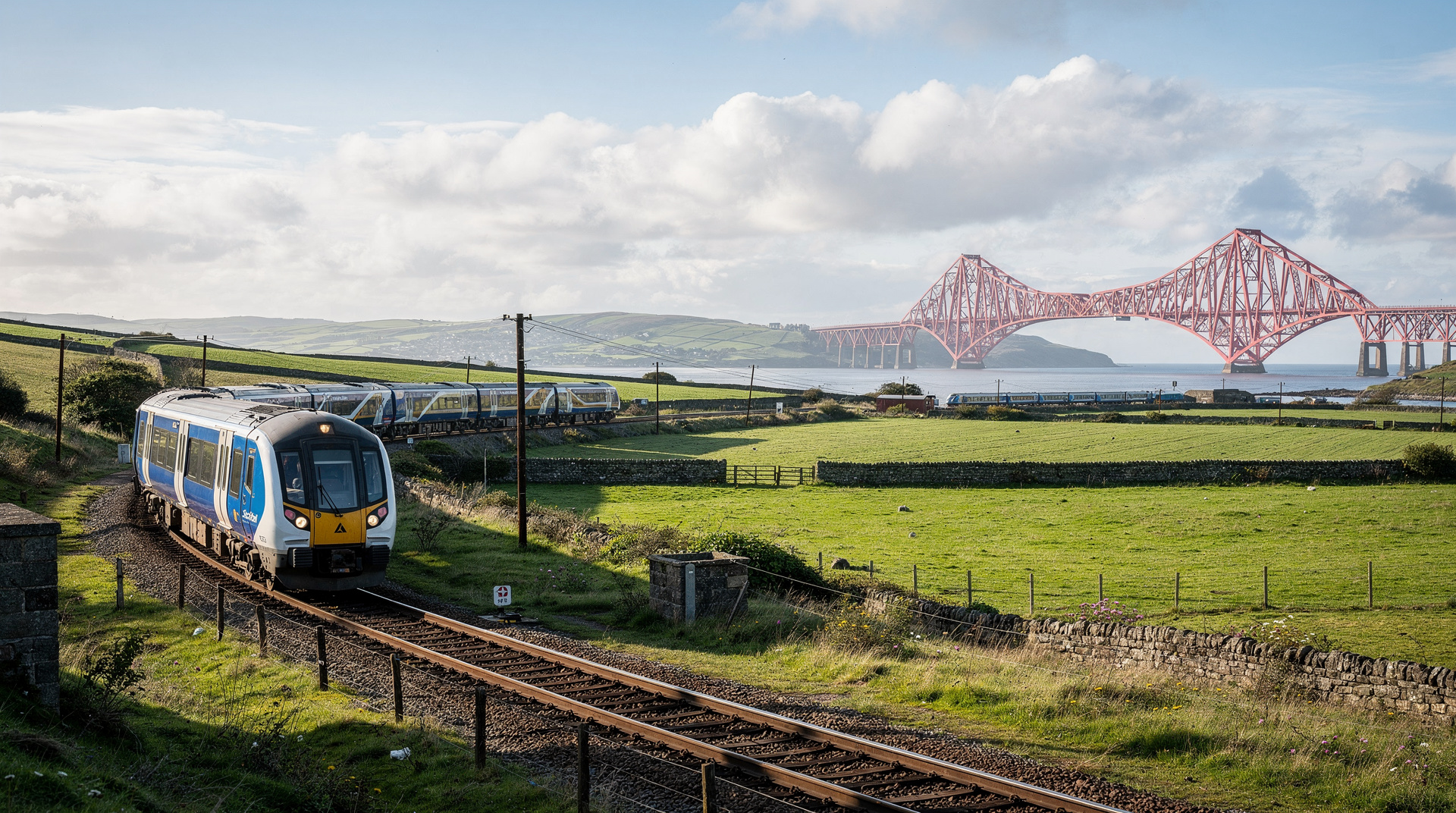
Take the train from Edinburgh Waverley to Glasgow Central or Queen Street — 50 minutes, services every 15-20 minutes, £10-18 return. Glasgow is very walkable; no guided tour needed. The city centre, Kelvingrove, and West End fill a full day comfortably. It is a genuinely different city from Edinburgh.
| Travel time | 50 min by train from Waverley |
| Cost | £10-18 return, cheaper booked ahead |
| Don’t miss | Kelvingrove Art Gallery, free |
| Full day covers | City centre, West End, one major museum |
| Guided tour needed? | No, but adds architectural context |
Glasgow is not Edinburgh — which is exactly why you should go
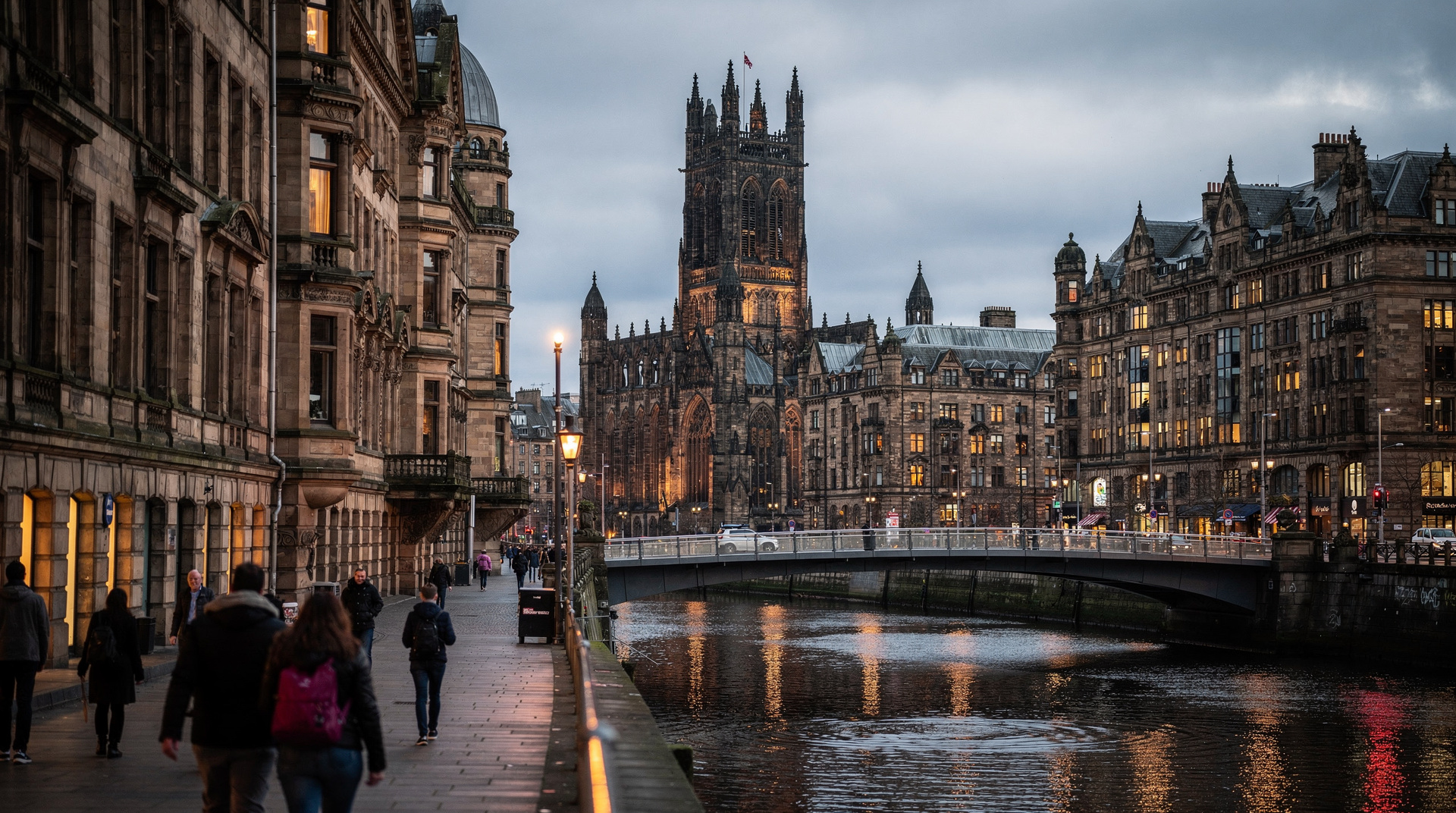
The standard expectation is that Glasgow will be a rougher, grittier version of Edinburgh. The reality is more interesting: Glasgow is a different kind of city entirely. Where Edinburgh is medieval, Georgian, and self-consciously historic, Glasgow is Victorian, industrial, and defiantly contemporary. Where Edinburgh’s character is reserved and architectural, Glasgow’s is social and effusive — the city that invented the concept of a warm welcome.
This does not mean one is better than the other. It means a day in Glasgow from Edinburgh gives you a genuinely contrasting experience, not a repeat of the same Scottish-city template.
The practical case for the day trip is strong: 50 minutes by train, services every 15-20 minutes throughout the day, and a city compact enough to cover a lot on foot. The Kelvingrove Art Gallery alone justifies the journey. The architecture of the city centre — Charles Rennie Mackintosh, Alexander Thomson, Victorian commercial buildings of extraordinary confidence — rewards simply walking. The food and bar scene, particularly in the West End, is more adventurous and better value than most of Edinburgh’s tourist-facing offerings.
Getting there
By train
Edinburgh Waverley to Glasgow Queen Street: 50 minutes on the express service (also stopping trains take 1h05). Edinburgh to Glasgow Central: 55 minutes. Both routes run every 15-20 minutes throughout the day; first trains run before 7am, last trains after 11pm.
Glasgow Queen Street is better positioned for the city centre and West End; Glasgow Central is marginally more convenient for the south side and Kelvingrove (though Kelvingrove is 20 minutes on foot from either station). For a day trip covering the city centre and Kelvingrove, either works.
Return tickets typically cost £10-18 depending on time of booking and time of travel. Buying in advance is cheaper; walk-up prices on peak trains are higher.
By car
Motorway (M8) from Edinburgh to Glasgow is 45 miles; drive time is 50-60 minutes in normal traffic. Parking in Glasgow city centre is straightforward but paid; the NCP car parks on Buchanan Street and Mitchell Street are central. The journey is easy but train travel is faster and removes parking costs and city-centre navigation. If you are weighing up whether a car is worth having at all during your stay, the do you need a car in Edinburgh guide lays out the trade-offs, and the Edinburgh trams and buses guide covers getting to Waverley at the start of the day.
By guided tour
A guided walking tour of Glasgow is useful for orientation, particularly for architectural and historical context that is easy to miss without a guide. The Glasgow city centre guided walking tour gives a well-structured introduction to the Victorian architecture and the city’s industrial history. The Glasgow must-see attractions walking tour covers the headline sites in a fixed route — good for first-time visitors who prefer structure.
For those combining Glasgow with Loch Lomond on the same day, the Glasgow Loch Lomond, Trossachs and Stirling Castle tour runs from Glasgow (not Edinburgh) but gives a sense of what a combined Glasgow and Loch Lomond circuit looks like.
Glasgow is fifty minutes by train and its centre reads as a grid of Victorian commerce rather than a medieval core, which is the opposite of what most visitors arrive expecting: a private historical walking tour of Glasgow explains the city that money built.
What to see in Glasgow in one day
Kelvingrove Art Gallery and Museum
The single best reason to make this day trip. Kelvingrove is a large, exuberant red sandstone building in the West End housing one of the best free museum collections in Britain: Rembrandt, Monet, Dali (the famous Christ of Saint John of the Cross), an impressive armour and weapons gallery, and an extraordinary natural history wing with a suspended Spitfire aircraft dominating the central hall. Free entry. Allow 2-3 hours minimum.
The building itself is worth seeing — Victorian Baroque in red sandstone, built for the 1901 International Exhibition. The café inside is good. The park around it (Kelvingrove Park) runs down to the River Kelvin and has excellent trees and several interesting Victorian monuments.
Mackintosh at the Willow
Charles Rennie Mackintosh is Glasgow’s most celebrated architect and designer, and his influence on the city is deep. The best currently accessible Mackintosh experience is Mackintosh at the Willow on Sauchiehall Street — a reconstruction of the famous Willow Tea Rooms (1903), which were commissioned by businesswoman Kate Cranston and represent Mackintosh’s total design vision at its most complete. Tea and scones in the restored tearoom is a reasonable tourist indulgence in this context. There is a small museum element as well. Entry to the museum: £7; the tearoom is pay per order.
The Glasgow School of Art (Mackintosh’s masterpiece, designed 1896) suffered major fires in 2014 and 2018 and is currently under restoration. Its reopening timeline is uncertain as of 2026; check the GSA website for current access.
The city centre: George Square and Merchant City
George Square is the civic heart of Glasgow, surrounded by Victorian civic buildings of considerable grandeur. The City Chambers on the east side have free public tours on weekdays — the interior is extraordinary, with marble staircases and painted ceilings that would look more at home in an Italian palazzo than a Scottish municipal building. Worth 45 minutes.
The Merchant City, immediately east of George Square, is where Glasgow’s 18th-century tobacco merchants built their townhouses — now converted to restaurants, bars, and boutiques. The Italianate architecture around Ingram Street is excellent. The Barras market (weekend only) is nearby for those who enjoy markets with a gritty Glasgow character.
The Clydeside and the Riverside Museum
The Clyde waterfront has been the site of Glasgow’s most successful post-industrial regeneration. The Riverside Museum (transport museum in a Zaha Hadid building on the Clyde) is excellent and free. The Tall Ship Glenlee, moored alongside, is included in entry. Allow 1.5-2 hours.
Across the river, Govan has some of Glasgow’s oldest history (the Govan Stones — early medieval carved stones — are in a church there), though it requires a short metro ride or walk across the pedestrian bridge.
The West End and Byres Road
The West End around Byres Road, Ashton Lane, and Great Western Road is Glasgow at its most liveable and food-forward. Ashton Lane is a cobblestoned back lane packed with bars, restaurants, and a small cinema — one of the more atmospheric dining environments in Scotland. The Ubiquitous Chip (on Ashton Lane, a Glasgow institution since 1971) represents the city’s culinary self-confidence, with a focus on Scottish produce in a relaxed environment. The West End also has Oran Mor (a former church converted to a bar and arts venue) and easy access to Kelvingrove.
What to skip
Glasgow’s other major museum options — the Burrell Collection (world-class art collection in a purpose-built building in Pollock Country Park, about 30 minutes from the centre by bus) and the Gallery of Modern Art (contemporary art in an impressive neoclassical building in Royal Exchange Square) — are both worthwhile but cannot all be combined in a single day. For a first visit, Kelvingrove is the priority.
The hop-on hop-off bus is less necessary in Glasgow than in Edinburgh because the main sights are concentrated in two walkable clusters (city centre and West End). The Glasgow City Sightseeing hop-on hop-off bus is useful for covering the distance between the two areas comfortably without walking.
The Burrell Collection: worth the journey south
For those willing to make the trip to Pollock Country Park in the south of the city (about 30 minutes by bus from the centre, or 15 minutes on the underground to Pollokshaws West), the Burrell Collection is among the finest art collections in Britain. Sir William Burrell was a Glasgow shipping magnate who assembled an eclectic, world-class collection over 60 years: medieval tapestries, Islamic art, Chinese bronzes, French Impressionist paintings, and Greek and Roman antiquities. The purpose-built gallery, which underwent a major refurbishment completed in 2022, is excellent — the collection is displayed with space and quality lighting that the cramped city-centre alternatives cannot match.
The adjacent Pollock House is a 1740 country house with a strong Spanish art collection (Goya, El Greco) and period interiors. Both are on the grounds of Pollock Country Park, which has good walking in mature woodland and is itself worth seeing.
For a focused Glasgow art day, the combination of Kelvingrove in the morning and the Burrell in the afternoon (via the underground) covers the two best collections the city has. This is a full day without any other additions.
Glasgow’s architecture: a walking guide
Glasgow’s Victorian and Edwardian commercial architecture is one of the finest concentrations of such buildings in Britain, and it is mostly visible simply by walking the city centre.
Buchanan Street: The main shopping street has several notable Victorian buildings. The Royal Exchange Square at the south end (now Gallery of Modern Art) is an 1829 neoclassical building of great ambition. The Princes Square shopping centre off Buchanan Street preserved an 1841 townhouse facade — worth the detour for the ironwork atrium.
West George Street and Blythswood Square: The New Town equivalent, with Blythswood Square (1823) one of the finest urban squares in Scotland. The Blythswood Hotel at the north corner of the square is a former Royal Automobile Club building with an interior worth seeing if you walk through the public areas.
Ingram Street: The heart of the Merchant City, with several late 18th-century neoclassical buildings from the tobacco merchant era. The Trades House on Glassford Street (1791, Robert Adam) is one of the most beautiful guild buildings in Scotland; free entry during business hours.
The Necropolis: The Victorian cemetery on the hill behind Glasgow Cathedral is one of the best Victorian cemeteries in Britain — a monument to the ambition of 19th-century Glasgow’s mercantile class, with elaborate mausoleums, obelisks, and Gothic memorial architecture crowded on a hillside above the city. Free entry, open daily. The view from the summit over the cathedral and the city is excellent.
Glasgow Cathedral
The only medieval cathedral in Scotland to survive the Reformation largely intact (most were demolished or fell into ruin), Glasgow Cathedral was built from the 12th century and has an exceptional lower church (the crypt) with a forest of columns. Entry is free; the Treasury exhibition has silver and historical artefacts. Allow 45 minutes. The exterior is less imposing than the interior — the Victorian Gothic additions to the facade are debated by architectural historians, but the core medieval nave and crypt are outstanding.
Glasgow vs Edinburgh: honest comparison
Both cities are worth spending time in. Glasgow wins on: art collections (Kelvingrove is better than anything in Edinburgh’s free museums), architecture variety (Victorian vs Georgian/medieval), food and bar culture (more experimental, better value), and a certain warmth of character that Edinburgh sometimes lacks. Edinburgh wins on: historic townscape (nothing in Glasgow approaches the Old Town or the castle), concentrated walkability (Glasgow is more spread out), and international visitor recognition.
The cities are not rivals in any useful sense — they are 50 minutes apart and complement each other well. If you have three or four days in Scotland, a day in Glasgow from Edinburgh is the obvious way to add depth. See the dedicated Edinburgh vs Glasgow guide for a full comparison, and the Edinburgh and Glasgow five-day itinerary if you want a structured way to see both properly rather than squeezing Glasgow into a single rushed day.
Timing a Glasgow day trip: which day of the week
Glasgow’s museums and attractions have slightly different hours across the week that are worth checking before you fix a date. Kelvingrove is open every day but has shorter hours on Friday and Sunday mornings. The Barras market only runs at weekends, so a Saturday or Sunday trip is the only way to see it. City Chambers free tours run on weekdays only. If your Edinburgh trip has flexible dates, a Saturday gives access to everything (Barras included); a weekday gives a slightly quieter Kelvingrove and access to the City Chambers tour.
Glasgow’s food and bar scene
Glasgow’s eating and drinking culture is the most dynamic in Scotland, with a concentration of good independent restaurants and bars particularly in the West End, Merchant City, and the Southside. A few specific recommendations worth knowing for a day trip:
Paesano (Great Western Road): The best pizza in Glasgow, and arguably in Scotland, with a wood-fired Neapolitan style and simple ingredients. Long queues at peak times; arrive before 12pm or after 2pm for lunch.
Ox and Finch (Sauchiehall Street): A Scottish small-plates restaurant that represents Glasgow contemporary food well — local ingredients, restrained technique, excellent wine list. Moderately priced by city standards.
The Gannet (Argyle Street, Finnieston): Finnieston is Glasgow’s food neighbourhood, and The Gannet represents its best quality: Scottish produce cooked with confidence. More expensive than the options above but exceptional.
Drygate Brewery (Duke Street, near the cathedral): A brewery-restaurant attached to a working craft brewery, with the fermentation tanks visible through glass walls. The beer is good and the food (burgers, loaded fries) matches the beer-focused setting. Good for a lunchtime stop near the cathedral.
BrewDog Glasgow (Argyle Street): The Edinburgh-founded craft beer company’s Glasgow outpost is larger than its Edinburgh equivalent, with a wider beer selection and food that is better than the chain’s reputation suggests. Reliable and accessible for visitors who find independent bar navigation daunting.
Charles Rennie Mackintosh: the full picture
Mackintosh (1868-1928) is Glasgow’s most significant cultural contribution to world architecture and design, and the city has more of his surviving work than anywhere else. Beyond the Willow Tea Rooms mentioned earlier:
House for an Art Lover (Bellahouston Park): A building designed by Mackintosh in 1901 for a German competition, never built in his lifetime, and constructed posthumously (completed 1996) in a south Glasgow park. The building houses a design centre and café, and is open to visitors at set times. The interior represents Mackintosh’s domestic vision more completely than any surviving original building.
The Lighthouse (Mitchell Street): Mackintosh converted a warehouse in 1895 to house the offices of the Glasgow Herald newspaper; it is now Scotland’s Centre for Design and Architecture. The rooftop viewing platform gives the best elevated view of the city centre. Free entry to the atrium; small charge for the tower.
Scotland Street School Museum (Scotland Street): A 1906 Mackintosh school building converted to a social history museum. The exterior with its distinctive semicircular stair towers in glass is excellent; the museum inside covers Scottish school history from Victorian times. Free entry; 20 minutes from the city centre by underground.
For serious Mackintosh devotees, the Hunterian Gallery at Glasgow University (in the West End, 20 minutes’ walk from Kelvingrove) has the reconstructed Mackintosh House — the interiors of the house he and Margaret Macdonald lived in from 1906-1914, dismantled and reinstalled in the gallery. The most complete surviving example of the domestic Mackintosh interior.
Practical details
Opening hours (Kelvingrove): Mon-Thu and Sat 10am-5pm; Fri and Sun 11am-5pm. Free. No booking needed.
Opening hours (City Chambers tours): Tour times change: check the current tour times on the official Glasgow City Council website before you go.
Food and drink: Ashton Lane in the West End for atmosphere; Merchant City for variety; the city centre along Buchanan Street and Argyle Street for high-street options. The West End consistently outperforms the tourist-facing areas of the city centre for quality-to-price ratio.
The Clydeside Distillery: For whisky enthusiasts, the Clydeside Distillery on the riverside near the SECC does tours and tastings — a working distillery in a converted Victorian pump house. The Clydeside distillery tour and whisky tasting is bookable in advance. For a broader Scotch education before or after, the understanding Scotch regions guide puts a single distillery visit into context.
Safety: Glasgow city centre is safe for day visitors. Byres Road and the West End are thoroughly comfortable. Avoid large crowds outside pubs on Friday and Saturday evenings if you are unfamiliar with the city.
Luggage: If you are travelling on to Glasgow directly rather than returning to Edinburgh the same night, both Queen Street and Central stations have left-luggage facilities, which is useful if your day trip is the last stop before flying home from Glasgow Airport.
Currency: Pounds sterling (£) throughout. See the Edinburgh currency guide for exchange and card advice.
Fitting Glasgow into a wider Scotland plan
A Glasgow day works best when it sits alongside other days that feel different from it. Pair it with a slower, historic day in the capital, such as the Old Town and the Royal Mile, and the contrast between the two cities becomes the point of the trip rather than a side effect. If you prefer to see the city on its own terms before committing a day, the Glasgow destination page gives a broader sense of the neighbourhoods.
If Glasgow is one of several day trips you are choosing between, the best day trips from Edinburgh guide compares the options side by side, and the Edinburgh in 3 days itinerary shows how a longer stay can leave room for a trip west without cutting into the capital’s main sights.
Making the most of a rainy Glasgow day
Glasgow’s west coast position means it receives noticeably more rain than Edinburgh — see the Edinburgh vs Glasgow guide for the comparison. This is worth planning around rather than worrying about: Kelvingrove, the Riverside Museum, the Gallery of Modern Art, and Mackintosh at the Willow are all fully indoors, which means a wet Glasgow day trip loses little compared to a dry one. The main casualty of rain is the Necropolis and any extended outdoor architecture walking — save those for a clearer forecast if your schedule allows flexibility, and lead with the museums if the forecast looks poor.
Frequently asked questions about the Glasgow day trip
Is Glasgow worth visiting as a day trip from Edinburgh?
Emphatically yes. Glasgow is one of the most underrated city breaks in Britain, and the 50-minute train connection makes it an easy addition to an Edinburgh trip. The Kelvingrove Art Gallery alone is worth the journey. The city’s character — its architecture, food scene, and general warmth — provides a strong contrast to Edinburgh.
How long does the train take from Edinburgh to Glasgow?
50 minutes on the fastest service (Edinburgh Waverley to Glasgow Queen Street). Standard services take 1 hour 5 minutes. Trains run every 15-20 minutes throughout the day from early morning to late evening, with walk-up tickets generally available.
Do I need a guided tour for Glasgow?
Not for a day trip if you are a confident urban explorer. Glasgow city centre is logical and easy to navigate, and a map of the West End and city centre covers the main sites. A guided walking tour adds architectural context that is genuinely interesting — the Victorian building story is better understood with a guide — but is not essential for a rewarding day.
What is the best thing to do in Glasgow for one day?
Kelvingrove Art Gallery (2-3 hours), a walk through the Merchant City and George Square, and an afternoon in the West End around Ashton Lane and Byres Road. This covers the essential Glasgow experience and requires no advance booking beyond checking Kelvingrove’s opening times.
Can I combine Glasgow and Loch Lomond in a day from Edinburgh?
In theory yes, but it makes for an exhausting day. Glasgow alone takes 5-6 hours to do properly; adding Loch Lomond requires another 45-60 minutes of driving each way. Most visitors find it better to choose one or the other, or to combine Loch Lomond with Stirling and save Glasgow for a separate day. See the Loch Lomond day trip guide for that combination.
Is the Burrell Collection worth the extra travel time?
Yes, if you have a genuine interest in art or a second Glasgow day trip in you. It requires an additional 30 minutes each way beyond the city centre, which makes it hard to combine with Kelvingrove and the West End on the same day without rushing both. First-time visitors on a single day trip should prioritise Kelvingrove; the Burrell is the better choice for a dedicated return visit.
What is the cheapest way to do a Glasgow day trip from Edinburgh?
Book train tickets as far in advance as possible — advance fares can be significantly cheaper than walk-up prices, particularly on off-peak services. Once in Glasgow, Kelvingrove, the Riverside Museum, Glasgow Cathedral, and the Necropolis are all free, meaning a full and satisfying day is achievable with only the train fare and food as costs.
Should I book Glasgow Central or Queen Street on the return leg?
Whichever station is closer to where you end your day. If you finish in the West End, Queen Street is the shorter walk or bus ride back; if you finish near the Riverside Museum or south side, Central may be marginally closer. Both stations run frequent Edinburgh services throughout the evening, so the choice rarely affects your journey time by more than a few minutes.
Top experiences
Bookable activities with verified prices and instant confirmation on GetYourGuide.