Glasgow
Glasgow from Edinburgh in 1.25 hours: the Kelvingrove, Mackintosh, the best curry in Britain, and why it is more than Edinburgh's rough cousin.
Glasgow: city centre guided walking tour
Quick facts
- Best time to visit
- Year-round; May–September for best weather
- Days needed
- 1 day (or stay overnight)
- Getting there from Edinburgh
- ~1.25 hrs by train (Queen Street or Central) from Waverley; or 1 hr by car (M8)
- Budget per day
- £50–£120; many museums free; Kelvingrove, Burrell Collection free entry
Why Glasgow deserves more than a day trip tag
Glasgow is Scotland’s largest city, its cultural capital by many measures, and one of the most interesting post-industrial cities in Europe. It is also chronically underestimated by Edinburgh-based travel itineraries, which tend to treat it as an optional day trip rather than a destination in its own right. This guide takes the honest position: if you have three or more days in Edinburgh and are comfortable moving around, Glasgow warrants at minimum a day and ideally a night.
| Where | 45 miles west of Edinburgh, Scotland’s largest city |
| Cost | Around £50–£120/person; most major museums are free |
| Time needed | A full day; better as an overnight if music or the Burrell Collection is a priority |
| Getting there | ~1.25 hrs by train from Waverley, or ~1 hr by car on the M8 |
| Best time | Year-round; May–September for the best weather |
The 1 hour 15 minute train from Edinburgh Waverley to Glasgow Queen Street (or Central) makes the two cities closer than their historical rivalry suggests. Several daily services connect them, the trains are comfortable, and the cost is reasonable if you book ahead. There is no reason to rent a car for this journey.
What Glasgow offers that Edinburgh does not, or does differently: the finest collection of Charles Rennie Mackintosh architecture in the world, the Kelvingrove Art Gallery (a jaw-dropping Victorian building with a world-class collection, free entry), the Burrell Collection (an extraordinary private collection of medieval art, recently renovated, also free), a South Asian restaurant scene that is genuinely better than most equivalent British cities, and a working-class cultural energy in its music and food scene that Edinburgh, for all its festival glamour, does not quite replicate.
Getting from Edinburgh to Glasgow
By train: ScotRail operates frequent services between Edinburgh Waverley and Glasgow Queen Street (East Kilbride services also call at Glasgow Central). Journey time around 50-55 minutes. Trains run roughly every 15-30 minutes depending on time of day. Day return fares from around £15-£25 if booked in advance; walk-on returns can be higher. Check Scotrail.co.uk for current timetables.
By car: The M8 motorway connects Edinburgh to Glasgow in about 1 hour in normal traffic, 70 miles. Parking in Glasgow city centre is expensive; the train is more practical unless you are continuing beyond the city.
Guided tours from Edinburgh: The Glasgow city centre guided walking tour provides historical context that independent visitors often miss — the Victorian architecture, the industrial legacy, the Mackintosh story. This pairs well with free museum visits afterwards.
Glasgow’s murals are concentrated in the lanes between the Merchant City and the river, and half of them are gone or repainted within a couple of years, which makes a current route worth more than a printed map: a Glasgow street art guided walking tour works from what is actually on the walls this season.
If you are still deciding how the trip fits into a wider Scottish plan, the Glasgow day trip guide lays out the practical side of a single day, and the blog comparison of Edinburgh and Glasgow helps you weigh how much time each city deserves.
The Kelvingrove Art Gallery and Museum
The Kelvingrove is Glasgow’s headline cultural institution and one of the best museums in Britain, by any measure. The building — a Spanish Baroque structure in red sandstone, built in 1901 for the International Exhibition — is spectacular. The collection is genuinely wide-ranging: Dali’s Christ of Saint John of the Cross hangs alongside Rembrandt, El Greco, and Scottish Colourists including Cadell and Peploe. There is a natural history collection, armour, and a Spitfire suspended from the ceiling. Entry is free, entirely free, with no timed slots required for most visits.
Allow two to three hours, more if the collection catches you. The café in the building is well-priced and good. The surrounding Kelvingrove Park is the best green space in Glasgow and worth a walk between attractions.
Charles Rennie Mackintosh
Mackintosh (1868-1928) was one of the pivotal figures in the development of Art Nouveau and the proto-modernist movement in architecture. Glasgow was where he lived and worked, and where his greatest buildings remain. The Glasgow School of Art, his masterpiece, suffered devastating fires in 2014 and 2018 and is currently in restoration — visits to the Mackintosh building itself are not currently possible, but the Mackintosh campus remains active.
The accessible Mackintosh experiences in Glasgow are: The Lighthouse on Mitchell Street (Scotland’s Centre for Design and Architecture, with a Mackintosh interpretation exhibition and his first commission, the Glasgow Herald newspaper offices, open to visitors); House for an Art Lover in Bellahouston Park (built posthumously from Mackintosh designs, open for tours); and Martyrs’ Public School, Townhead (exterior only). The Willow Tea Rooms on Sauchiehall Street — reconstructed using Mackintosh’s original designs — are the most accessible experience of his interior design approach and combine architecture with afternoon tea.
For a comprehensive Mackintosh tour, the Mackintosh and Glasgow design guide covers all accessible sites.
Eating: Glasgow’s strongest card
Glasgow’s food scene has always had a different character from Edinburgh: less refined, more diverse, more generous with portions. The South Asian restaurant concentration along Sauchiehall Street and Woodlands Road — the so-called “Curry Mile” — is genuinely excellent by UK standards. Mother India on Westminster Terrace is the landmark, but Dakhin for South Indian food, Yadgar in the Southside (the best Pakistani restaurant in Scotland by many assessments), and Charcoals in the Merchant City are all worth a specific visit. Budget around £20-£35 per person with drinks for a proper restaurant meal.
For seafood and Scottish produce in a gastropub setting, the Bon Accord on North Street and the Finnieston area (Argyle Street west of the motorway) have the most interesting options in 2026 — the area has gentrified into a food and bar destination over the past decade. Brutti Ma Buoni, Ox and Finch, and the Sisters restaurant are all reliable without being tourist-priced.
The covered Victorian market, the Barras flea market, and the weekend farmers’ market in the Merchant City are all worth a walk through if you arrive on a Saturday.
The West End and the university quarter
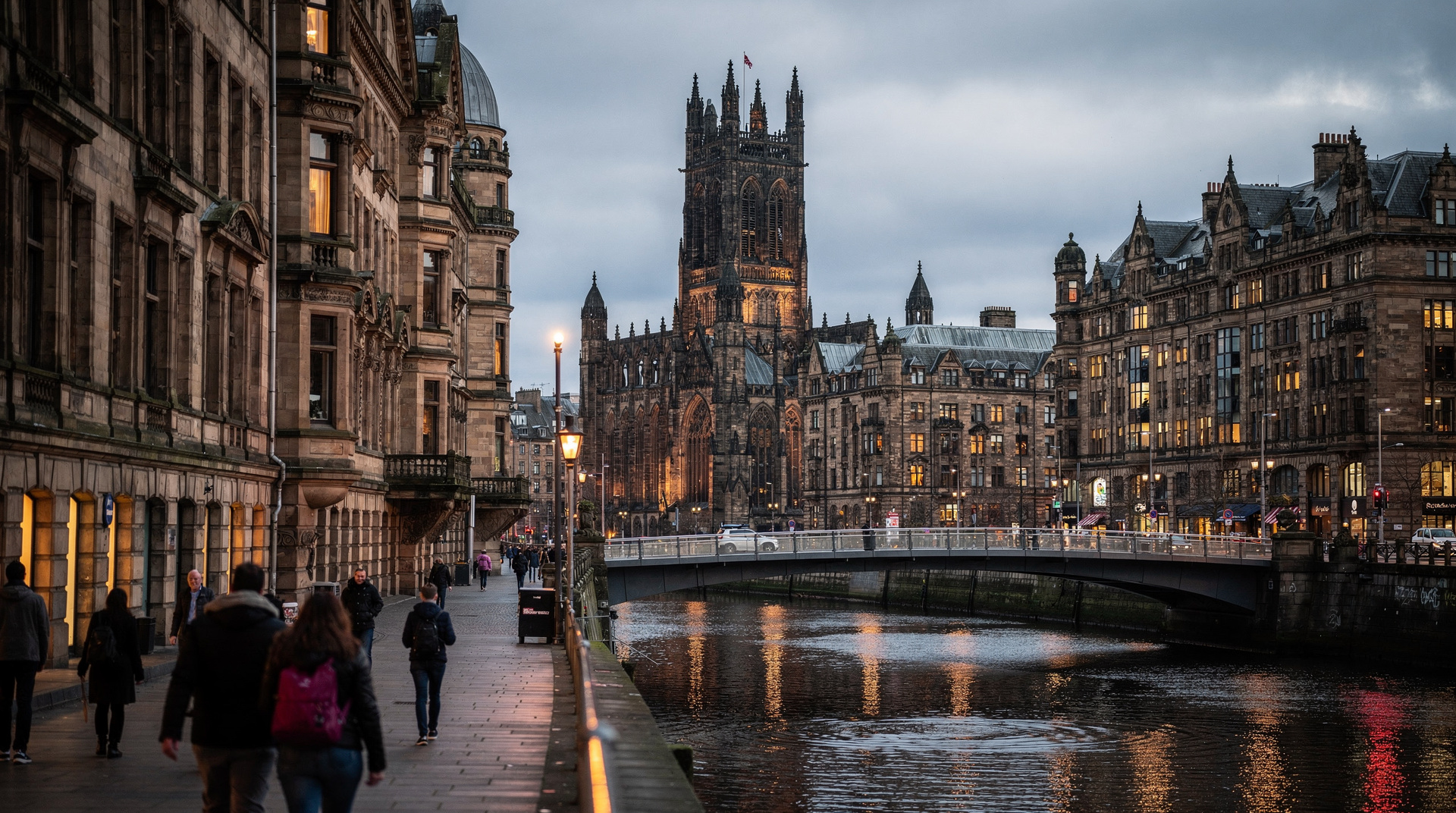
Glasgow’s West End, centred on Byres Road and the University of Glasgow, is the most pleasant area for a walking day in the city. The university buildings — Gothic Revival, modelled on Oxford — are open to walk around, and the Hunterian Museum and Art Gallery within the university is free and excellent (includes Mackintosh’s reconstructed home, currently the best place to see his domestic interior design). Byers Road has independent bookshops, cafés, and the best density of good independent restaurants outside the Merchant City.
A walk from the Kelvingrove along the riverbank of the Kelvin, through Kelvingrove Park to the university and along Byers Road, takes 30-40 minutes and passes all the key West End landmarks without needing to navigate.
The Clydeside and industrial heritage
The River Clyde, on which Glasgow’s industrial wealth was built — shipbuilding, engineering, locomotive manufacturing — is now a regenerated waterfront. The Riverside Museum (free, designed by Zaha Hadid) covers Glasgow’s transport and industrial heritage with good collections including historic locomotives, trams, and the Clyde-built tall ship SS Glenlee alongside the building. The museum is about 1.5 miles west of the city centre, walkable along the riverside path.
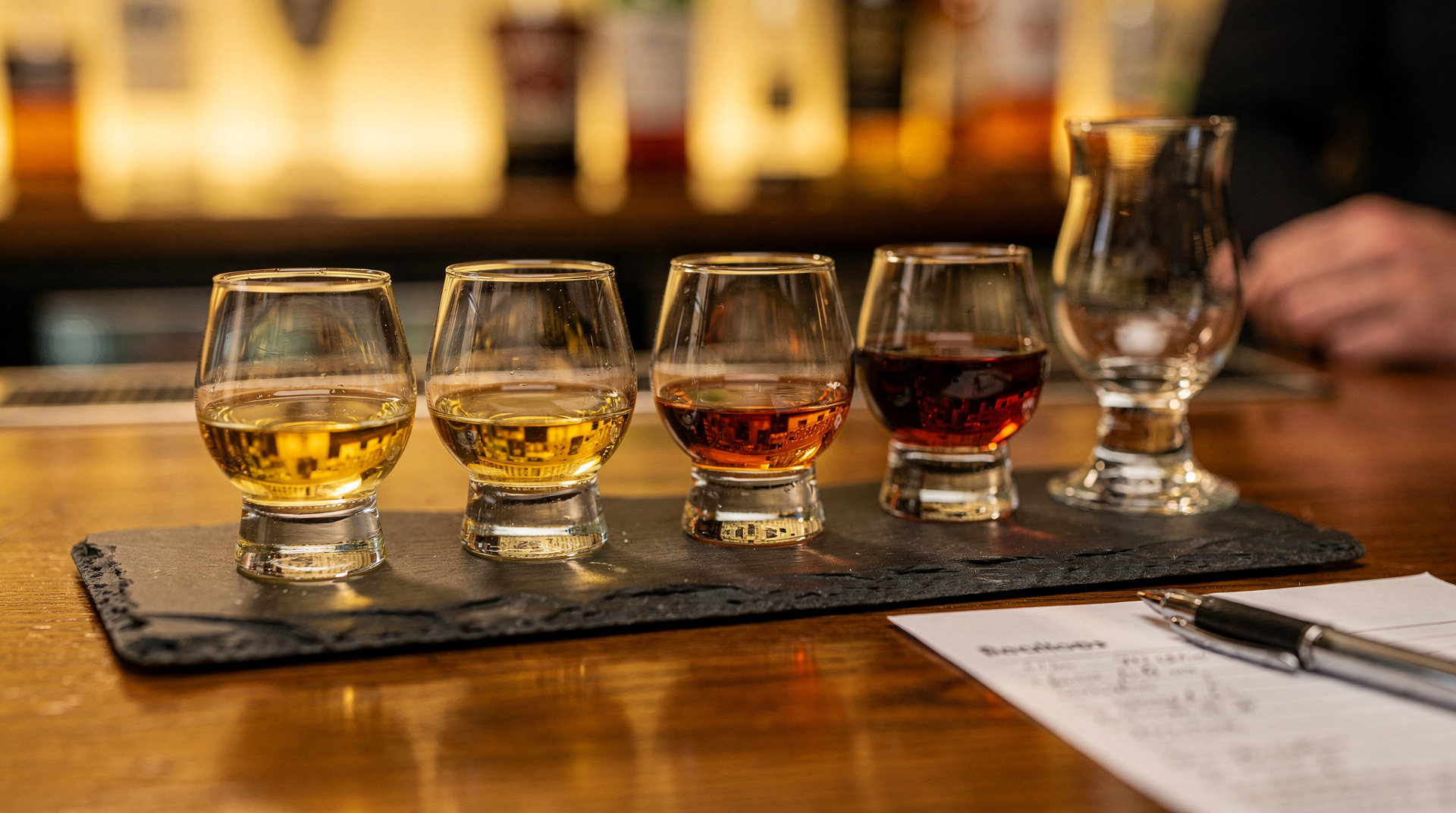
For those interested in whisky, the Clydeside Distillery tour and whisky tasting is in a restored Victorian pumphouse on the Clyde, giving a working Lowland distillery experience within the city. Glasgow was historically a major whisky blending centre, and the Clydeside revival is part of a broader Scottish craft distillery expansion.
Guided walking tours vs independent
Glasgow is very walkable in the central areas, and the free museums mean independent visits are cost-effective. A Glasgow must-see attractions walking tour is worth considering if you want the historical narrative to connect the cathedral, merchant city, and Mackintosh landmarks — the guides on these tours typically provide context on the industrial history and its aftermath that is not obvious from signage alone.
The Glasgow hop-on hop-off bus tour covers the major sites including the Kelvingrove, Riverside Museum, and West End — useful for a first visit if you want to cover ground efficiently before deciding where to spend more time.
Glasgow Cathedral and the medieval city
Most tourists concentrating on the West End and Kelvingrove miss the medieval core of Glasgow — the cathedral and its surroundings, which represent the original settlement and are a 20-minute walk northeast from the city centre.
Glasgow Cathedral is one of the finest complete medieval cathedrals in Scotland — built from the 12th century, it is the only mainland Scottish cathedral to have survived the Reformation intact. The lower church (crypt) is particularly impressive: a forest of columns supporting the vaulted ceiling, with the tomb of St Mungo (Glasgow’s patron saint) at its heart. Entry is free.
Adjacent to the cathedral is the Glasgow Necropolis, a Victorian cemetery on a hill with elaborate tombs and monuments and views over the city. It is the kind of place that reveals the Victorian ambition of a city at the height of its industrial wealth. Free to walk through; the hillside circuit takes about 30-40 minutes.
Provand’s Lordship, across the street from the cathedral, is Glasgow’s oldest surviving domestic building (1471) and is now a small museum with period interiors. Mary, Queen of Scots is said to have stayed here. Free entry.
The Merchant City
Between the cathedral and the main shopping street (Buchanan Street) lies the Merchant City, the 18th-century commercial quarter built on the wealth of tobacco and sugar trading with the Americas. The street plan is Georgian, the buildings are solid and handsome, and the area has been successfully regenerated as Glasgow’s arts, café, and restaurant quarter.
The Gallery of Modern Art on Royal Exchange Square (free entry) occupies the neoclassical former Royal Exchange building and has good contemporary Scottish and international art collections. The square is one of Glasgow’s most photographed — the Duke of Wellington equestrian statue with a traffic cone on its head is a Glasgow tradition so persistent that the council eventually conceded and raised the plinth height rather than continuing to remove it.
Ingram Street and the surrounding Merchant City streets have the best density of independent restaurants and bars in Glasgow. Hutchesons (Ingram Street), Rogano (Exchange Place, a seafood restaurant in its original 1930s Art Deco interior), and the Saramago Cafe Bar in the CCA (Centre for Contemporary Arts) are all worth knowing.
Glasgow’s music scene
Glasgow’s claim to be Scotland’s — possibly the UK’s — best music city is not simply boosterism. The city has produced an extraordinary number of influential bands and artists across genres: Mogwai, Teenage Fanclub, Belle and Sebastian, Franz Ferdinand, Chvrches, Frightened Rabbit, Boards of Canada, Simple Minds, and many others have come from Glasgow or Glasgow’s university and arts college scene.
The venues that support live music are among the best in Britain: the Barrowland Ballroom (a 1930s ballroom above the Barras market) has a reputation among touring musicians as one of the best mid-size venues in the world, with a sprung wooden floor and a committed audience culture. King Tut’s Wah Wah Hut on St Vincent Street is the smaller city-centre venue; the O2 Academy and SEC Armadillo cover the larger end.
For a day trip from Edinburgh, catching live music at Barrowland or King Tut’s requires staying overnight — most shows start at 8pm and end around 11pm. The Edinburgh and Glasgow five-day itinerary builds in an overnight Glasgow stay for exactly this reason.
The Burrell Collection
The Burrell Collection at Pollok Park in the south of Glasgow is Glasgow’s most underrated major museum. Sir William Burrell, a Glasgow shipping magnate, assembled one of the most eclectic private art collections of the 20th century — medieval tapestries, stained glass, Chinese porcelain, Persian carpets, Egyptian antiquities, Impressionist paintings (Degas, Cezanne, Renoir), and medieval armour, among much else. He donated the collection to the City of Glasgow in 1944. The building, which incorporates sections of medieval architecture from Burrell’s Hutton Castle in Berwickshire, was renovated and reopened in 2022.
The collection is genuinely good and genuinely free, and it is in Pollok Country Park — a woodland park in the south of the city that also has highland cattle grazing in its grounds. Getting there from the city centre requires a train to Pollokshaws West or a bus; allow 25 minutes from the city centre. The combination of the museum visit and a walk in the park makes a complete afternoon.
Combining Glasgow with the rest of your trip
Glasgow works best when it is treated as one part of a longer Scottish route rather than an isolated stop. Many visitors base themselves in the capital and head west for a day, so it helps to know what Edinburgh itself offers on the other days: the Royal Mile and Edinburgh Castle anchor the Old Town, while the New Town gives a very different, Georgian feel. The contrast between those districts and Glasgow’s Victorian centre is part of the pleasure of seeing both.
If you want help sequencing your days, the three-day Edinburgh itinerary leaves room to swap a day for Glasgow, and the Edinburgh travel guide for first-timers covers the basics that apply to the whole trip.
Day trips from Glasgow
Glasgow is also a base for day trips — though these are better known from Edinburgh because Edinburgh’s tourism marketing is stronger. From Glasgow, Loch Lomond is 30 minutes north (faster than from Edinburgh), Stirling is 45 minutes east, and the Trossachs National Park is easily accessible. The Glasgow: Loch Lomond, Trossachs and Stirling Castle tour covers this Highland-adjacent day trip directly from Glasgow.
Glasgow versus Edinburgh: the honest contrast
| Glasgow | Edinburgh | |
|---|---|---|
| Character | Industrial, Victorian grandeur, working-class energy | Georgian and medieval, festival city, more polished |
| Museums | Kelvingrove, Burrell, Hunterian — mostly free and world-class | National Museum, National Gallery — also strong, smaller free offer overall |
| Food | Best South Asian food in Britain, Finnieston bars | More refined fine dining, tourist-heavy Old Town options |
| Architecture | Mackintosh, Victorian commercial grandeur | Georgian New Town, medieval Old Town |
| Music/nightlife | Genuinely excellent live venues (Barrowland, King Tut’s) | Strong but more festival-seasonal |
| First-time visitor pull | Underrated, less obviously photogenic | Instantly photogenic, higher name recognition |
Neither city makes the other redundant — visitors who only do Edinburgh are missing a genuinely different and excellent Scottish city 50 minutes away by train.
Practical information for 2026
Free museums: Kelvingrove, Hunterian, Burrell Collection, Gallery of Modern Art, Riverside Museum, Glasgow Cathedral — all free entry. Glasgow’s free museum offer is one of the best in Britain.
Getting around: The subway runs a single circular line covering the city centre and West End — useful for getting between the city centre and Kelvingrove or Byres Road. All-day passes are good value.
Comparing Edinburgh and Glasgow: The Edinburgh vs Glasgow comparison guide gives an honest assessment of which city suits which type of visit and what each does distinctively well.
Best districts for food: Finnieston (west of the motorway on Argyle Street) for modern Scottish restaurants; Merchant City for variety; Byers Road and surroundings for independent cafes and cuisine diversity; Sauchiehall Street area for South Asian restaurants.
Currency: Pounds sterling throughout Scotland — the same currency you use in Edinburgh. The Edinburgh currency guide covers exchange advice for visitors from non-sterling countries. Glasgow does not use euros and most venues prefer card payment.
UK ETA: International visitors should check the UK ETA guide for current entry requirements before travelling to the UK.
UK ETA: Overseas visitors — see the UK ETA guide for requirements.
Frequently asked questions about Glasgow
How long does the train from Edinburgh to Glasgow take?
Around 50-55 minutes from Edinburgh Waverley to Glasgow Queen Street, with several services per hour. Day returns cost roughly £15-£25 if booked ahead. The M8 motorway by car takes about 1 hour.
Is Glasgow safe to visit?
Yes. Glasgow has a historical reputation for rough areas that is decades out of date in the city centre and West End. The areas tourists visit — Merchant City, Kelvingrove, West End, Clydeside — are safe and well-maintained. The usual city-common-sense applies as in any urban area.
What is Glasgow famous for culturally?
Mackintosh architecture, the Kelvingrove, Celtic and Rangers football, the music scene (which produced Mogwai, Teenage Fanclub, Chvrches, Belle and Sebastian, Franz Ferdinand, and many others), the international curry restaurants, and the Barras market. Glasgow also claims to have invented the deep-fried Mars bar, which is accurate and not something to be proud of.
Are the Kelvingrove and Burrell Collection worth visiting?
Yes, strongly. Both are genuinely world-class collections available free of charge — an unusual combination. The Kelvingrove building alone justifies the visit; the Burrell Collection (medieval art, Oriental art, and European decorative arts collected by shipping magnate William Burrell) is exceptional for its range and quality.
Should I spend a night in Glasgow or just day-trip?
For most Edinburgh visitors with limited time, a day trip is sufficient for the city centre highlights. If you have a strong interest in architecture, music, or art, or want to do the West End and Clydeside properly, a night in Glasgow gives you better coverage. The Edinburgh and Glasgow five-day itinerary builds both cities into a complete twin-city programme.
Do I need to book museum entry in advance?
Generally no — Kelvingrove, the Burrell Collection, the Hunterian, and Glasgow Cathedral are all free with walk-up entry for most visits. Occasional ticketed special exhibitions may require advance booking; check individual museum websites if there’s a specific show you want to see. This is one of the genuine advantages of a Glasgow day trip over more heavily ticketed cities.
Top experiences
Bookable activities with verified prices and instant confirmation on GetYourGuide.