Outlander filming locations near Edinburgh: the complete guide
Edinburgh: the Outlander 1-day experience guided tour
What are the best Outlander filming locations near Edinburgh?
Doune Castle (Castle Leoch), Midhope Castle (Lallybroch exterior), Blackness Castle, Linlithgow Palace, and Falkland (the Inverness scenes) are all within 1-2 hours of Edinburgh. A guided day tour is the most efficient option; some sites require significant driving to reach on your own.
Scotland and Outlander: why the locations matter
Outlander, Diana Gabaldon’s novel series adapted for television, is set primarily in eighteenth-century Scotland during the Jacobite rising of 1745. The combination of Jacobite history, Scottish landscape, and time-travel romance has created one of the most loyal and enthusiastic travel-tourism fanbases in Scotland’s visitor economy. The show has generated a measurable increase in visits to several key locations, and the Scottish tourism industry has embraced it as a major driver.
The filming locations are genuine and in most cases historically significant in their own right — Doune Castle, for instance, was a real medieval stronghold used in multiple productions, and Linlithgow Palace was the birthplace of Mary Queen of Scots. This means that even visitors who are not Outlander fans will find the locations worthwhile, which is a useful argument for convincing travel companions.
Most of the key filming locations are within one to two hours of Edinburgh. Some require a car; others are accessible by a combination of train and local bus. Guided day tours from Edinburgh are the most efficient option for visiting multiple locations in a single day.
| Where | Central Scotland, 40 minutes to 2 hours from Edinburgh |
| Cost | Guided tour ~£50-80/adult; individual site entry £7.50-£10 |
| Time needed | Half-day for one site, full day for three or four |
| Getting there | Guided tour, self-drive, or train + bus for closer sites |
| Best time | April-October; low autumn light suits the castles |
Doune Castle: Castle Leoch in the series
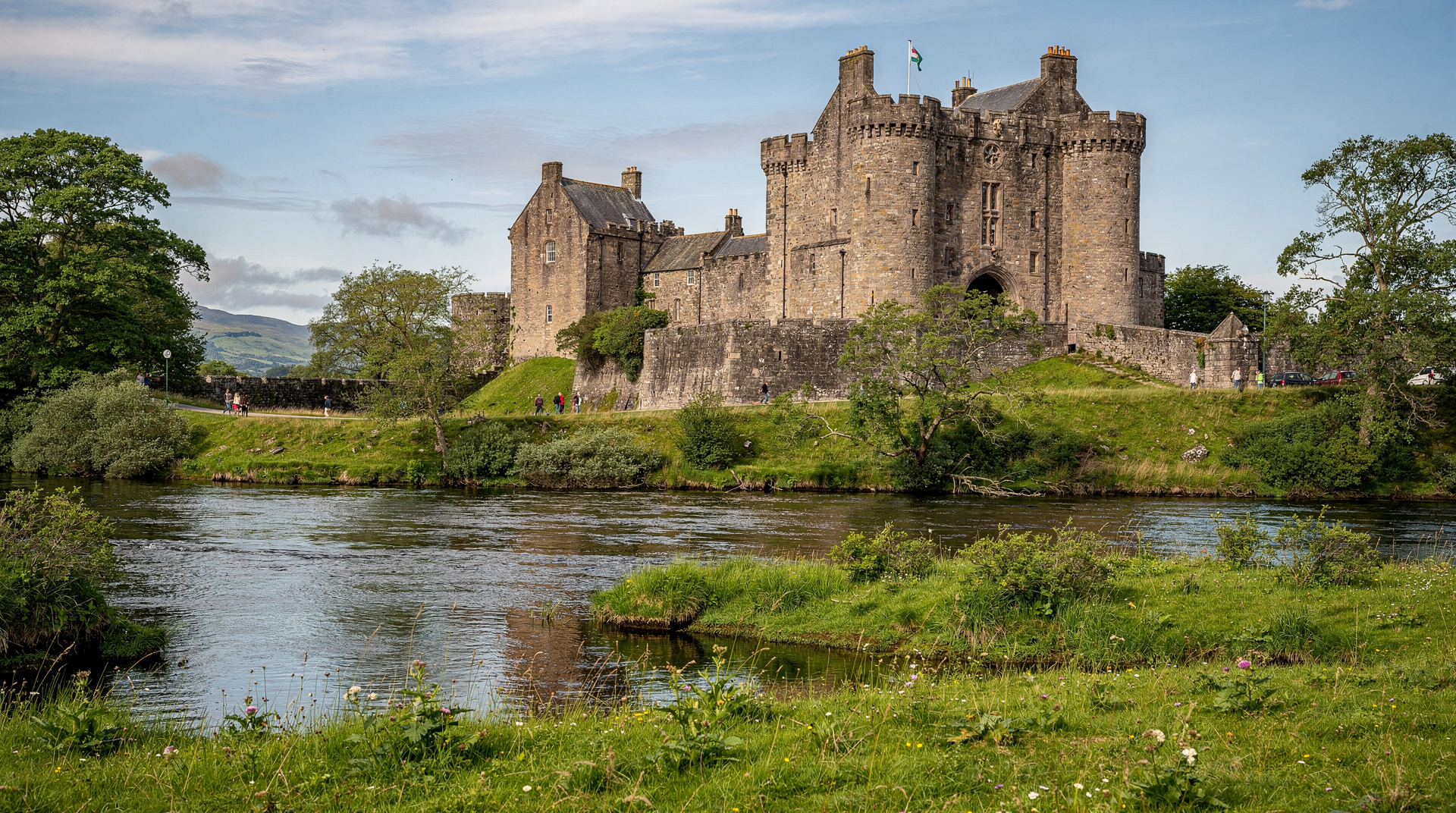
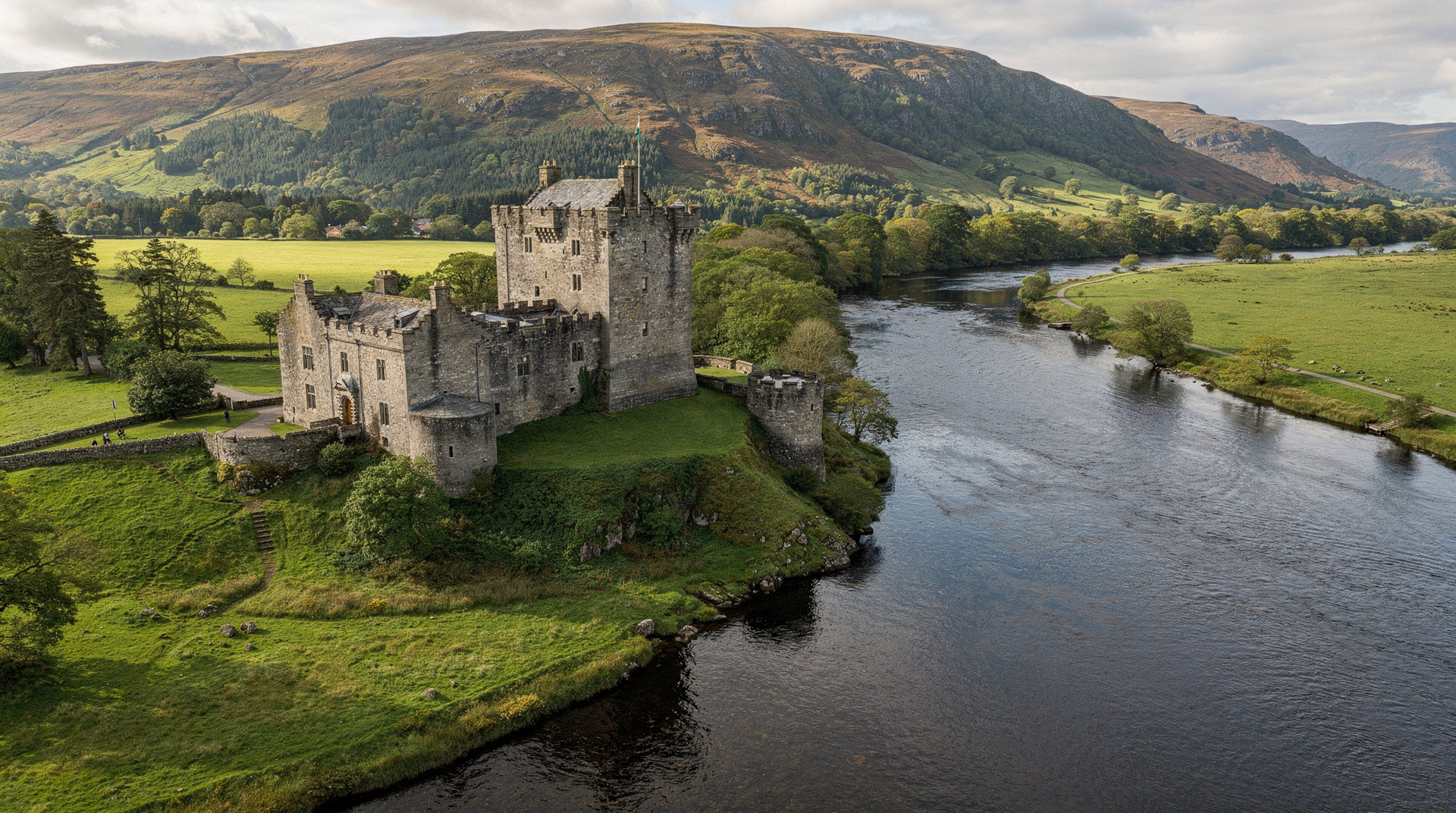
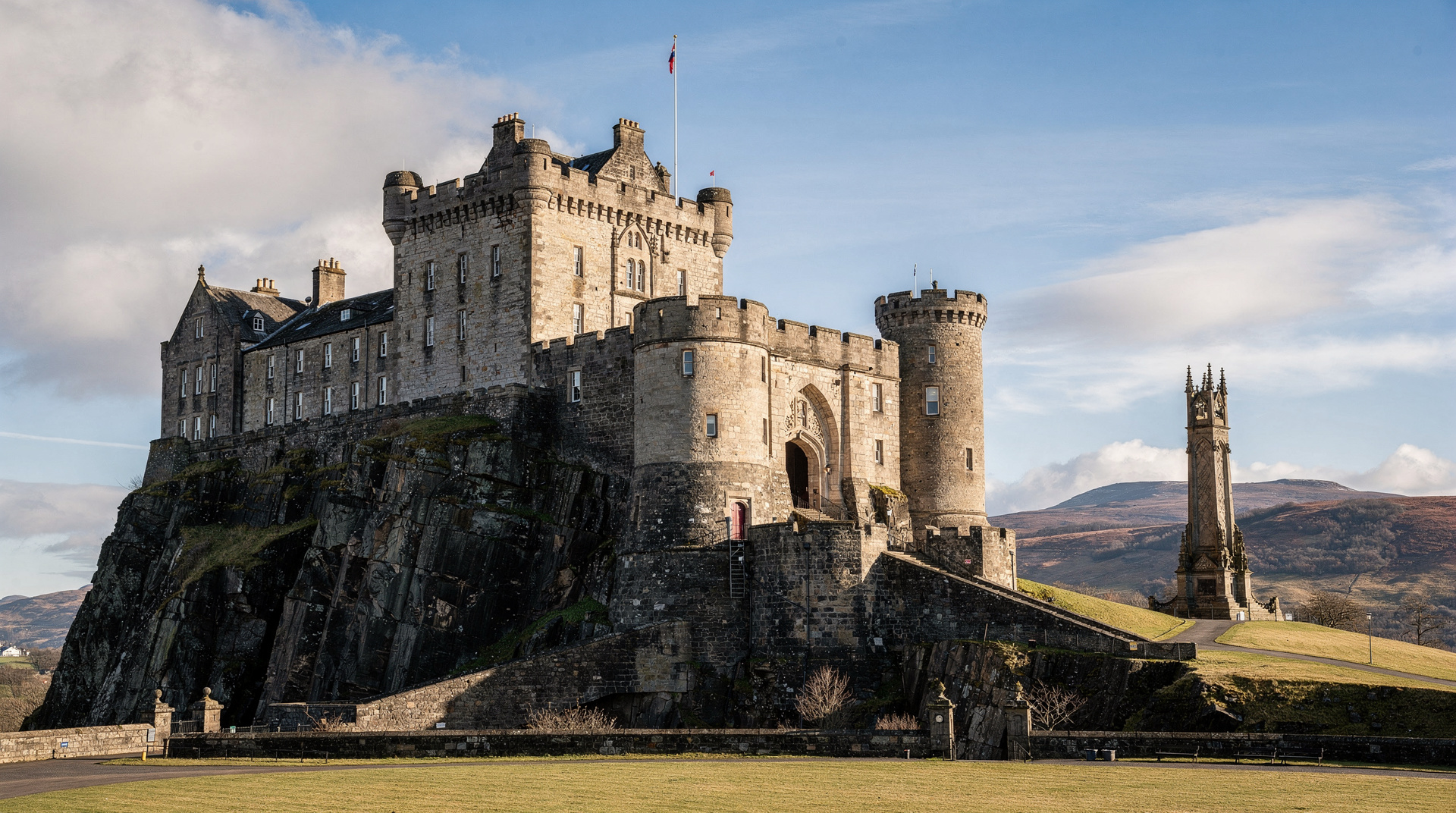
Doune Castle, in Stirling-shire about an hour west of Edinburgh, is the most immediately recognisable Outlander filming location in central Scotland. In the show, it appears as Castle Leoch, the seat of Clan MacKenzie, which is central to the first two seasons. The castle is a well-preserved fourteenth-century stronghold — grey stone, imposing towers, the kind of austere Scottish castle that photographs dramatically in any light.
The site is managed by Historic Environment Scotland and is open to visitors year-round. Admission is £10 per adult when booked online. An audio guide voiced by Sam Heughan (who plays Jamie Fraser in the series) is available at the castle. The combination of genuine medieval history and Outlander association makes Doune probably the single best value film tourism destination in the Edinburgh day-trip range.
Getting there without a tour: train to Stirling (50 minutes from Edinburgh Waverley), then a bus or taxi to Doune — total journey around 90 minutes. By car from Edinburgh, it is approximately one hour via the M9 and A84.
Lallybroch: Midhope Castle
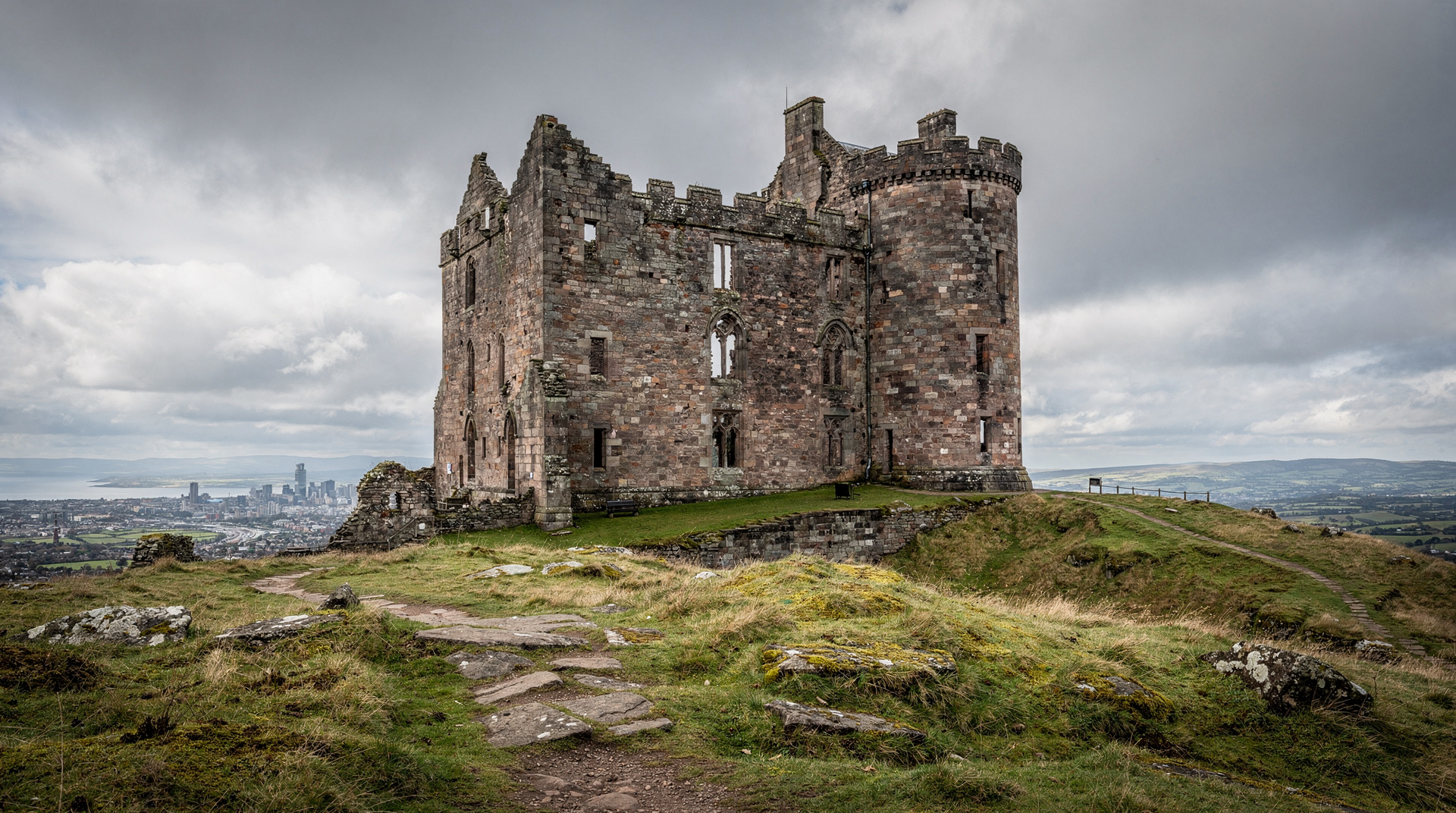
Midhope Castle serves as the exterior of Lallybroch, the Fraser family estate, in the Outlander television series. The real building is a ruined sixteenth-century tower house on the grounds of the Hopetoun House estate near South Queensferry, about 40 minutes west of Edinburgh.
Access to Midhope Castle requires advance planning. It is on private land within the Hopetoun Estate and is not part of the standard Hopetoun House visitor admission. As of 2026, timed access tickets for Midhope Castle can be purchased through the Hopetoun House website, with current prices on the official Hopetoun House website. Visiting without a ticket is not possible — the estate controls access carefully partly because of the volume of Outlander tourism.
The castle is a ruin and cannot be entered, but the exterior and the surrounding landscape are exactly as shown in the series. Combining a visit to Midhope with a full visit to Hopetoun House (a magnificent Georgian stately home with fine interiors) makes for a good half-day in the Queensferry area.
Blackness Castle: Fort William in the series
Blackness Castle, on the south shore of the Firth of Forth about 25 miles west of Edinburgh, appears in the series as Fort William — the British garrison where Jamie Fraser is flogged. The castle is an unusual ship-shaped fortification built in the fifteenth century and used as a state prison in later periods. It is one of Scotland’s better-preserved medieval castles and photogenic in the extreme, especially from the approach road along the shoreline.
Managed by Historic Environment Scotland; admission £7.50 per adult when booked online. Getting there from Edinburgh without a car is possible but cumbersome — train to Linlithgow, then a taxi. By car, allow 40-45 minutes from Edinburgh city centre.
Linlithgow Palace: the Paris and Versailles scenes
Linlithgow Palace, about 20 miles west of Edinburgh, served as the French palace of Louis XV in Outlander and was also used for scenes set in other French court locations. This is one of the more striking film-location choices in the series: the real building is a ruined Scottish palace that was the birthplace of Mary Queen of Scots, and the transformation required to make it look like Versailles was achieved primarily through strategic framing and set dressing.
The palace is a major historic attraction in its own right. It stands on the banks of Linlithgow Loch, and the combination of ruin, loch, and the adjacent Linlithgow Parish Church (which provides the historic townscape) is worth visiting regardless of Outlander. Managed by Historic Environment Scotland; admission £10 per adult when booked online. Train from Edinburgh Waverley to Linlithgow is approximately 20 minutes — the palace is a short walk from the station.
Falkland: standing in for 1940s Inverness
The small Fife town of Falkland served as the 1940s version of Inverness in the early episodes of Outlander, primarily because it retains enough intact period architecture to be dressed for the 1940s without extensive CGI. The town is centred on Falkland Palace, a Renaissance palace that was a favourite residence of the Stuart kings and is one of Scotland’s more underrated historic attractions.
Falkland is about an hour from Edinburgh by car or an hour and twenty minutes by train (change at Markinch or Kirkcaldy). It is typically combined with St Andrews on a Fife day trip — see the St Andrews day trip guide for the full Fife circuit.
Visiting via guided tours
The most efficient way to visit multiple Outlander filming locations in a single day is a guided tour from Edinburgh. The distance and transport challenges of individual sites make driving or public transit logistics time-consuming if you are trying to cover several locations.
The Outlander one-day experience from Edinburgh is the headline tour — a full-day guided excursion covering the main filming locations with a specialist guide who provides both the Outlander context and the real Scottish history. It typically covers four to five sites and includes pickup from central Edinburgh.
The full-day Outlander filming locations explorer tour covers a slightly different selection of sites and is oriented more specifically toward fans who want to stand in the exact filming positions — it provides more granular location-matching than the general experience tour. Both are good options; the choice depends on whether you want depth (explorer) or breadth (one-day experience).
For visitors who want to combine Outlander locations with broader Scottish history and landscape, the Outlander day trips guide covers additional locations further from Edinburgh that require a multi-day visit.
Planning your Outlander visit from Edinburgh
The Outlander filming locations are geographically spread in a way that requires careful sequencing. Visitors who try to cover all the key sites in a single day will find themselves spending more time driving or in transit than at the locations themselves. A realistic single-day programme covers two or three sites; a two-day programme allows four to five sites and the possibility of including Falkland or the Stirling area.
For visitors without a car, the getting around Edinburgh guide covers the transport options in detail. Linlithgow (train, 20 minutes) and Stirling (train, 50 minutes) are the most accessible Outlander-adjacent areas by public transport. Doune Castle requires a bus change in Stirling. Midhope/Lallybroch requires a taxi from Dalmeny station or a hire car.
Visitors planning a longer Scotland trip might consider routing through the Outlander locations as part of a wider Central Scotland itinerary. The Stirling area alone — Stirling Castle, Doune Castle, the Wallace Monument, and the Bannockburn battlefield — covers enough Scottish history to justify an overnight, and the Outlander connection at Doune is a natural additional draw. The Stirling day trip guide covers the full area.
Best time for Outlander tourism: April through October for open sites and the best weather. Several sites are managed by Historic Environment Scotland and have reduced winter hours. The summer months of June through August bring the most visitors; April, May, and September are excellent for quieter conditions with full programming at most sites.
UK ETA requirement: Many non-UK visitors need an Electronic Travel Authorisation (UK ETA) before arrival in the UK — around £20, applied for online. This is relevant for any trip to Scotland including Outlander tourism. See the UK ETA guide for current requirements.
Connecting Outlander to the real Jacobite history
One of the most rewarding aspects of Outlander tourism is that it consistently leads visitors to genuinely significant historical sites. The Jacobite rising of 1745-46 — the event at the heart of the series’ historical narrative — is one of the most consequential events in Scottish history, ending with the Battle of Culloden and the brutal suppression of Highland culture that followed.
The real historical sites associated with the Jacobites go beyond the Outlander filming locations. Stirling Castle, which appears briefly in the series, was a key Jacobite prize — Edinburgh Castle held out against the Jacobites when the city briefly fell to Bonnie Prince Charlie in 1745. The Edinburgh Castle guide covers this episode. The Palace of Holyroodhouse, where the prince held court during his occupation of Edinburgh, is open to visitors as part of the standard Royal Mile itinerary — see the Holyrood guide for details.
For visitors who want to combine the Outlander connection with a genuine understanding of the Jacobite history, the Jacobites and Edinburgh guide provides the full narrative context from the 1688 Glorious Revolution through to Culloden and its aftermath.
The honest Outlander tourism note
Some of the Outlander filming locations are extraordinarily beautiful and historically significant in their own right. Doune Castle and Linlithgow Palace would be worth visiting without any Outlander connection. Others — Midhope Castle in particular — are primarily of interest to series fans; the ruin itself is modest, and the visit makes sense mainly because of its significance to the show.
A good guided tour will give you both the Outlander context and the genuine history, making the locations interesting on multiple levels. A poor tour focuses exclusively on the show without engaging with why these buildings are worth seeing beyond the filming connection. When choosing a tour, look for operators who mention Scottish history alongside Outlander — the best guides treat the show as a gateway to the real history rather than as the destination itself.
The Outlander landscape beyond the filming sites
One of the rewards of Outlander tourism in central Scotland is that the filming locations sit within a genuinely remarkable landscape that is worth experiencing independent of any show connection. The Stirling area — where Doune Castle is located — is at the heart of Scottish medieval history: Stirling Castle commanded the lowest crossing point of the Forth for centuries, making it the key to Scotland’s geography and the site of some of the country’s most important battles.
The drive from Edinburgh to Doune, via the M9 and the A84, passes through the Ochil Hills and across the flat carseland of the upper Forth valley — a landscape of considerable drama in any season. In late summer and autumn, the heather moors visible from the road turn purple in a way that directly evokes the visual texture of the show’s outdoor scenes. The landscape authentically is what the show suggests it is, which is not always the case with television location filming.
For visitors specifically interested in the landscape photography angle — replicating shots from the series or simply experiencing the Scottish scenery — the Trossachs National Park (adjacent to the Doune/Stirling area) offers the most accessible Highland-quality landscape from Edinburgh. The Loch Lomond and Trossachs day trip guide covers the options in detail.
Practical planning for Outlander tourism
Best time to visit: April through October offers the best weather for outdoor filming locations. Several of the sites (Doune, Blackness, Linlithgow) are at their most dramatic in low autumn light. Falkland is particularly good in spring when the palace gardens are at their best.
Accessibility: Most Outlander filming locations involve walking on uneven historic surfaces. Doune Castle has some very steep stairs. Midhope Castle is accessible from a flat path but involves a walk across estate grounds. Check individual attraction accessibility pages if this is a concern.
Photography: All the filming locations allow photography. The Hopetoun/Midhope access tickets typically include photography rights — check at the time of booking.
What to wear: Central Scotland’s weather changes quickly at any of these sites, and several involve time outdoors in castle courtyards or across estate grounds. A waterproof jacket and sturdy, closed shoes matter more than the season — Doune Castle in particular has steep, uneven stone stairs that are unpleasant to navigate in unsuitable footwear. Layers work better than one heavy coat, since indoor visitor centres are heated while battlements and courtyards are exposed.
Outlander tourism in the wider Scottish visitor economy
The Outlander effect on Scottish tourism has been measurable and sustained. Visit Scotland has tracked an increase in American visitors to Scotland — one of the show’s largest audiences — that correlates with the series premiere and subsequent seasons. Several of the filming locations have reported significant increases in visitor numbers, particularly Doune Castle and Midhope.
This has had mixed effects. At Doune Castle, the Outlander association has introduced a new audience to a genuinely excellent medieval castle that was previously undervisited. At Midhope, the popularity has required the Hopetoun Estate to introduce ticketing and access controls to manage the volume of visitors to a fragile historic ruin. The tension between accessibility and preservation is ongoing.
For visitors, the practical implication is that some sites require advance booking that was not necessary before the show’s popularity peaked. Midhope in particular can sell out its timed access slots days in advance during the summer season. Plan accordingly.
This tension is a useful lens for visitors deciding how to behave on site: stick to marked paths, follow estate signage at Midhope, and treat these as working historic properties rather than film sets. The volume of visitor traffic at the most popular locations means small individual choices — not climbing on ruined walls, not leaving litter, keeping noise down near residential areas close to Doune and Blackness — have a cumulative effect on whether access continues to be granted as freely as it is today.
The best day trips from Edinburgh guide provides a broader overview of all day trip options from the city, including how Outlander locations compare in terms of travel time and visitor experience with other day trip options such as Loch Ness, St Andrews, and Stirling.
Doune Castle versus Midhope Castle: which matters more
Visitors with limited time often ask which single site to prioritise if they can only manage one. Doune Castle is the stronger standalone visit: it is a genuine, fully explorable fourteenth-century stronghold with towers, a great hall, and battlements, and it would be worth visiting regardless of any Outlander connection. Midhope Castle, by contrast, is a small ruined tower house that cannot be entered — the value is almost entirely in recognising the exterior from the show and standing in the Lallybroch landscape. For a single stop with limited time, choose Doune. For completionist fans who want the full Lallybroch experience alongside a visit to the genuinely impressive Hopetoun House next door, Midhope is worth the extra planning.
A realistic two-site half-day from Edinburgh
For visitors with only half a day and no car, the most efficient combination without a guided tour is Linlithgow Palace (train, 20 minutes) followed by a taxi or short additional journey to Blackness Castle. Both are Historic Environment Scotland sites with straightforward admission, and the pairing covers two very different Outlander storylines — the French court scenes and the Fort William garrison — in a single outing that takes roughly four hours door to door including travel. Visitors with a car can extend this to a third site (Doune or Midhope) if starting before 10am.
Frequently asked questions about Outlander locations near Edinburgh
Which Outlander filming location is closest to Edinburgh?
Midhope Castle (Lallybroch) is approximately 40 minutes from Edinburgh city centre by car. Blackness Castle is similar distance. Both are within the Edinburgh city-region and require no long-distance travel.
Do I need a car to visit Outlander filming locations?
Not necessarily, but it helps. Linlithgow Palace is easily accessible by train (20 minutes from Waverley). Doune Castle requires a change in Stirling but can be done by public transport. Midhope/Hopetoun is awkward by public transport. The guided day tours from Edinburgh solve the logistics problem entirely and are worth considering for their convenience alone.
Is Outlander filmed entirely in Scotland?
Primarily yes, though some scenes were filmed in South Africa (representing the West Indies in later seasons) and elsewhere. The Scottish landscape is the dominant visual context for the series and the vast majority of the recognisable Scottish locations are accessible from Edinburgh.
Can you visit the Outlander filming locations without being a fan?
Absolutely. Doune Castle, Linlithgow Palace, Falkland, and Blackness Castle are all genuinely important historic sites that reward a visit independent of any television connection. If anything, the Outlander connection brings additional visitors who then discover the depth of Scottish history the locations contain.
Are there Outlander locations in Edinburgh itself?
The city of Edinburgh does not feature prominently as a filming location in Outlander — the show set in rural Scotland, Highland landscapes, and smaller towns rather than the capital. Some scenes were filmed in the old town area, but Edinburgh itself is not a major Outlander set. The city is primarily a base for visiting the surrounding locations.
Which single Outlander site should I visit if I only have time for one?
Doune Castle. It is the most recognisable location from the series, it is a genuinely impressive medieval building independent of the show, and it is reachable in about an hour each way by car or roughly 90 minutes by public transport. See the comparison above for how it stacks up against Midhope Castle specifically.
Can I visit Outlander locations as a half-day trip without a car?
Yes, with realistic expectations. Linlithgow Palace alone is a straightforward half-day by train. Combining it with Blackness Castle requires a taxi connection and takes closer to a full half-day. For visitors without a car who want to see three or four sites, a guided tour remains the more time-efficient option than assembling public transport connections independently.
Top experiences
Bookable activities with verified prices and instant confirmation on GetYourGuide.