Holyrood and Arthur's Seat
Everything you need for Holyrood Palace, Arthur's Seat, and Holyrood Park: honest ticket advice, hiking routes, and how to combine the lot in a half day.
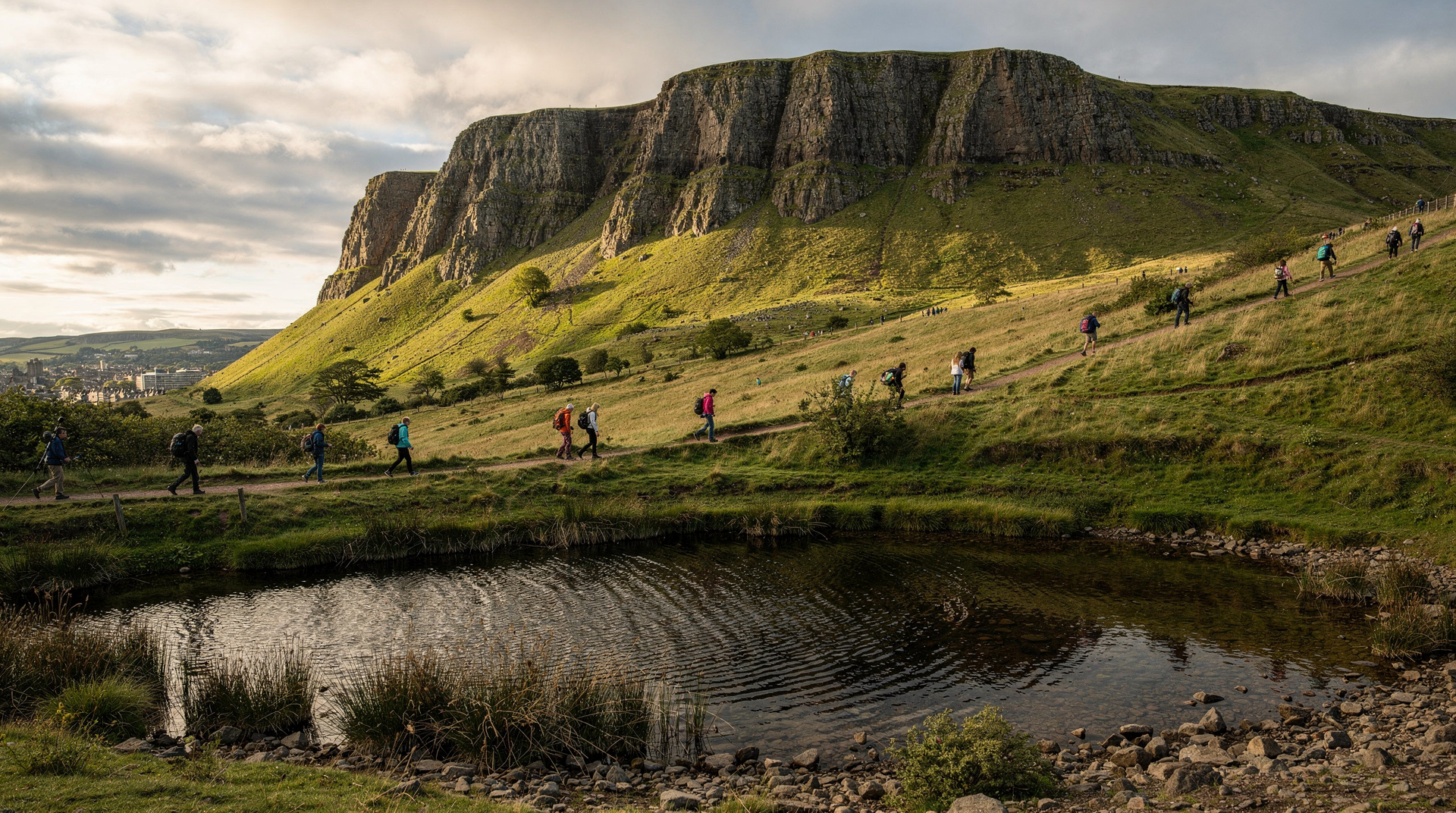
Edinburgh: guided hike to Arthur's Seat and Holyrood Park
Quick facts
- Best time to visit
- Clear days for the summit; May–September for hiking
- Days needed
- Half day
- Getting there
- 10-min walk from Waverley; foot of the Royal Mile
- Budget per day
- Holyrood Palace £22 adults; Arthur's Seat free
A volcano, a palace, and one of Britain’s best urban hikes
At the lower end of the Royal Mile, where the medieval city gives way to the Scottish Parliament building and then to open parkland, Edinburgh reveals one of its strangest qualities: a 251-metre volcanic hill sitting within a kilometre of the city centre, rising above a royal palace and a parliament, offering views that on a clear day extend from the Bass Rock to the Pentlands. Arthur’s Seat is the central summit of Holyrood Park, which covers 650 acres of volcanic landscape that has never been built on, despite being surrounded by one of Scotland’s largest cities.
Combining Arthur’s Seat with a visit to the Palace of Holyroodhouse — the official Scottish residence of the British Royal Family — makes one of the finest half-days available in Edinburgh. The two things together give you six centuries of Scottish royal history and one of the most rewarding short hikes in Britain.
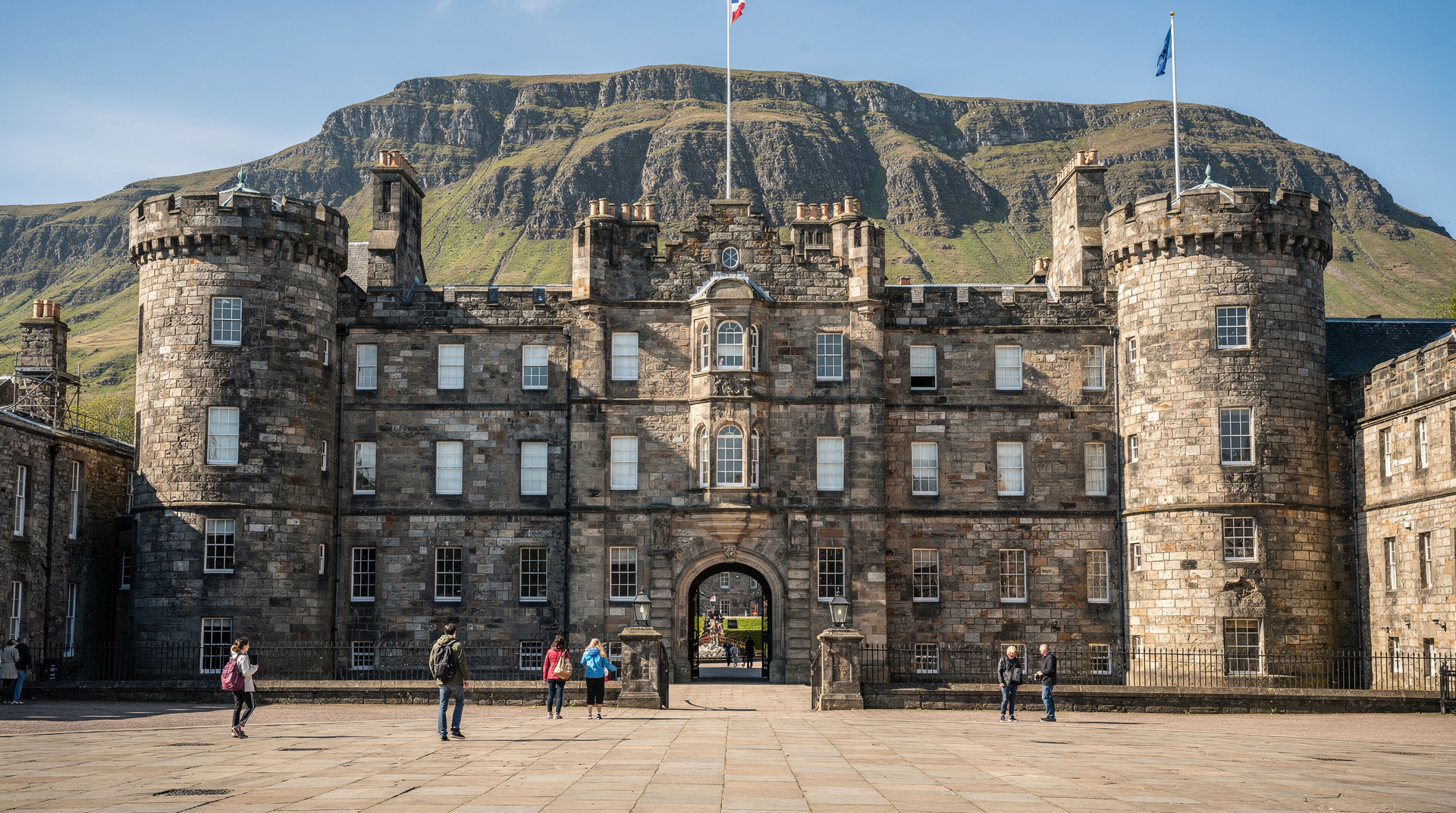
The Palace of Holyroodhouse
The Palace of Holyroodhouse began as an Augustinian abbey founded by David I in 1128. The abbey ruins are still visible at the eastern end of the palace complex, roofless now but with substantial walls still standing. The palace itself developed through the fifteenth and sixteenth centuries as the preferred residence of Scottish monarchs, most famously Mary Queen of Scots, whose apartments in the tower overlooking the entrance are the most historically charged rooms in the building.
Mary’s apartments in the northwest tower include the rooms where her private secretary David Rizzio was murdered in 1566, allegedly with the involvement of her husband Lord Darnley and a group of Protestant nobles. The spot where Rizzio died is marked by a brass plaque. Whether or not you consider the story entirely reliable in its received form, the physical rooms are genuinely atmospheric — small, stone-floored, dark even on bright days.
The State Apartments on the ground floor, used for royal receptions during state visits, are furnished from the eighteenth century onward and are impressive but somewhat formal. The Picture Gallery, with its famous series of 110 portraits of Scottish kings commissioned by Charles II, is historically interesting; the portraits are all clearly from the same hand and were commissioned for political reasons rather than genuine historical record. The official audio guide covers this honestly.
Entry in 2026 is £22 for adults when booked in advance (£26 on the day); check the official Royal Collection Trust site for child prices. The palace is sometimes closed for royal occasions — check before visiting, particularly in late June and early July when the King typically visits Edinburgh for Holyrood Week. The Palace of Holyroodhouse entrance ticket can be booked in advance, which is recommended during summer.
For visitors combining the palace with Edinburgh Castle, the Edinburgh Castle guided tour and Holyrood Palace ticket packages both in a single booking.
Arthur’s Seat: the hike
Arthur’s Seat is an extinct volcano — the central summit of a cluster of volcanic hills that dominated the landscape before Edinburgh grew up around them. The summit stands at 251 metres and involves a 180-metre ascent from the park gates near Holyrood Palace, typically taking 45 to 60 minutes up depending on your pace and the route chosen.
There are several routes to the summit, but the most straightforward is the path from the Dunsapie Loch car park on the eastern side of the park, which follows a clear ridgeline to the summit in about 30 minutes. More rewarding but slightly longer is the path from the Holyrood Palace gates, which climbs through Hunter’s Bog — the valley between Arthur’s Seat and the Salisbury Crags — and reaches the summit from the south. This gives the best views during the ascent.
The guided hike to Arthur’s Seat and Holyrood Park covers the summit route with an expert guide who can provide geological and historical context for the landscape. This is particularly good if you are interested in the volcanic geology, which Edinburgh’s landscape is exceptional for.
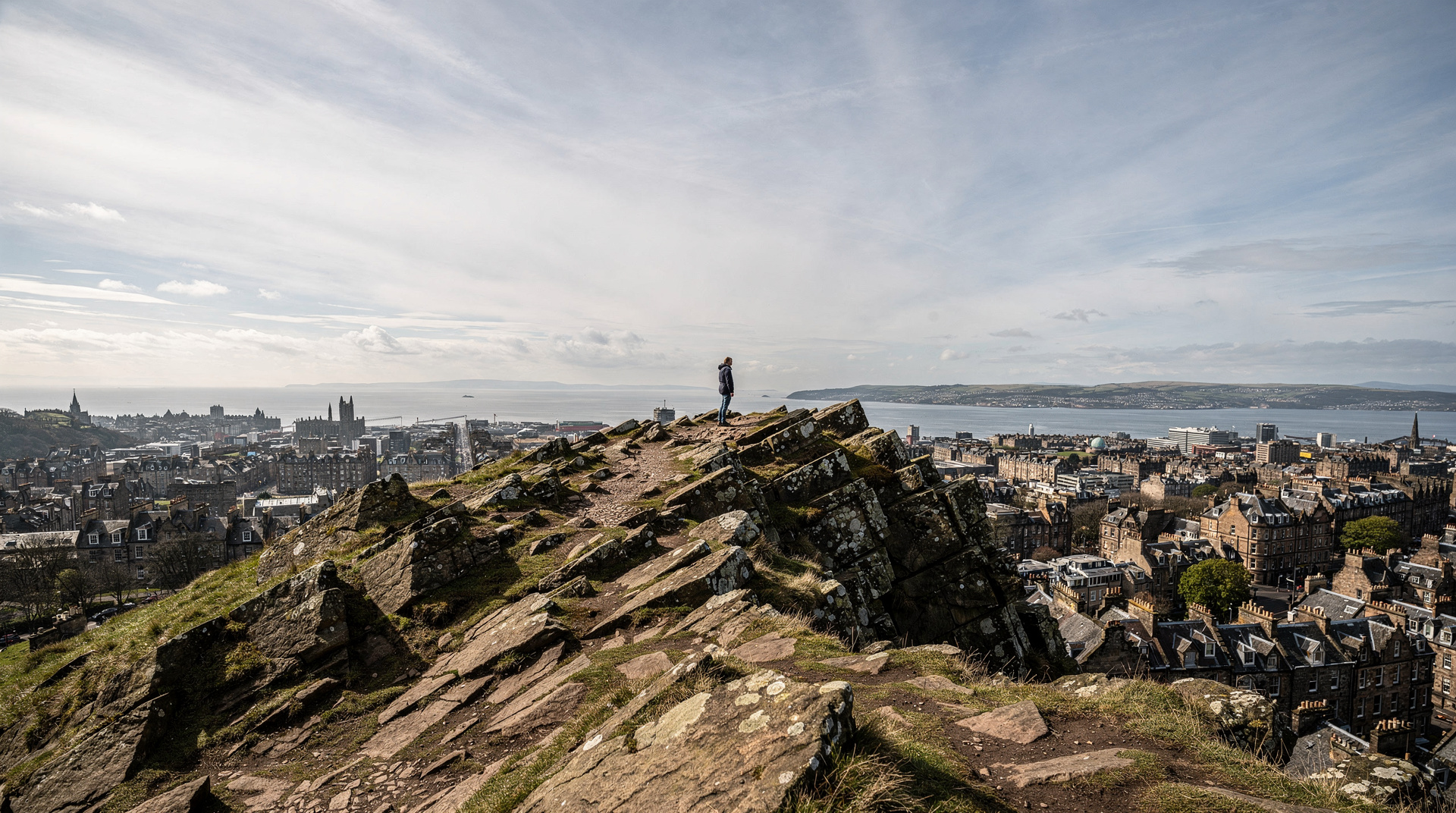
For a more memorable summit experience, the Arthur’s Seat sunset hike takes you up in the late evening to watch the sun set over the Firth of Forth and the Edinburgh skyline. On a clear evening this is genuinely spectacular — the city below you, the Pentlands to the south, and the sea visible to the north and east.
Practical notes for the hike: The summit path is rocky and steep in places. Waterproof footwear is strongly recommended — the grass and paths become slippery when wet, which is frequent. Even in summer, bring a warm layer for the summit. The park is always open and free; access is 24 hours. The wind on the summit can be fierce even on calm days below.
The Salisbury Crags
The dramatic cliff face of the Salisbury Crags — a near-vertical escarpment of dolerite that forms the western wall of Holyrood Park — is perhaps the most striking geological feature in central Edinburgh. The path along the base of the crags (the Radical Road, built in 1820) and the path along the top give very different experiences: from below, the crags are overwhelming; from above, on the Haggis Knowe ridge, you get dramatic views over the city with the crags dropping away beneath you.
The Radical Road gets its name from the proposal that it be built to provide employment for unemployed handloom weavers after the Napoleonic Wars — a practical solution to social unrest. The poet Walter Scott is supposed to have suggested the scheme. True or not, the path is genuinely useful and the geology at the base of the crags is interesting: the site where James Hutton made observations in the eighteenth century that formed the basis of modern geology.
The Scottish Parliament building
Adjacent to Holyrood Palace, the Scottish Parliament building opened in 2004 and is one of the most architecturally significant contemporary buildings in Scotland. The architect Enric Miralles drew on the landscape of Scotland for the design — the forms of the Crags, of upturned boats, of the land itself. The result divides opinion but is undeniably interesting, and the public areas of the building are open on non-sitting days for self-guided visits.
The Debating Chamber and committee rooms can be visited when Parliament is not in session, and the public gallery is accessible on sitting days for those who want to observe proceedings. See the Scottish Parliament website for the visiting schedule — it changes seasonally.
Planning your visit: tickets and timing
The palace is worth booking in advance, particularly from June through August when visitor numbers are highest. The Historic Environment Scotland website (which manages the palace) allows timed entry booking. If combining with Edinburgh Castle, the Edinburgh day planning guide covers the logistics of doing both in a single day — it is achievable but requires an early start at the castle (9:30am opening) and a direct walk down the Royal Mile to Holyrood by early afternoon.
Visitors on a budget should know that the park and Arthur’s Seat are entirely free. The Edinburgh on a budget guide rates Arthur’s Seat as one of the finest free half-day experiences in Scotland. See the getting around Edinburgh guide for how to reach Holyrood from various points in the city without needing a taxi.
The geology of Holyrood Park
Holyrood Park is one of the finest examples of urban geological exposure in Britain. The hills — Arthur’s Seat, the Salisbury Crags, Crow Hill, and Whinny Hill — are all remnants of a volcanic complex active around 340 million years ago, during the Carboniferous period. The lava flows and intrusive rocks of the complex have been eroded by millions of years of glacial and fluvial action to expose a sequence of volcanic and sedimentary rocks in remarkable detail.
James Hutton, working here and at Siccar Point on the East Lothian coast in the 1780s, made the observations that led to his Theory of the Earth — the founding document of modern geology. At Hutton’s Section, on the north side of the park, you can see the unconformity that Hutton described: older Silurian sedimentary rocks tilted nearly vertical by ancient earth movements, overlain by younger Carboniferous rocks. This exposure, technically the most important geological site in Edinburgh, receives fewer visitors than the castle each day and has no ticket price.
Walking through Holyrood Park is also a walk through post-glacial Edinburgh. The park shows the landscape as it was before human settlement: volcanic hills, lochans (Dunsapie Loch is a natural feature), and the distinctive curved ridgelines of glacial erosion. The Queens Drive, the road that circles the park, was constructed for Queen Victoria in the 1850s and disrupted the park’s natural drainage, but the landscape it crosses is essentially as Holyrood’s Augustinian monks would have seen it in the twelfth century.
St Anthony’s Chapel ruins
On the northeast shoulder of Arthur’s Seat, the roofless ruins of St Anthony’s Chapel occupy a dramatic position overlooking Duddingston Loch — one of the oldest surviving artificial lochs in Edinburgh, designated as a Site of Special Scientific Interest for its wintering wildfowl. The chapel dates from the fifteenth century and its dedication to St Anthony reflects the saint’s patronage of animals and the working people who kept them, appropriate for a chapel overlooking the grazing land of the park.
The chapel is accessible from the path that circles the lower slopes of the hill and adds about 20 minutes to a standard summit visit. The ruins are more substantial than they appear from below, and the views from the chapel position toward the Firth of Forth and the Fife coast are excellent.
Duddingston Village
Below the eastern side of Holyrood Park, accessible from the park paths or from Portobello direction via Duddingston Road, Duddingston Village is one of Edinburgh’s best-preserved pre-urban settlements — a small cluster of buildings around Duddingston Kirk that has the feel of a rural village despite being surrounded by the city on three sides. The kirk dates from the twelfth century and the Reverend Robert Shirra’s grave — the minister who supposedly conducted the wedding of Prince Charles Edward Stuart before the Battle of Prestonpans in 1745 — is in the kirkyard.
The Sheep Heid Inn in Duddingston claims to be Scotland’s oldest surviving licensed premises, in continuous operation since 1360 (or 1580, depending on which claim you accept). Whether or not the historical claim is exact, it is one of Edinburgh’s most atmospheric pubs — a low-ceilinged building with a beer garden backing onto Holyrood Park that is particularly good in summer. The skittle alley in the garden is one of the last surviving in Scotland.
Duddingston is reached from Holyrood Park via the path that skirts the south side of Arthur’s Seat, or from Duddingston Road West. It adds about 30 minutes to an Arthur’s Seat day and is worth the detour.
Duddingston Loch itself is a designated bird sanctuary and one of the best places in Edinburgh to see wintering wildfowl, including goldeneye and occasional whooper swans arriving from Iceland. The loch is not accessible to the public directly (it is managed as a nature reserve), but the paths around its edge give good views, and the RSPB occasionally runs guided walks from the kirk in winter. The combination of the loch, the kirk, and the Sheep Heid Inn makes Duddingston one of the more complete small detours available from central Edinburgh.
Arthur’s Seat in different seasons
| Season | Conditions | What to expect |
|---|---|---|
| Spring (Mar–May) | Improving, still changeable | Green slopes, fewer crowds than summer, gorse in bloom on the lower paths |
| Summer (Jun–Aug) | Best weather odds, longest days | Busiest period, especially the sunset hike and midday summit; book the palace ahead |
| Autumn (Sep–Oct) | Cooling, increasingly windy | Good light for photography, noticeably quieter than summer |
| Winter (Nov–Feb) | Cold, occasional ice on the summit path | Fewer visitors, dramatic light, but the final scramble can be genuinely hazardous in ice or snow |
Whatever the season, the summit itself is consistently windier and colder than the park gates — pack a layer even when Edinburgh at sea level feels mild.
Photography on Arthur’s Seat
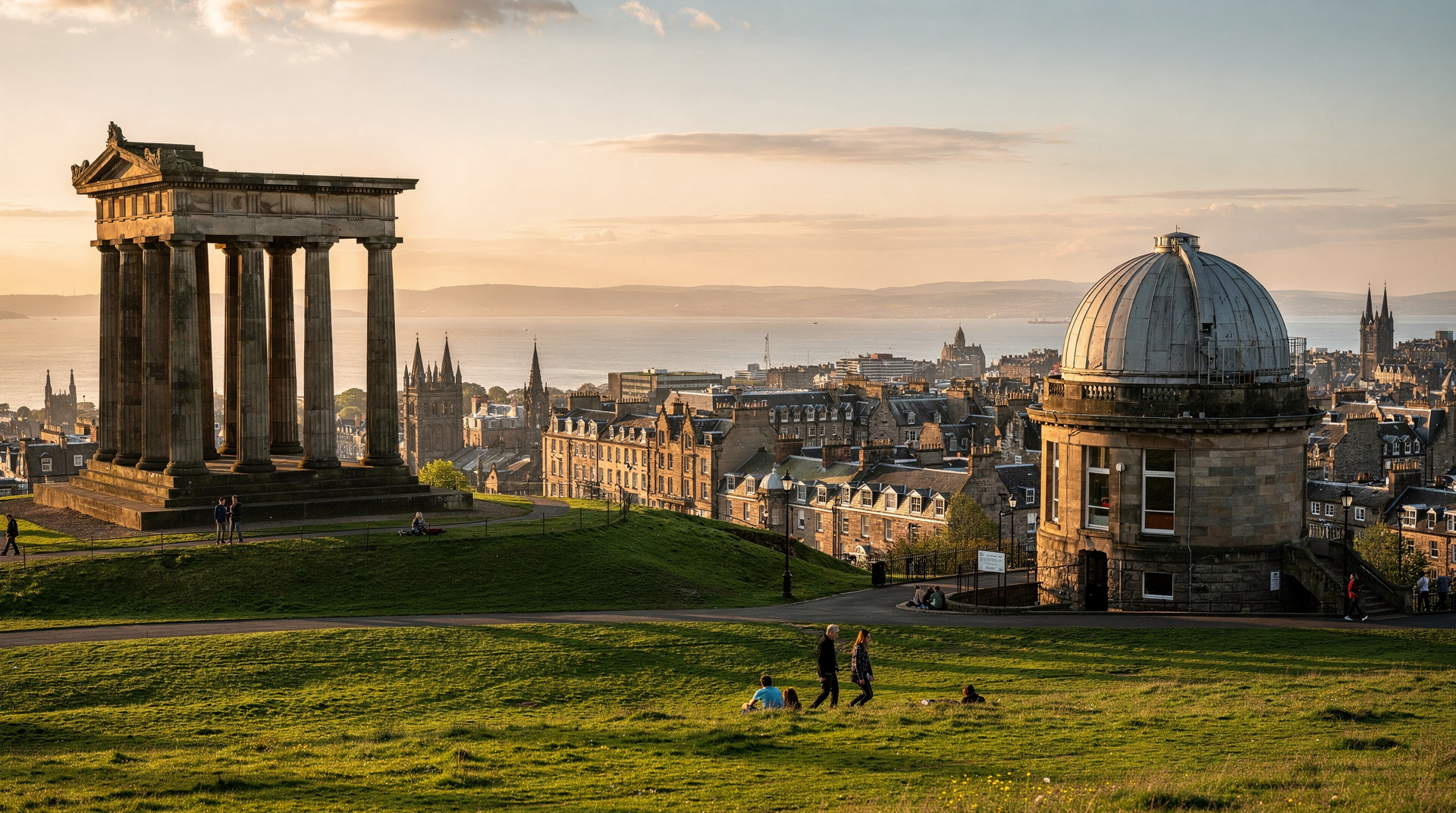
The classic shot from the summit looks west over the Old Town toward the castle, with the New Town and the Forth beyond — best in the hour after sunrise or the hour before sunset, when the low sun rakes across the city rather than sitting directly overhead. The Salisbury Crags, photographed from below on the Radical Road, are most dramatic in late afternoon light when the dolerite face catches warm sun. For a different angle entirely, the view of Arthur’s Seat itself from Calton Hill or from the Innocent Railway path gives a sense of the hill’s volcanic profile that is impossible to capture while standing on it.
Practical getting there
Holyrood Palace and the park entrance are at the foot of the Royal Mile, approximately 10 minutes on foot from Waverley Station or 20 minutes from the castle end of the Royal Mile. The City Sightseeing hop-on hop-off bus stops near the palace as part of its main city circuit, making it easy to combine with stops at Edinburgh Castle and the Old Town on a bus-and-walk day.
From the Grassmarket or the Southside, Holyrood is about 15 minutes on foot via the Cowgate and Canongate. No bus is needed for any approach from within the central Edinburgh area.
For visitors combining Holyrood with Calton Hill, the walk between the two goes via the Scottish Parliament and Regent Road — about 20 minutes. The combination of the hill’s panoramic view and the palace’s historical depth makes for an excellent afternoon.
Combining Holyrood with Arthur’s Seat
The natural sequence is to visit the palace first (allow 90 minutes) and then hike Arthur’s Seat in the afternoon. From the palace entrance, the path into Holyrood Park begins immediately, and the standard route to the summit and back takes around two to three hours including the descent. The total time for both activities is four to five hours — a comfortable half-day.
If you also want to include the Scottish Parliament building, allow an additional 30 to 45 minutes and visit it between the palace and the park.
This end of the Royal Mile is best reached on foot from the Old Town — the walk from the castle down the full length of the Royal Mile to Holyrood is one of Edinburgh’s classic routes, taking about 20 minutes at a walking pace and passing most of the key Old Town sights. See the one-day Edinburgh itinerary for the sequence that combines the castle in the morning with Holyrood and Arthur’s Seat in the afternoon.
For visitors with multiple days, the eastern side of the park connects to Portobello by bike or on foot (via the Innocent Railway cycle path), combining a morning in the park with an afternoon at the beach. The Edinburgh outdoors guide covers the best cycling and walking connections from Holyrood Park to the wider Edinburgh countryside.
Frequently asked questions about Holyrood and Arthur’s Seat
How difficult is the hike up Arthur’s Seat?
Arthur’s Seat is a moderate hike — not technical, but involving a significant ascent and rocky paths. It is suitable for most reasonably fit adults and older children. The steepest sections are near the summit, where the path becomes a scramble over loose basalt. Allow 45 to 75 minutes for the ascent depending on your pace. Good shoes are essential; trainers can work in dry conditions but waterproof walking shoes are recommended.
How do I get to Holyrood from different parts of Edinburgh?
From the Old Town: walk down the Royal Mile from the castle (20 minutes). From the New Town: cross the North Bridge and descend via the Old Town (25 minutes). From Marchmont and the Southside: walk east through the Meadows (20 minutes). From Calton Hill: descend via Regent Road (20 minutes). There is no convenient bus that stops directly at the palace; walking is the best approach from most central Edinburgh areas.
Is Arthur’s Seat safe in all weather?
The main risks in poor weather are slipping on wet rock and getting cold near the summit. Neither is usually serious, but the combination of wet grass, exposed ridge, and high winds can make the upper sections challenging. In heavy rain, strong winds, or snow, the summit scramble becomes significantly harder and is not recommended for those without walking experience. The lower paths around the park remain pleasant in most weather.
When is the Palace of Holyroodhouse closed?
The palace is sometimes closed for royal occasions, most notably during Holyrood Week in late June and early July when the King is in residence. The palace gift shop and grounds remain open on these occasions, but the interior is closed. Check the official Historic Environment Scotland website before booking. Outside these periods, the palace is open year-round.
Can you see both Edinburgh Castle and Holyrood Palace in one day?
Yes. Edinburgh Castle in the morning (arrive at 9:30am opening, allow three to four hours) and the Palace of Holyroodhouse plus Arthur’s Seat in the afternoon (allow four to five hours) makes a full but achievable day. The two attractions anchor either end of the Royal Mile. The one-day Edinburgh itinerary covers this combination in detail.
What are the views like from the Arthur’s Seat summit?
On a clear day, the views extend over the entire Edinburgh skyline, north across the Firth of Forth to Fife, east to the Bass Rock and the North Berwick Law, south to the Pentland Hills, and west toward the Forth Bridges. You can see the castle, the New Town, Calton Hill, and the rooftops of the Old Town spread below you in a way that is impossible from any other point. The 360-degree panorama from the summit is one of the finest urban views in Britain.
Is the route to Arthur’s Seat accessible for families with children?
Yes, with appropriate footwear and a realistic assessment of the children’s fitness. The lower paths in Holyrood Park are entirely accessible and enjoyable for all ages. The summit route is manageable for most children aged eight or over, but younger children may find the final rocky section challenging. The Dunsapie Loch approach, which is gentler than the direct route from Holyrood, is the better choice for families.
What is the best time to hike Arthur’s Seat?
Early morning on a weekday in May, June, or September gives the clearest air, the best light, and the fewest people on the summit. Sunset hikes are popular and the views are spectacular, but the path is busier and you will need good torches for the descent after dark. August is the busiest month and the summit can be crowded during the day.
Is Arthur’s Seat different to visit in winter?
Yes, considerably. Winter brings fewer visitors, cleaner light, and a starker, more dramatic landscape, but also the highest risk of the summit scramble becoming genuinely hazardous — ice on the exposed basalt sections is common and the final approach should not be attempted without appropriate footwear and caution. The lower park paths remain pleasant and safe in most winter conditions. If in doubt about conditions on a given day, the Historic Environment Scotland and National Trust for Scotland social channels sometimes post updates on Holyrood Park access.
Can I photograph the sunset from Arthur’s Seat safely?
Yes, and it is one of Edinburgh’s best sunset viewpoints, but the descent needs planning — the path becomes genuinely difficult to see once darkness falls, particularly on the rockier sections near the summit. Bring a proper torch or headtorch, allow at least 45 minutes for the descent after sunset, and consider joining the guided sunset hike if you are unfamiliar with the route, as it handles the timing and the descent for you.
Top experiences
Bookable activities with verified prices and instant confirmation on GetYourGuide.