Victoria Street and the Diagon Alley connection
Edinburgh: Harry Potter magical guided walking tour
Is Victoria Street in Edinburgh actually Diagon Alley?
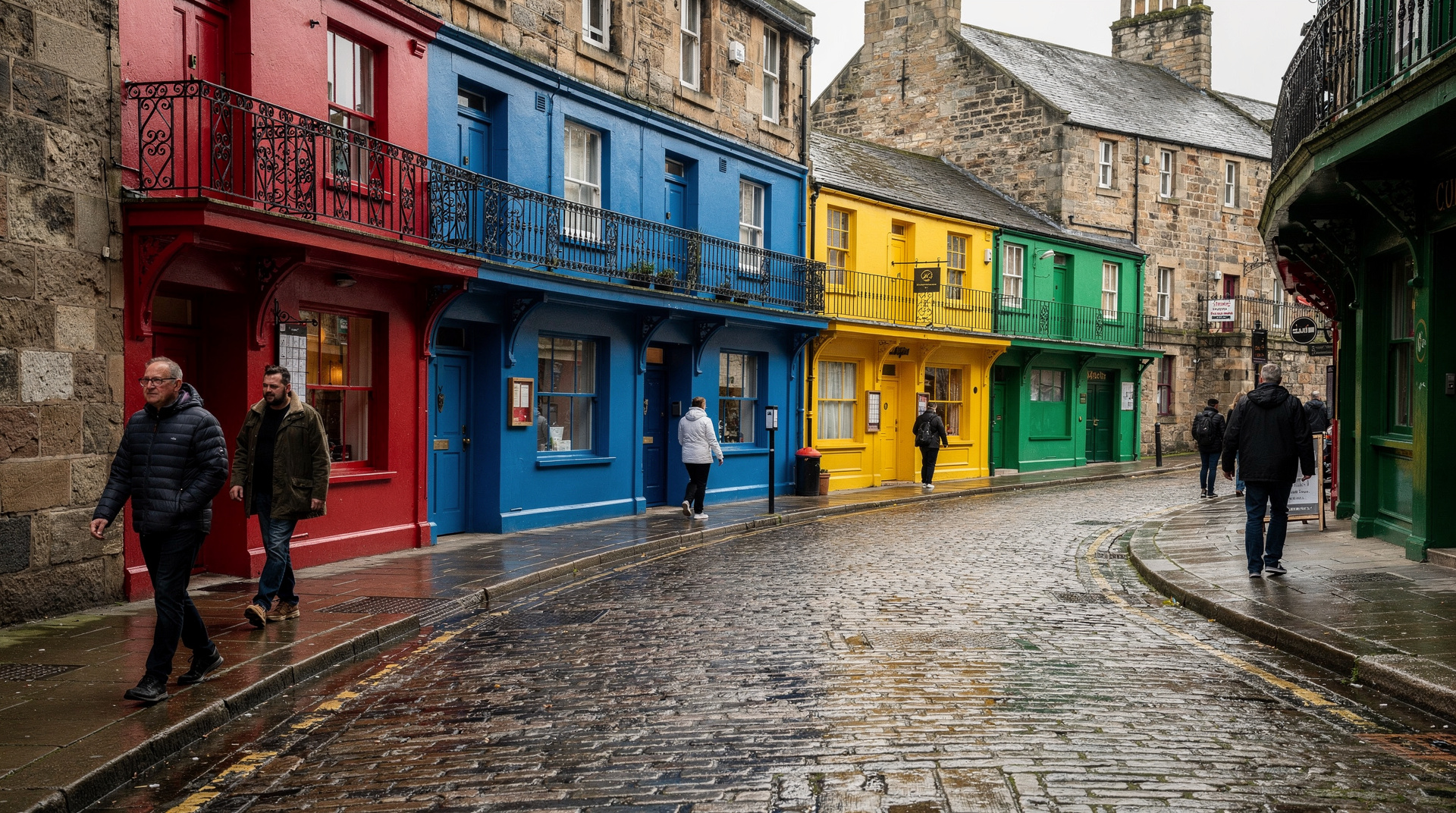
Victoria Street is the strongest visual parallel to Diagon Alley in Edinburgh — a curved, cobblestoned lane with colourful bow-fronted shops, descending between medieval walls. JK Rowling never officially confirmed the connection, but she lived nearby and the resemblance is genuine. Worth visiting regardless: it is one of Edinburgh's most photogenic streets.
One of Edinburgh’s most beautiful streets, with or without Harry Potter
Victoria Street deserves its reputation as one of Edinburgh’s most photographed locations quite apart from any literary connection. The street descends from George IV Bridge to the Grassmarket in a graceful curve, with colourful two-storey shopfronts on the lower level and a terrace walkway (Victoria Terrace) running above. The combination of medieval scale, Victorian shop windows, and the variety of colours — each shopfront painted differently, creating a palette that shifts as you walk the curve — is genuinely distinctive.
The street was built in the 1840s as part of Edinburgh’s Victorian improvements programme, creating a usable descent from the South Bridge area to the Grassmarket that the previous maze of closes and stairs had not provided. The result is a street that feels both historic and designed — more deliberate than the organic closes of the medieval Old Town, but scaled and textured in a way that maintains the character of its surroundings.
The Diagon Alley connection, documented or not, has amplified interest in Victoria Street enormously. On any summer day, the street is busy with visitors taking photographs, many of them specifically looking for the Harry Potter parallel. This has been good for the independent shops that line it, many of which have leaned into the connection with varying degrees of enthusiasm. It has also, in high season, made the street quite crowded — the best time to experience Victoria Street at its most atmospheric is early morning or evening, outside the main tourist hours.
| Where | Between George IV Bridge and the Grassmarket, Old Town |
| Cost | Free to walk; shop and cafe prices vary |
| Time needed | 20-30 minutes for the street alone; 2 hours for the full Old Town circuit |
| Getting there | 5-minute walk from the Royal Mile via George IV Bridge |
| Best time | Before 9am or after 7pm in summer for the quietest photographs |
The Diagon Alley parallel: what we know
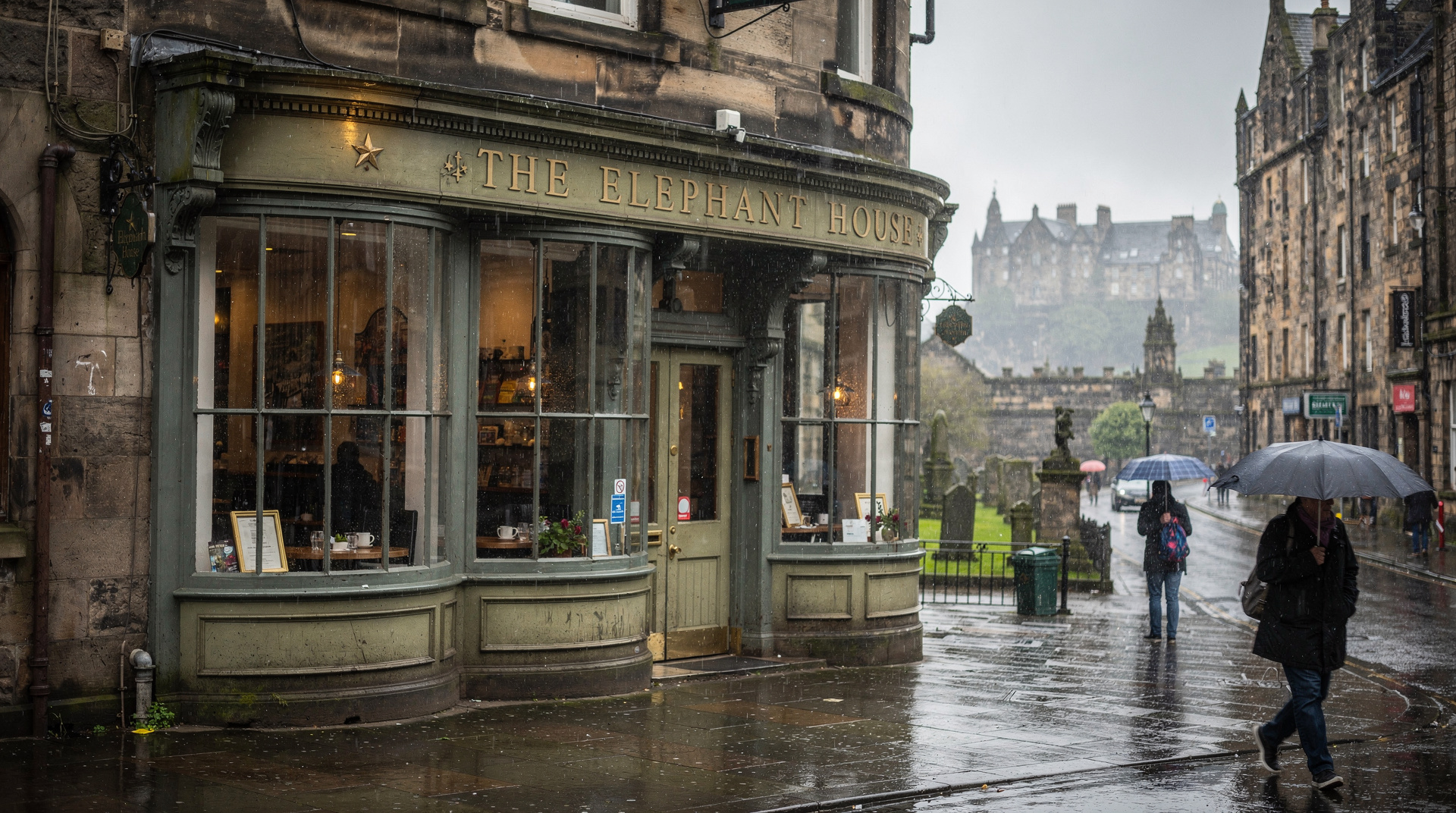
J.K. Rowling lived in Edinburgh during the period when she was writing the Harry Potter books, working partly at the Elephant House cafe on George IV Bridge — a few minutes’ walk from the top of Victoria Street. She would have walked past it regularly. The physical characteristics of Diagon Alley as described in the books — a hidden shopping street with colourful, unusual shops selling specialist goods, accessed through an inconspicuous passage — correspond closely to Victoria Street’s character: a steep, curved lane partially hidden from the main street, with a mix of independent specialist shops.
Rowling has confirmed in general terms that Edinburgh’s geography influenced the atmosphere of the wizarding world without specifically naming Victoria Street as the source for Diagon Alley. The connection is, as most honest sources acknowledge, a highly plausible speculation rather than a confirmed fact. This does not diminish the experience of visiting — the visual and atmospheric resonance is real, and the street is worth visiting on its own merits.
Walking Victoria Street: what you will find
The street runs from George IV Bridge at the top to the Grassmarket at the bottom, a descent of perhaps five minutes at a leisurely pace. Victoria Terrace, the walkway above, runs parallel and provides a view down into the street and the shops below.
The upper end (George IV Bridge entrance): The entrance from George IV Bridge is on the left as you walk south from the Elephant House. The street curves away to the right and initially appears shorter than it is — the curve conceals its full length until you are some way in.
The shops: Victoria Street’s shops are a mix of independent retailers, some with genuine specialist character and some clearly oriented toward tourist trade. Among the more interesting: Armchair Books (second-hand books, an excellent browse), Aha Ha Ha (magic and novelties, appropriate given the context), Mr Wood’s Fossils (genuine fossils and geological curiosities, one of Edinburgh’s more unusual shops), and several galleries and craft shops. The balance between genuine specialists and tourist-oriented shops shifts depending on where you are in the street — the lower half tends to be more commercial, the upper half more interesting.
The restaurants and cafes: Victoria Street has several decent eating options at prices more reasonable than the Royal Mile. Maison de Moggy (Edinburgh’s original cat cafe) is at the top of the street — booking is required. The Mosque Kitchen on the adjacent Nicholson Street serves excellent inexpensive Scottish-Asian food that is one of the better budget options in the area. For something more atmospheric, the lower section of the street has a couple of wine bars and restaurants with good views up the curve.
Victoria Terrace: The elevated walkway above the main street provides a different perspective and connects back to Castlehill and the top of the Royal Mile. It is worth walking both levels — the view down into the coloured shopfronts from above is the shot that most Harry Potter visitors are looking for.
Connecting Victoria Street to the Old Town circuit
Victoria Street sits naturally in a walking circuit of the southern Old Town that covers most of the Harry Potter sites and the principal dark tourism locations. A logical sequence:
- Start at the Elephant House on George IV Bridge for the Rowling writing-spot context.
- Walk south along George IV Bridge to the Victoria Street entrance and descend to the Grassmarket.
- Continue through the Grassmarket — the old execution ground, now full of good pubs and restaurants.
- Walk uphill on Candlemaker Row to Greyfriars Kirkyard — find the Tom Riddle grave.
- Return to George IV Bridge via the Grassmarket and the Vennel steps viewpoint.
This circuit takes about two hours at a relaxed pace and combines the Harry Potter sites with some of Edinburgh’s most interesting historic spaces. The Harry Potter Edinburgh guide covers the full roster of sites; this circuit covers the most walkable cluster.
For a guided walking tour that covers Victoria Street and the wider Harry Potter Edinburgh circuit, the Harry Potter magical guided walking tour is the most popular option. Alternatively, Edinburgh’s Old Town history and tales walking tour covers Victoria Street within a broader Old Town historical context — useful if you want the street’s full historical character alongside the Harry Potter angle.
It includes Victoria Street as a stop on the Old Town circuit and provides the narrative context for connecting the various sites. The Old Town guide covers the broader neighbourhood for those who want to understand the historical context beyond the Harry Potter connection.
The honest shopping guide to Victoria Street
Some of what is sold on Victoria Street is genuinely interesting; some is tourist merchandise dressed up with heritage aesthetics. A few observations:
The Harry Potter merchandise: Several shops sell unofficial Harry Potter merchandise (wands, house scarves, postcards) alongside general Edinburgh tourist goods. The merchandise is freely sold in the UK and is not counterfeit, but it has no particular connection to the actual Harry Potter franchise. Visitors expecting an “official” Harry Potter experience similar to the Warner Bros. Studio Tour should know that Victoria Street is an informal association, not a licensed location.
The genuinely independent shops: Mr Wood’s Fossils, Armchair Books, and several of the craft and gallery shops are legitimate specialist retailers that would be interesting regardless of their location. These are worth time; the generic tourist shops less so.
Prices: Victoria Street shops generally charge tourist-area prices for gift items. For everyday goods, the nearby Grassmarket and the shops on Candlemaker Row are more competitively priced.
Victoria Street in the context of the Old Town
Victoria Street was built in the 1840s as part of the Victorian improvements to Edinburgh’s Old Town — a period when the city belatedly addressed some of the worst overcrowding and infrastructure problems that had accumulated in the medieval street pattern. The street created a usable descent from the South Bridge/George IV Bridge level to the Grassmarket below, replacing a tangle of closes and stairs that had been difficult for wheeled vehicles. The curved design was partly a practical response to the topography.
The result is one of the few Victorian additions to the Old Town that feels genuinely integrated with its surroundings. Unlike some other Victorian-era Edinburgh streets that feel grafted onto the medieval fabric, Victoria Street’s curve and scale sit comfortably within the existing pattern. The presence of established independent shops — some of which have traded in the street for decades — reinforces the sense of a working urban street rather than a heritage theme park.
The wider Old Town contains the full range of Edinburgh’s historic street types: the closes and wynds off the Royal Mile, the Grassmarket square below, Dean Village along the Water of Leith, and the formal Georgian grid of New Town visible from Calton Hill. Victoria Street fits into this landscape as a Victorian addition that connects the Georgian South Bridge infrastructure to the older Grassmarket settlement. The Old Town versus New Town guide provides the broader context.
The Grassmarket connection
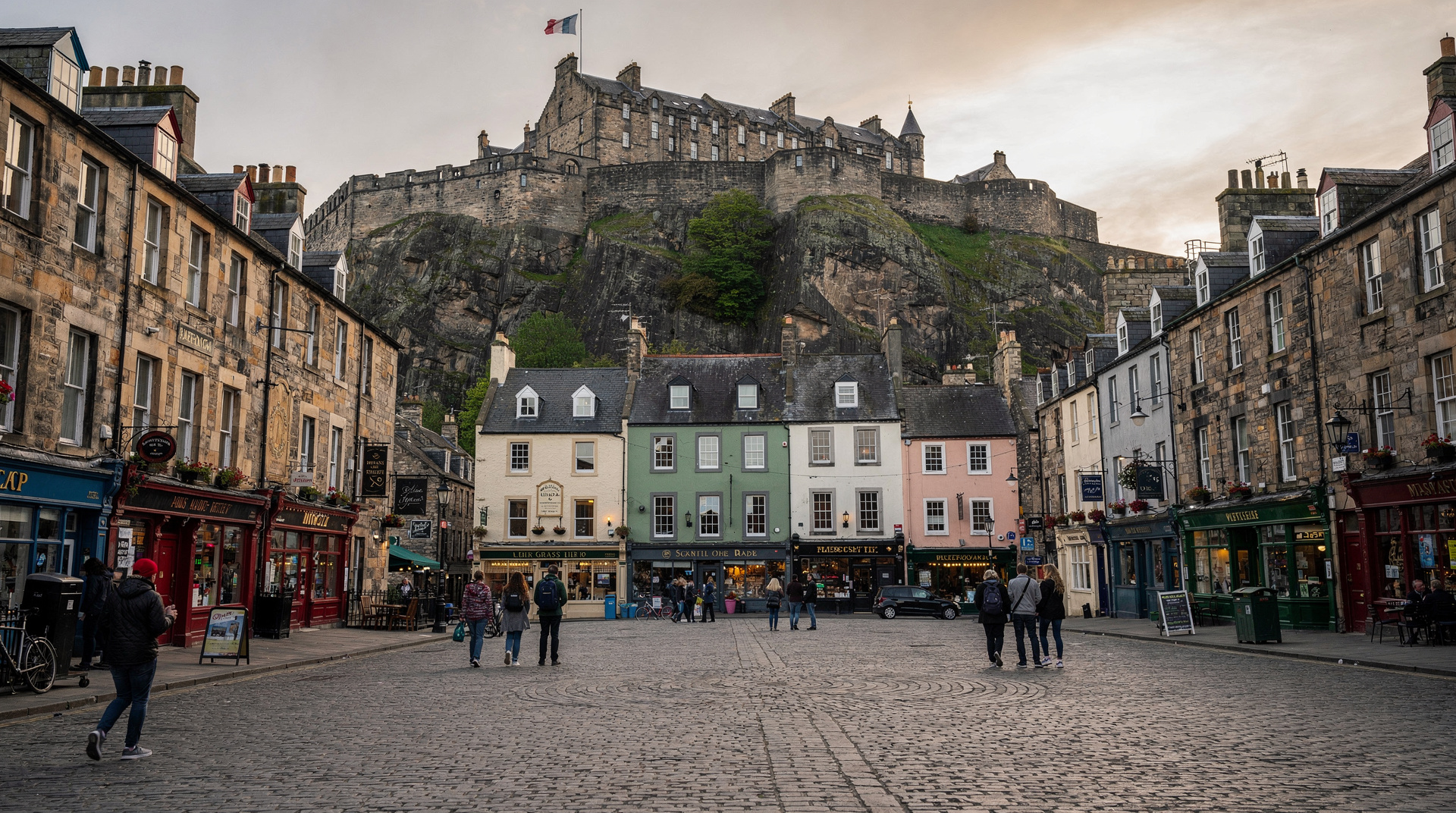
Victoria Street descends to the Grassmarket at its lower end, and the connection is worth emphasising: the Grassmarket is one of Edinburgh’s most historically significant public spaces, and arriving at it from Victoria Street gives a different perspective from the more standard approach from the west.
The Grassmarket was Edinburgh’s primary place of public execution from medieval times until 1784. The gallows stood at the east end of the square; over three hundred people were hanged here. This history sits somewhat incongruously alongside the current use of the space as a lively area of pubs, restaurants, and independent shops. The Grassmarket guide covers both the history and the current visitor offer.
For Harry Potter visitors, the Grassmarket approach to Victoria Street works well as a return route — you can descend Victoria Street from the top (George IV Bridge) and return through the Grassmarket, completing a circuit that also passes through the lower Cowgate area associated with Edinburgh’s dark history. The underground vaults guide covers the vaults entrance on Niddry Street, a short walk from the bottom of Victoria Street.
Eating and drinking near Victoria Street
The area around Victoria Street has a better selection of independent restaurants and cafes than the Royal Mile above, and at more reasonable prices. A few specific options:
The Grassmarket area: Several good pubs in the Grassmarket include the White Hart Inn (Edinburgh’s oldest surviving pub by most accounts) and the Greyfriars Bobby pub near the corner of Candlemaker Row. Both are atmospheric and serve reasonable food.
George IV Bridge: Above Victoria Street, George IV Bridge has several decent cafes including the Elephant House (the Harry Potter writing cafe) and a few independent options. The street also has a branch of Elephant House is on this street, which connects the Harry Potter circuit naturally to a coffee stop. See the Elephant House guide for what to expect.
Candlemaker Row: The street running between the Grassmarket and Greyfriars has several independent cafes that are less touristy than the Royal Mile options and more interesting than the major chains. Good for lunch before or after Greyfriars.
Victoria Street through the seasons
Victoria Street looks different across the year in ways that are worth planning around. In summer, the colourful shopfronts are at their brightest against clear light, but the crowds are heaviest and photographs without other tourists in frame require real patience or an early start. Autumn brings softer light and noticeably thinner crowds after the Fringe crowds disperse in early September — arguably the best month for photography here.
Winter, particularly during the Christmas market period when the city centre is busiest overall, sees Victoria Street relatively quiet compared to Princes Street and the Royal Mile, since it is slightly off the main markets route; it is also atmospheric after dark, when the shopfront lighting comes into its own against the December gloom.
Spring is unpredictable weather-wise but generally the second-quietest season after winter. Whatever the season, the shopfronts are lit and open from mid-morning, so the very earliest light of the day tends to show a beautiful but partly shuttered street — factor that trade-off into your timing if photography without crowds is the priority.
A reasonable compromise for most visitors is to aim for the hour just after the shops open (typically 10-11am on weekdays), which balances open shopfronts against still-manageable crowds before the main tour-group wave arrives later in the morning. This same window tends to give the most pleasant browsing experience too, since shopkeepers are less rushed than during the midday peak and more willing to chat about their stock.
Victoria Street’s role in Edinburgh’s Old Town neighbourhood
Victoria Street and the adjacent Victoria Terrace form a distinctive micro-neighbourhood within the broader Old Town. The street is not just a tourist route but an active commercial street with independent businesses that serve Edinburgh residents as well as visitors. The mix of shops reflects this dual function: some are clearly tourist-oriented; others — the fossil shop, the bookshop, some of the galleries — attract local customers year-round.
The wider area around Victoria Street is the part of the Old Town most associated with Edinburgh’s bohemian character. The Grassmarket below, once the site of public executions, has evolved into Edinburgh’s most eclectic pub and restaurant zone. George IV Bridge above connects the area to the university quarter, Greyfriars, and the bookshops. The closes off the lower Royal Mile visible from Victoria Terrace are some of the best-preserved medieval urban fabric in Scotland.
For visitors interested in understanding Edinburgh as a living city rather than a heritage site, the Victoria Street area rewards slower exploration than the main tourist route. Sit in one of the cafes for an hour and watch the mix of students, residents, and tourists that passes through — it is a more varied crowd than the Royal Mile above. This mix is part of what distinguishes Victoria Street from purely heritage-preserved streets elsewhere in Europe: the shops trade daily to real customers, not only to tour groups, and that working character is worth noticing alongside the more obvious photographic appeal.
Even visitors with no particular interest in shopping tend to find that spending twenty unhurried minutes here, rather than the standard photo-and-move-on approach, changes how the street reads — less a backdrop, more a functioning piece of the city that happens to photograph exceptionally well and rewards the visitor who slows down enough to notice its details rather than treating it as a rushed five-minute checklist item on the way to somewhere else entirely.
The connection to the literary Edinburgh tradition is strong here: the National Library of Scotland is two minutes’ walk; the university faculty buildings are nearby; and the second-hand bookshop on the street is the kind of independent retailer that has historically supported Edinburgh’s literary culture. Even the Harry Potter connection, speculative or not, fits into a longer tradition of Edinburgh as a city that generates fiction — from Walter Scott through Stevenson to Rowling and Ian Rankin.
The Harry Potter connection in perspective
It is worth being clear about the scale of Edinburgh’s Harry Potter connections relative to the full franchise. Edinburgh provides the book-writing origin story — Rowling lived here, wrote here, and was influenced by the city’s atmosphere. But the Harry Potter films were made almost entirely in England: Alnwick Castle in Northumberland (broomstick scenes), Gloucester Cathedral (corridors), Christ Church Oxford (Great Hall inspiration), and Leavesden Studios (the purpose-built sets).
Victoria Street’s connection to Diagon Alley is the most visually compelling Edinburgh-specific claim, and it is a reasonable one. But visitors expecting an Edinburgh equivalent of Universal’s Wizarding World of Harry Potter will find something rather different — an actual functioning street with real shops, real Edinburgh history, and a speculative literary connection that is interesting but unconfirmed.
The appropriate frame for Victoria Street is: a genuinely beautiful and interesting Edinburgh street that plausibly contributed to Rowling’s visual imagination, and that is worth visiting regardless of the Harry Potter angle. See it for what it is, and let the Harry Potter connection add a layer rather than be the whole point.
For the confirmed film locations, the Alnwick Castle guide covers the broomstick filming site about two hours from Edinburgh. For the full Harry Potter Edinburgh circuit, the Harry Potter Edinburgh guide covers all the sites in context.
Where to stay near Victoria Street
Victoria Street sits at the edge of the Old Town’s densest visitor accommodation cluster. Staying nearby puts you within a few minutes of the Grassmarket, Greyfriars, and the lower Royal Mile — the best hotels in Edinburgh Old Town guide covers specific options in this area, useful if you want to be able to walk the Diagon Alley circuit at the quiet early-morning hours without a bus or taxi first.
Frequently asked questions about Victoria Street
Is Victoria Street free to visit?
Yes — the street itself is free to walk at any time. Individual shops charge for their merchandise, some cafes and restaurants require purchase, and Maison de Moggy (the cat cafe) requires a booking with a fee. There are no admission charges for the street itself.
When is Victoria Street least crowded?
Before 9am and after 7pm in summer, or on weekday mornings in autumn and winter. The street is at its busiest between 11am and 4pm on summer weekends when tour groups and individual tourists overlap.
Can you see Victoria Street from Victoria Terrace above?
Yes — Victoria Terrace runs along the level above Victoria Street and provides excellent views down into the street. Access from the George IV Bridge end (head up the stairs on the left side of the street as you enter from above) or from Castlehill at the top of the Royal Mile.
Are there any Harry Potter-specific events on Victoria Street?
No official or regular Harry Potter events are scheduled on Victoria Street. During the Edinburgh Festival Fringe in August, various street performers and theatrical events may occur near the street, some with Harry Potter themes.
What is the best approach to Victoria Street for photographs?
For the classic Diagon Alley photograph, start at the bottom of the street in the Grassmarket and look up the curving lane with the shops on either side. Alternatively, stand on Victoria Terrace above and look down into the shopfronts. The light is best in the morning (the street faces roughly southeast) or in the low afternoon light of autumn and winter.
Is Victoria Street wheelchair or pushchair accessible?
The main street has a moderate slope but is manageable for most wheelchairs and pushchairs on its paved surface. Victoria Terrace above is reached by stairs at both ends, so it is not step-free; visitors needing step-free access should stay on the lower street level.
Top experiences
Bookable activities with verified prices and instant confirmation on GetYourGuide.