Greyfriars Kirkyard: history, hauntings, and Greyfriars Bobby
Edinburgh: Greyfriars Kirkyard tour
What is Greyfriars Kirkyard and why should I visit?
Greyfriars Kirkyard is Edinburgh's most historic and atmospheric graveyard, with graves from the sixteenth century onward. It is famous for Greyfriars Bobby (a loyal dog buried here), the Covenanters' Prison where 1,200 Covenanters were imprisoned in 1679, and a long tradition of ghost sightings. Entry to the kirkyard is free.
Edinburgh’s most atmospheric — and historically significant — graveyard
Greyfriars Kirkyard sits on the south side of the Royal Mile area, a few minutes’ walk from the Grassmarket and from the rear of the National Museum of Scotland. It occupies the site of a Franciscan friary dissolved at the Reformation, and the first burials here date from 1562. The graveyard is free to enter, open every day, and one of the most rewarding places in Edinburgh to spend an unhurried hour.
It is also one of the most storied. The history of the Covenanters, the grave of Greyfriars Bobby, the elaborate seventeenth-century funerary monuments, and the long tradition of ghost encounters all contribute to a place that is substantially more than a tourist attraction — it is a genuine piece of Edinburgh’s historical fabric.
| Where | Greyfriars Place, off Candlemaker Row, near the Grassmarket |
| Cost | Free to enter; ghost tour of the Covenanters’ Prison around £12–£18 |
| Time needed | 30–45 minutes self-guided, longer with a tour |
| Getting there | Five minutes from the Grassmarket, ten from the Royal Mile |
| Best time | 8am for quiet, or an evening ghost tour for the locked section |
Greyfriars Bobby: the story and the myth
The bronze statue of Greyfriars Bobby — a small Skye terrier — stands at the gate to the kirkyard on Candlemaker Row and is one of Edinburgh’s most photographed objects. The story, as told on tourist boards and in the 1961 Disney film, is that Bobby was the faithful dog of a Midlothian farmer named John Gray, who was buried in the kirkyard in 1858. Bobby supposedly kept vigil at his master’s grave for fourteen years until his own death in 1872.
The historical reality is more complicated. The Victorian dog warden John Traill appears to have discovered Bobby as a useful tourist attraction — there are photographs of Bobby from the 1860s that were sold as postcards. Historians have questioned whether there was continuity between the original dog and later dogs presented as Bobby. The grave of John Gray is in the kirkyard (marked by a small stone near the entrance); Bobby’s grave is just inside the gate, marked by a pink granite stone erected by the Dog Aid Society of Scotland in 1981.
Whether the story is wholly true or not, the statue and the grave are genuinely touching — and the kirkyard itself, which you will likely have entered to see the statue, is far more interesting than many visitors who stop for a photograph realise.
The Covenanters’ Prison and the history of the graveyard
The most historically significant section of the kirkyard is the Covenanters’ Prison — also known as the Black Mausoleum enclosure — in the southwest corner. In 1679, following the Battle of Airds Moss, approximately 1,200 Covenanting prisoners were held here in appalling conditions for five months. The Covenanters were Presbyterians who had signed the National Covenant of 1638 defending their form of worship against the attempts of Charles I to impose Anglican practices on Scotland. The later Covenanting movement involved increasingly severe repression by the Crown, and the 1679 imprisonments — during what became known as the Killing Time — were among the most brutal episodes of that period.
Around 400 of the prisoners died during their imprisonment from exposure, disease, and malnutrition. A few hundred were transported to the colonies; the rest were eventually released. The enclosed area where they were held is still a distinct space within the kirkyard, and the atmosphere — partly the history, partly the dense accumulation of seventeenth-century monuments — is striking.
The Covenanters’ section contains the Black Mausoleum, the tomb of Sir George Mackenzie of Rosehaugh — Lord Advocate under Charles II and the man responsible for the prosecution of the Covenanters. Mackenzie is both a genuinely significant historical figure and the subject of Edinburgh’s most persistent ghost story: the so-called “McKenzie Poltergeist,” which is said to have attacked visitors to the tomb since a homeless man broke into it in 1999. The claims are much-discussed in the ghost-tour industry and are treated with varying degrees of seriousness.
The funerary monuments
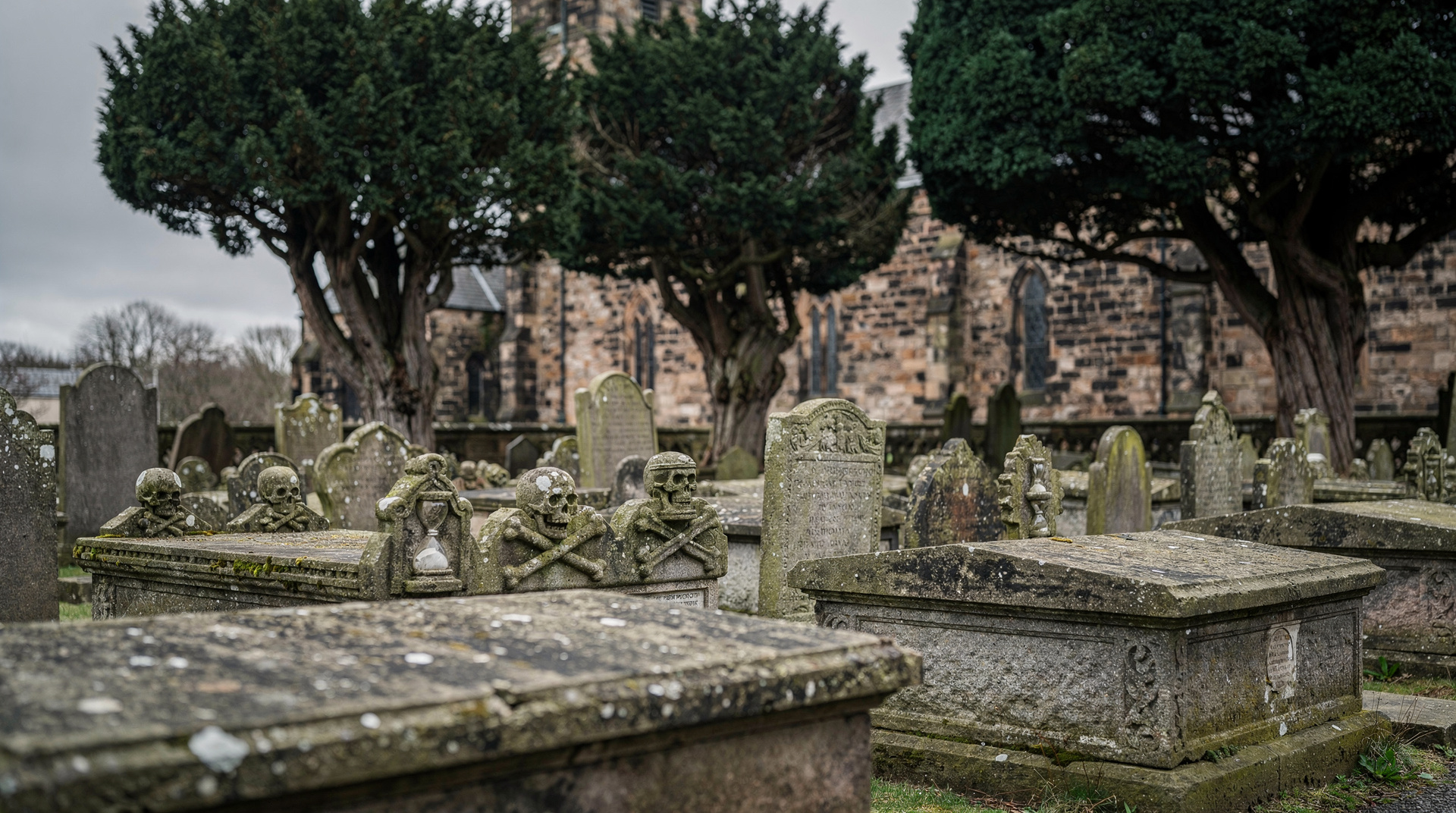
The seventeenth and eighteenth-century monuments in Greyfriars Kirkyard are among the finest examples of Scottish funerary sculpture of the period, and largely unappreciated by most visitors. The elaborately carved tableaux of skulls, hourglasses, angels, and crossed bones that decorate many of the stones are not generic Victorian sentiment but a specific seventeenth-century iconography of mortality — the memento mori tradition translated into stone.
Some of the monuments are enormous. The mausoleum of Sir George Mackenzie is castle-like in scale. The Martyrs’ Monument commemorates the Covenanters killed during the Killing Time. The grave of Bloody Mackenzie, as the monument is now popularly known, bears the wording “To the Memory of George Mackenzie” — one of Edinburgh’s more ironic understatements.
Among the other notable burials in the kirkyard: James Craig, who designed the New Town grid plan in 1766; William Smellie, who edited the first edition of the Encyclopaedia Britannica in 1771; and Thomas Riddell, one of the Riddells whose family tombstone is locally associated (without solid evidence) with the derivation of J.K. Rowling’s character names.
Ghost tours: which are worth doing
Greyfriars Kirkyard is one of Edinburgh’s ghost tour destinations, with multiple companies offering evening tours that include entry to the locked Covenanters’ section. The Greyfriars Kirkyard ghost tour covers the history of the kirkyard with particular attention to the Covenanters and the McKenzie poltergeist claims.
The quality of ghost tours in Edinburgh varies considerably. The best operators treat the history seriously and use the ghost stories as a framework for genuine historical content. The worst are theatrical performances that substitute atmosphere for accuracy. The best ghost tours Edinburgh guide reviews the main operators honestly. For a broader Old Town dark history experience, the Edinburgh mysteries, witchery and murders walking tour covers Greyfriars as part of a wider route.
One practical note: the Covenanters’ Prison section is locked outside of organised tours. To enter it, you need a ticket for one of the ghost tour operators who hold keys. The main kirkyard is always accessible during daylight hours without a tour.
The Kirkyard at different times of day
The Kirkyard at midday on a summer day is busy with tourists visiting the Bobby statue and taking photographs. The Kirkyard at 8am on a weekday morning, before the tour groups arrive, is a different experience entirely — quiet enough that you can read the inscriptions on the monuments, walk the pathways without weaving around other visitors, and absorb the genuine atmosphere of the place.
Evening ghost tours typically start around 8pm-9pm and run for about an hour. They include access to the Covenanters’ section and are conducted in near-darkness. If the ghost-story angle does not interest you but you want access to the enclosed section, this is the only way in.
Getting to Greyfriars Kirkyard
The main entrance is on Greyfriars Place, off Candlemaker Row — about a five-minute walk from the Grassmarket, ten minutes from the Royal Mile, and immediately adjacent to the rear of the National Museum of Scotland. There is no charge to enter the main kirkyard. A suggested donation box is near the entrance.
Combining Greyfriars with other nearby attractions
The National Museum of Scotland, which is free and one of the best museums in the country, is immediately adjacent. The Grassmarket is a five-minute walk. The Royal Mile is ten minutes. The Edinburgh Old Town history guide sets the kirkyard in the broader context of the medieval city. For a half-day that combines the most interesting attractions in the Old Town, a sequence of Greyfriars, the National Museum, and a walk up through the closes to St Giles’ and the Royal Mile is hard to improve on.
A short self-guided route around the Kirkyard
For visitors doing this without a guide, a logical route through the main sections takes about 30–40 minutes:
- Enter from Candlemaker Row and find Bobby’s grave just inside the gate, marked with a pink granite stone.
- Walk south along the main path past the eighteenth-century monuments, noting the memento mori carvings — skulls, hourglasses, and crossed bones — on the older stones.
- Head to the southwest corner for the exterior of the Covenanters’ Prison enclosure and the Black Mausoleum (Sir George Mackenzie’s tomb), which you can view from outside the locked gate even without a tour.
- Look for James Craig’s area and the other notable graves in the eastern section, using the interpretation boards for context.
- Exit toward the National Museum of Scotland, which is a genuinely worthwhile follow-on stop and free to enter.
Practical tips most visitors miss
A few details that make the difference between a rushed photo stop and a properly rewarding visit. The stones nearest the entrance are the most worn by weather and foot traffic; the more legible inscriptions tend to be further into the kirkyard, away from the main tourist flow. Photography is unrestricted during the day, but flash photography during evening ghost tours is generally discouraged out of respect for the atmosphere the guides are building and for other visitors.
If you are visiting specifically for the Harry Potter connections — the Thomas Riddell and William McGonagall graves — note that neither is officially marked as a Harry Potter site, so it helps to know roughly where to look or to join a themed walking tour that includes them.
The kirkyard’s opening hours vary seasonally, generally from around 8am to between 4pm in winter and 9pm in midsummer. There is no fixed closing time posted at the gate in the way many attractions display one, so if you are planning an evening visit outside a guided tour, check current hours locally rather than assuming.
Greyfriars in a wider Edinburgh dark history day
Greyfriars is one stop in a much larger network of Edinburgh sites connected by overlapping history. The haunted Edinburgh map guide sequences Greyfriars alongside the South Bridge vaults, Mary King’s Close, and the Old Town closes into a single coherent day or two. For visitors whose main interest is the Covenanting period specifically, the Jacobites and Edinburgh guide covers the later but related period of Scottish religious and political conflict, and the National Museum of Scotland, a three-minute walk away, holds material from both eras.
Frequently asked questions about Greyfriars Kirkyard
Is it free to visit Greyfriars Kirkyard?
The main kirkyard is free to enter during daylight hours. The Covenanters’ Prison (the locked enclosure in the southwest corner) is only accessible on organised ghost tours, which charge £12-£18 per person.
Where is Greyfriars Bobby’s grave?
Bobby’s grave is just inside the main gate of the kirkyard, marked by a small pink granite stone. It is to the left as you enter. The bronze statue of Bobby stands on the street outside, at the junction of Candlemaker Row and George IV Bridge.
Is the McKenzie poltergeist real?
The claims of a poltergeist activity in the Covenanters’ Prison — people being scratched, knocked unconscious, or experiencing unexplained cold — began after a 1999 incident and are taken seriously by some ghost tour operators and dismissed by sceptics. The history of the Covenanters’ imprisonments and George Mackenzie’s role in their persecution is entirely real and is the more interesting story in any case.
Who is buried in Greyfriars Kirkyard?
The kirkyard contains over a hundred thousand burials from 1562 onward. Notable figures include James Craig (designer of the New Town), William Smellie (first editor of the Encyclopaedia Britannica), John Gray (owner of Greyfriars Bobby), George Mackenzie (Lord Advocate under Charles II), and many Covenanters who died during the Killing Time.
How long should I allow for Greyfriars Kirkyard?
A self-guided visit to the main areas takes 30–45 minutes. Add the guided ghost tour of the Covenanters’ Prison and you should allow around 90 minutes in total. Combined with the adjacent National Museum of Scotland, a half-day is comfortably filled.
Can I do a self-guided tour of the kirkyard?
Yes. A printed guide is available from the church office (usually open on weekday mornings), or you can use the interpretation boards at key points around the kirkyard. The stones are in varying states of legibility — some are remarkably clear; others have been worn by centuries of Scottish weather to near-illegibility.
Top experiences
Bookable activities with verified prices and instant confirmation on GetYourGuide.